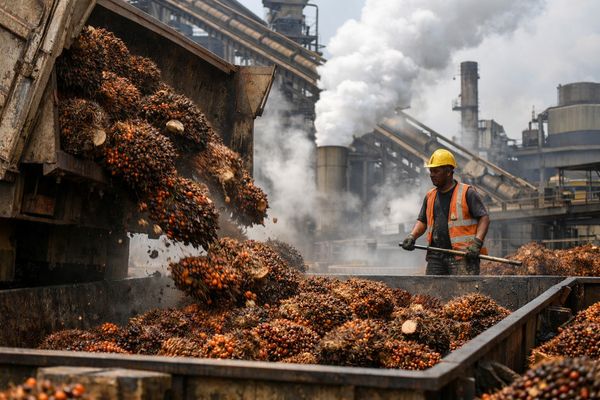
Palm oil futures on the Malaysian exchange are trading firmer along the curve, supported by geopolitical tensions and expectations of softer production, while energy markets and biodiesel demand add a secondary layer of price support. Short-term volatility remains elevated as traders weigh logistics risks in global oil flows against only moderate strength in underlying demand from the oilseed complex.
The market focus is squarely on Malaysian palm oil, where futures have recently gained on rising geopolitical uncertainty in the Middle East and expectations of lower March output. Higher crude oil prices are feeding through to the vegetable oil complex via biodiesel demand, while broader oilseed fundamentals remain comfortable, particularly in soy, tempering the upside. Forward curves show a mild backwardation from nearby to 2027–2028, reflecting perceived near-term tightness but no structural shortage.
📈 Prices & Forward Curve
Benchmark palm oil futures on the Malaysian exchange are trading just below recent highs, with the active May 2026 contract around 4,793 MYR/t and nearby positions slightly lower after a minor correction. Along the 2026 strip, prices hold in a tight 4,740–4,830 MYR/t range, indicating a firm but not explosive market tone.
Further out, 2027 contracts trade progressively lower, around 4,520–4,580 MYR/t, and 2028–2029 positions are clustered near 4,474 MYR/t, underlining a gently backwardated curve that signals tighter perceived balances in the short term versus a more comfortable medium-term supply outlook. Daily changes across the forward curve are modest (roughly +0.3–0.5%), consistent with a market consolidating earlier gains rather than initiating a new rally leg.
🌍 Supply, Demand & Geopolitics
The latest price strength is driven primarily by expectations of declining Malaysian production in March and ongoing geopolitical tensions around the Middle East. Market participants are concerned that disruptions around key maritime routes could increase freight and insurance costs for vegetable oils, indirectly tightening effective supply into key importing regions.
At the same time, higher crude oil prices are improving the economics of biodiesel blending, supporting discretionary demand for palm oil as a feedstock. However, export data for related oilseeds signal that the overall vegetable oil market is not overheating: recent U.S. sales for soybeans and soyoil are solid but unremarkable, and a quarterly stocks report has confirmed comfortable soybean inventories, implying that ample competing oilseed supply caps runaway upside in palm.
📊 Fundamentals & Cross-Commodity Signals
From a fundamental standpoint, palm oil benefits from two reinforcing, but not yet extreme, drivers: localized supply risks and stronger energy prices. Expectations of a month-on-month drop in Malaysian output in March, following recent weather issues, have tightened sentiment around near-term availability. Market talk ahead of the upcoming official Malaysian data release points to lower inventories versus earlier in the season, even if structural production capacity remains intact.
In contrast, the soybean complex is sending a slightly bearish signal. U.S. soybean stocks as of 1 March are about 10% above last year and marginally higher than anticipated, with winter-quarter usage coming in weaker than expected. This suggests that global vegetable oil availability, while tighter in palm, is buffered by comfortable supplies of alternative oils, reducing the risk of a sustained, one-way price spike.
☁️ Weather & Regional Outlook
Weather conditions in key producing regions are transitioning, but without an immediate, clearly bullish shock. In Indonesia, meteorological agencies report the end of a weak La Niña and a shift toward ENSO-neutral conditions, with the dry season gradually starting between April and June and the potential for a hotter, drier-than-normal period later in 2026.
Short-term (7–13 April) forecasts still point to scattered rainfall across parts of Indonesia due to transitional atmospheric dynamics and cyclonic influences, implying no imminent widespread drought stress but rising medium-term weather risk for plantations as the dry season advances. For now, the market is more focused on recent production hiccups and logistics uncertainties than on confirmed large-scale weather-driven crop losses.
📆 Trading Outlook & Strategy
- Producers / Sellers: Use current firmness in the May–August 2026 strip to extend modest forward hedging, especially where local cash prices have followed futures higher. Consider layering in sales on rallies while avoiding over-hedging given ongoing geopolitical and weather risks.
- Consumers / Buyers: Maintain at least partial coverage for Q2–Q3 2026 needs, but avoid chasing short-term spikes; the comfortable broader oilseed balance argues for patience and opportunistic buying on pullbacks.
- Speculators: The mild backwardation and tight but not extreme fundamentals favor a cautiously constructive stance, with preference for buying nearby spreads against further-dated months rather than aggressive outright longs.
📍 3-Day Price Indication (Direction, in EUR)
Using indicative FX (1 EUR ≈ 5 MYR), current MDEX levels translate to roughly:
| Contract | Indicative Level (EUR/t) | Short-Term Bias (next 3 days) |
|---|---|---|
| May 2026 | ≈ 960 EUR/t | Slightly firmer to sideways, with support from geopolitics and energy |
| August 2026 | ≈ 960–965 EUR/t | Sideways, tracking nearby contracts and crude oil moves |
| January 2027 | ≈ 935 EUR/t | Mostly stable, reflecting comfortable medium-term supply expectations |
Overall, palm oil prices are likely to remain underpinned in the very short term by geopolitical and logistical risk, with any pullbacks limited as long as crude oil stays firm and production data confirm only a gradual recovery.