
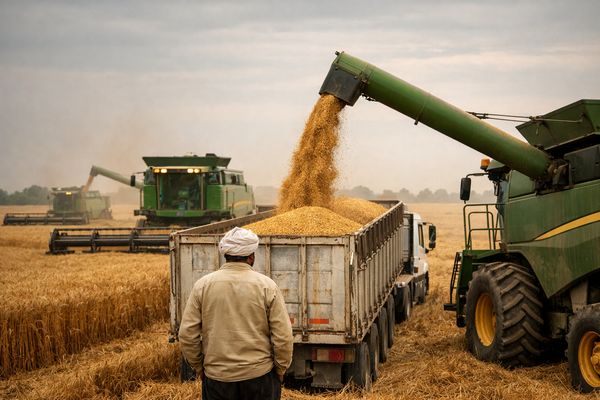
Unseasonal rain and hail across key northern Indian wheat belts are threatening a 3–4% cut to the current rabi crop and creating a quality squeeze that is likely to lift premiums for top-grade wheat, even as ample public stocks cap the risk of a runaway price spike.
India’s wheat market is pivoting from a short-term lull in flour mill buying to a more weather-driven phase. Damage to standing crops and early harvests in Uttar Pradesh, Bihar, Punjab, Haryana and parts of Uttarakhand is raising concern over grain quality and harvest logistics. At the same time, sizeable central grain reserves and subdued export channels mean domestic dynamics will dominate, while lower global wheat prices and recent pressure on CBOT futures temper the overall bullish case.
Exclusive Offers on CMBroker

Wheat
protein min. 11,00%
98%
FOB 0.29 €/kg
(from FR)

Wheat
protein min. 11,00%
98%
FOB 0.18 €/kg
(from UA)

Wheat
protein min. 10,50%
95%
FOB 0.19 €/kg
(from UA)
📈 Prices & Spreads
Physical wheat prices in key north Indian trading hubs have softened slightly on weaker near-term mill demand, but this is viewed more as a pause than a trend shift. At Kitcha in Uttarakhand, prices eased by around EUR 0.11 per quintal to approximately EUR 26.50–28.70 per quintal (converted from USD), while at Hapur in western Uttar Pradesh, wheat for direct flour-mill delivery slipped by about EUR 0.30 per quintal to roughly EUR 26.20–26.30 per quintal.
Outside India, export offers signal a broadly stable but subdued global price environment. Recent FOB indications show French 11.0% protein wheat around EUR 0.29/kg (Paris), Ukrainian 11.0–12.5% protein wheat FOB Odesa near EUR 0.18–0.19/kg, and U.S.-origin CBOT-linked wheat close to EUR 0.21/kg, all essentially unchanged over the past weeks. CBOT May futures have edged lower, with SRW wheat recently trading just under USD 6.00/bu, reflecting improved global supply expectations and some relief around Middle East conflict risk premia.
🌍 Supply, Demand & Weather
India’s 2025–26 rabi wheat harvest had been projected near 115 million tonnes, but widespread unseasonal rain and hail in recent days have introduced a downside risk of 3–4%, particularly in Uttar Pradesh, Bihar, Punjab and Haryana where crops are still standing or at an early cutting stage. Crop lodging and moisture damage are likely to reduce both yields and milling quality in affected plots. Recent reports from Haryana and Punjab highlight drenched stocks in mandis and delays to procurement as showers continue.
Despite these production concerns, India’s overall grain balance sheet remains comfortable. Public stocks stand near 60.2 million tonnes, including roughly 22.2 million tonnes of wheat and 38.0 million tonnes of rice—well above buffer norms and adequate for the public distribution system and emergency use. This inventory cushion significantly limits the probability of a disorderly domestic price spike, even if the final harvest falls short of earlier expectations.
Weather remains the pivotal short-term driver. A sequence of western disturbances has triggered rain, thunderstorms and hail over large parts of North India, with meteorological agencies maintaining yellow to orange alerts in several wheat-producing districts into early April. Forecasts suggest continued unsettled conditions in parts of Rajasthan, Punjab, Haryana, western Uttar Pradesh and Uttarakhand over the next few days, keeping the risk of further lodging and quality loss in play as the harvest window extends through May.
📊 Fundamentals & External Drivers
The quality dimension is set to become the defining feature of this Indian wheat marketing season. Lodging and wet-weather harvesting tend to increase shrivelled and discoloured kernels, raise mycotoxin risk in poorly dried lots and reduce overall test weight—factors that push more grain into lower-grade or feed channels. As a result, premiums for clean, undamaged milling wheat are likely to widen in coming weeks, especially in belts spared the worst of the storms.
On the macro side, the ongoing Iran–Israel–US conflict and associated disruptions in the Strait of Hormuz and Red Sea have driven up freight, fuel and insurance costs. This has complicated grain and food aid logistics as some cargoes face rerouting and delays, raising delivered costs to importing regions. However, India’s wheat export window remains effectively closed under existing restrictions, so direct transmission from global freight inflation into Indian farm-gate wheat prices is limited for now.
Globally, improved crop prospects in other major exporters and recent weakness in CBOT wheat futures have offset some of the conflict-driven cost pressure. For buyers in the Middle East, Africa and Asia, competitively priced Black Sea and European wheat in the EUR 0.18–0.29/kg FOB range help anchor international benchmarks, even if freight premia remain elevated. In this context, India’s domestic wheat prices will be shaped primarily by local harvest and policy outcomes rather than import or export arbitrage.
📆 Short-Term Outlook (2–4 Weeks)
Assuming the current 3–4% downside risk to India’s wheat output is confirmed, national supply should tighten modestly but remain far from critical thanks to robust stocks. The more visible market impact is likely to be the emergence of a clear quality ladder, with top-grade wheat commanding a rising premium over weather-affected grain as mills and institutional buyers compete for limited high-protein, undamaged lots.
In the next two to four weeks, domestic spot prices are expected to firm moderately from current levels, especially for superior milling grades in less-affected areas. Further heavy rain or hail before the harvest is complete would constitute the main upside risk, potentially deepening quality losses and complicating logistics. Conversely, a shift to drier, stable weather that allows rapid cutting, drying and procurement would ease pressure and keep price gains contained.
🧭 Trading Outlook & Recommendations
- Flour mills (India): Gradually increase coverage of top-grade wheat for April–June, focusing on regions with lower damage. Consider flexible specifications and blending strategies to manage a widening quality spread.
- Producers: Prioritise rapid harvesting and adequate drying wherever fields are accessible, and segregate lots by quality to capture potential premiums for clean grain later in the season.
- Importers in MENA/Asia: Monitor Indian developments mainly as a signal on South Asian fundamentals, but continue to base procurement on competitively priced Black Sea and EU origins while freight markets adjust to Middle East tensions.
- Speculative participants: With CBOT wheat under modest pressure and Indian fundamentals tightening only gradually, a cautiously bullish stance focused on quality spreads rather than flat-price breakouts appears more appropriate.
📍 3-Day Regional Price Indication (Directional, in EUR)
| Region / Contract | Current Level (Indicative) | 3-Day Bias | Comment |
|---|---|---|---|
| India, North (Kitcha, Hapur physical) | ~EUR 26–29/quintal | ➡️ to ⬆️ | Softness from mill lull likely to fade as damage is better quantified. |
| France FOB Paris, 11% protein | ~EUR 0.29/kg | ➡️ | Stable export offers; global supply outlook comfortable. |
| Ukraine FOB Odesa, 11–12.5% protein | ~EUR 0.18–0.19/kg | ➡️ | Discounted versus EU; geopolitical freight risk largely priced in. |
| CBOT SRW nearby | Just under EUR 0.20/kg equivalent | ➡️ to ⬇️ | Recent slip below USD 6/bu amid better weather and ceasefire talk. |
Related posts:
 Wheat Futures Edge Higher as Weather Risks Confront Flat Cash Market
 Barley Market Steady but Weather and Wheat Acres Add Upside Risk
 Wheat Market Steadies on Tender Support and Weather Risks
 Corn pauses after rally as heavy U.S. stocks cap upside, eyes on USDA report
 Stable Ukrainian Oat Prices Face Modest Spring Upside on South Asian Demand
 India Wheat: Weather Damage Trims Record Crop, Marginally Tightening Balance
 Wheat edges higher on softer euro, Russian export pace and strong EU crop outlook