
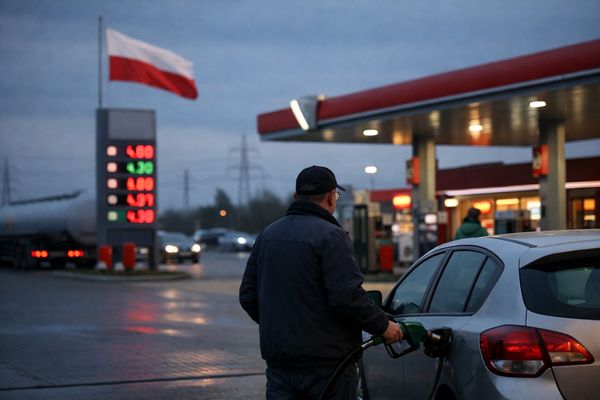
Polish retail fuel prices will remain unchanged on Wednesday, April 8, as the new CPN (Cheaper Fuel Prices) package locks in maximum pump rates despite extreme volatility on global oil markets triggered by the Iran war. This policy sharply weakens the transmission of the Strait of Hormuz crisis into Polish forecourt prices in the near term.
The Ministry of Energy has confirmed that the April 8 ceiling keeps the holiday fuel price levels in place, countering the surge in global crude benchmarks caused by Iran’s closure of the Strait of Hormuz and attacks on key export infrastructure. While Brent crude only just started to retreat below USD 100/barrel after a short ceasefire and partial reopening of Hormuz, the domestic cap, VAT cuts and lower excise effectively shield Polish households and transport firms from immediate price spikes, at the cost of tighter margins for fuel distributors and a higher fiscal burden.
📈 Prices & Policy Setup
For Wednesday, April 8, the Minister of Energy has set the following maximum retail prices:
- Gasoline 95: 6.21 PLN/l (≈ 1.42 EUR/l at 4.37 PLN/EUR)
- Gasoline 98: 6.82 PLN/l (≈ 1.56 EUR/l)
- Diesel: 7.87 PLN/l (≈ 1.80 EUR/l)
These caps are unchanged from the Easter period (April 4–7), delivering short-term price stability at the pump, even as global oil benchmarks have swung violently on Middle East headlines.
The CPN package cut fuel VAT from 23% to 8% and reduced excise to the minimum allowed under EU rules, lowering the tax burden on each liter of fuel. Together with an administratively set operating margin of 0.30 PLN/l, this effectively decouples domestic retail prices from daily global oil moves, at least while the scheme is in force.
🌍 Supply, Demand & Geopolitical Shock
The backdrop to Poland’s intervention is one of the sharpest global oil supply disruptions in decades. Iran’s earlier closure of the Strait of Hormuz—through which roughly 20% of world oil and LNG trade passes—combined with attacks on Kharg Island and other regional energy assets, has pushed Brent crude well above USD 100/barrel in recent weeks, with peaks around USD 115–126.
Recent news of a two-week ceasefire between the U.S. and Iran, including a partial reopening of Hormuz, has triggered a sharp pullback in prices: Brent has slid back toward the mid‑USD 90s, though volatility remains high and the market is bracing for renewed tension once the ceasefire window closes.
For Poland, this means that underlying import costs remain elevated and unstable, but the new cap and tax cuts temporarily mute the pass‑through to end users. Domestic fuel demand is supported by improved affordability at the pump and messaging from the government that cheaper fuel is intended as direct relief for households and businesses, particularly road transport, logistics and agriculture.
📊 Fundamentals & Market Mechanics
The Minister of Energy sets the daily maximum price using an algorithm based on:
- Arithmetic average of wholesale fuel prices from the previous business day, reported by the five largest market players
- VAT and excise levels (reduced under CPN)
- Fuel charge
- Fixed operating cost allowance of 0.30 PLN/l
This formula keeps the cap linked to wholesale dynamics but with a heavy buffering effect through lower taxes and a standardized margin. Selling above the maximum price carries penalties of up to 1 million PLN, enforceable by the National Revenue Administration, which underpins strong compliance and de facto freezes the retail price corridor day to day.
At the same time, sharply reduced VAT and excise compress state revenue per liter and constrain the room for further fiscal support if the global oil shock persists or re‑intensifies. With crude benchmarks still well above historical averages and the Iran conflict unresolved, the risk is that sustaining this policy for long will require either additional budgetary resources or adjustments to the cap and tax parameters.
🌦️ Market Risks & Weather Angle
Weather is currently a secondary driver for the Polish fuel market compared with geopolitics and policy, but it matters for diesel demand in agriculture and logistics. As spring fieldwork accelerates, stable capped diesel prices provide cost relief for farmers who are simultaneously facing higher fertilizer and input costs linked to the broader energy shock from the Iran war.
The main near‑term risk is a breakdown of the current ceasefire or renewed damage to export infrastructure in the Persian Gulf, which could push Brent back above recent highs and re‑tighten European product supplies. In that scenario, Poland’s wholesale procurement prices could climb again even if retail prices remain capped, increasing pressure on refiners and importers’ margins.
📆 Trading & Hedging Outlook
- Fuel consumers (transport, logistics, farmers): Use the current capped price window (approx. 1.42–1.80 EUR/l) to lock in medium‑term fuel needs where possible via contracts or storage, as the policy may be adjusted if global prices spike again.
- Retailers & distributors: Focus on volume and efficiency; with margins administratively fixed, the key risk is any sudden upward revision in the cap formula if wholesale prices keep climbing after the ceasefire period.
- Institutional energy traders: Expect continued high volatility in European refined products; positions should account for a structurally tighter global supply picture but also short‑term downside spikes on further diplomatic breakthroughs.
📉 3‑Day Directional Price View (Poland)
| Product | Current retail cap (EUR/l) | 3‑day view (to April 11) |
|---|---|---|
| Gasoline 95 | ≈ 1.42 EUR/l | Flat – cap expected to hold barring sudden legal change |
| Gasoline 98 | ≈ 1.56 EUR/l | Flat – same cap in place |
| Diesel | ≈ 1.80 EUR/l | Flat to marginal downside risk if global crude retreat persists, but policy‑driven |
Given the daily publication of maximum prices and the political emphasis on stability and relief, short‑term retail prices in Poland are likely to remain effectively unchanged through the next few days, even as international benchmarks continue to fluctuate.
Related posts:
 Middle East War Blocks Hormuz, Driving Energy, Fertilizer and Farm-Cost Shock for Poland and Europe
 Poland’s Emergency Fuel Price Cap Raises Cost Pressures Across Dairy and Agri‑Food Supply Chains
 Myanmar Fuel Shock: Strait of Hormuz Closure Slams Economy and Trade
 Iran War and Hormuz Strait Closure Ignite Petrochemical Shockwave for Global Packaging Supply Chains
 Iran War Chokes Hormuz, Diverts Diesel Cargoes and Tightens Global Middle Distillate Supply
 Hormuz Crisis Deepens as Iran War Hits Gulf Shipping and Food Import Routes
 Strait of Hormuz War Chokes Gulf Oil Flows, Roiling Energy and Food Commodity Costs