
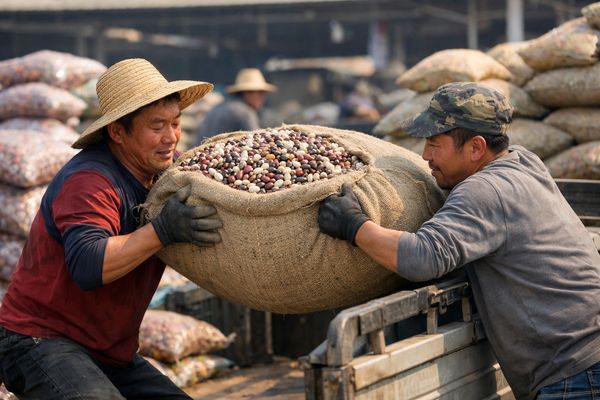
Chinese bean FOB prices are drifting modestly lower this week, with most mung, kidney and adzuki bean grades in Beijing seeing small declines versus early April in euro terms. The moves are incremental rather than structural, reflecting comfortable domestic stocks and a broadly stable global pulse environment.
Overall, the market tone is mildly bearish but orderly. China’s foreign trade has started 2026 with strong overall goods flows, suggesting no broad macro drag on agricultural exports, yet pulses are not seeing notable fresh demand shocks. Weather across key northern production provinces is transitioning into a typical, mild April pattern, with no acute threats to the coming planting window. Against this backdrop, buyers have regained a little pricing power, while sellers are increasingly focused on clearing remaining old-crop volumes ahead of the next production cycle.
Exclusive Offers on CMBroker

Mung beans
organic
99.5%
FOB 1.57 €/kg
(from CN)

Mung beans
3.8 mm up
99.5%
FOB 1.49 €/kg
(from CN)

Kidney beans
small, black, organic
99.5%
FOB 1.08 €/kg
(from CN)
📈 Prices & Recent Moves
All prices below are FOB China (Beijing) converted approximately to EUR at 1 USD ≈ 0.92 EUR. They represent today’s spot indications versus one week ago.
| Commodity | Specification | Origin | FOB Price (EUR/kg) | 1W Δ (EUR/kg) |
|---|---|---|---|---|
| Mung beans | organic, 99.5% | CN, Beijing | ≈1.45 | -0.02 |
| Mung beans | 3.8 mm up, 99.5% | CN, Beijing | ≈1.37 | -0.02 |
| Kidney beans | large white, conv. | CN, Beijing | ≈1.89 | -0.05 |
| Kidney beans | dark red, conv. | CN, Beijing | ≈1.12 | -0.02 |
| Kidney beans | black, conv. | CN, Beijing | ≈0.93 | -0.02 |
| Adzuki beans | red, conv., 5.0 mm | CN, Beijing | ≈1.20 | ≈0.00 |
Price action is characterized by:
- Small week‑on‑week declines across most Chinese mung and kidney bean grades, typically in the 1–3% range when expressed in EUR.
- Adzuki beans holding roughly flat, suggesting relatively tighter balance versus mung and kidney beans.
- Internationally, no major pulse price shocks have emerged in the last few days, and global agri markets are broadly in a gentle easing phase consistent with World Bank expectations of a modest agricultural price decline in 2026.
🌍 Supply, Demand & Trade Flows
China remains a key exporter of mung, adzuki and kidney beans within Asia, though recent official and attaché reporting highlights that kidney bean export volumes have been under pressure due to reduced planting area and competition from origins such as Myanmar and Central Asia. This structural context helps explain why kidney bean prices in China are softening: supplies are adequate for current demand despite lower acreage, and buyers are in no rush.
On the demand side, China’s total goods trade posted strong double‑digit growth in January–February 2026, signaling resilient external demand and logistical capacity, even if pulses are a small slice of this trade. Recent global regulatory updates in China focus mainly on import procedures for overseas food manufacturers rather than new constraints on domestic pulse exporters, so current export channels for beans remain functionally unchanged in the very near term.
Internationally, structural expansion in pulse processing and derivative markets is continuing, underpinning medium‑term demand for raw beans as ingredients. A recent global market study points to ongoing growth in cereal, grain and pulse derivatives through the early 2030s, implying steady industrial demand for mung and other beans beyond traditional food uses. However, this is a slow‑burn driver rather than an immediate price catalyst for April 2026.
🌦️ Weather & Crop Outlook – China Focus
Weather conditions in China in early April are seasonally mild. Recent climate analyses describe April as a generally favorable month across eastern and northern China, with moderate temperatures and increasing rainfall only in parts of the south. For the northern bean belt (Heilongjiang, Jilin, Inner Mongolia, Hebei), this translates into gradually warming soils and limited weather stress so far.
No acute, nationwide adverse events affecting the main dry bean regions have been reported in the last few days. Earlier in March, localized convective storms and hail were observed in Yunnan province, but this southwestern event is peripheral to the core northern bean‑growing areas. Overall, current weather patterns support timely preparations for spring planting, reinforcing the slightly soft tone in prices as supply expectations remain comfortable.
📊 Fundamentals & Market Drivers
- Stocks & old crop: The gentle but persistent easing in Chinese kidney and mung bean FOB offers indicates that sellers still hold sufficient old‑crop inventory and are willing to discount slightly to stimulate nearby demand.
- Macro environment: Global agricultural markets are expected to see a small average price decline in 2026, with relatively balanced supply and demand and reduced macro shocks versus previous years. This backdrop caps the upside for beans in the short run.
- Regulation & logistics: New customs and food‑regulatory updates in China are oriented toward imported foods and documentation requirements, not directly constraining bean exports in April 2026, but exporters should prepare for more documentation rigor later in the year.
- Competing origins: Recent export statistics from Myanmar and other origins confirm ongoing strong trade in mung and adzuki beans, preserving competitive pressure on Chinese offers into Asian markets.
📆 Short‑Term Forecast & Trading Outlook
Over the next 3 trading days, we expect Chinese FOB bean markets to remain in a narrow, slightly softening range, assuming no sudden weather or policy shocks.
- Importers / buyers:
- Use current minor weakness to extend coverage modestly for Q2 shipments, especially in kidney beans where offers have eased 2–3% in EUR terms versus early April.
- For mung and adzuki beans, stagger purchases; current levels are attractive but not distressed, and further small discounts are possible if stocks remain ample.
- Exporters / sellers in China:
- Consider rewarding firm bids on large white and dark red kidney beans to manage old‑crop exposure before planting gathers pace.
- Maintain offer discipline on adzuki beans, where price erosion is minimal and demand appears more balanced.
- Traders / speculators:
- Short‑term directional opportunities are limited; focus instead on relative value spreads between China and competing origins or between bean classes (e.g., kidney vs adzuki).
📍 3‑Day Directional Price Indication (FOB China, EUR)
- Mung beans (organic & 3.8 mm up): Slight downward bias of up to 0.5–1.0% in EUR, reflecting comfortable supply and calm external markets.
- Kidney beans (large white, dark red, black): Mild further softening likely, in the order of 0.5–1.5%, as sellers continue to prioritize volume over price.
- Adzuki beans (red): Mostly stable; any movement expected to stay within ±0.5% absent fresh demand or weather news.
Related posts:
 Chinese Bean Market Holds Steady as Traders Resist High Mung Prices
 China Adzuki Bean Market Steady as Farmers Hold Back Remaining Stocks
 Chinese Bean FOB Prices Edge Mixed As Spring Sowing Accelerates
 Lentils Market: Indian Mung Beans Cap Global Pulse Upside While FOB Lentils Ease
 UK Pea Market Steady as Weather Improves and Black Sea Supply Stays Quiet
 Canadian Lentils Ease Lower as Export Demand Pauses
 Soft Downtrend in Bean FOB Prices from Brazil and UK Amid Weather Noise