
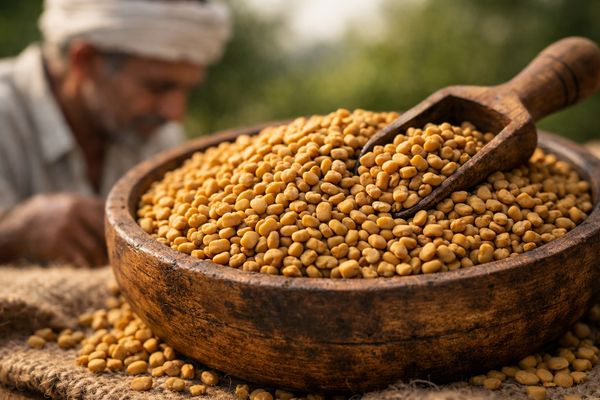
India’s fenugreek market is entering a structurally tight phase, with origin prices rising and limited prospects for a quick correction. A sharply smaller crop, thin carry-over, delayed arrivals and strong institutional demand are combining to keep the market well supported, especially for higher qualities.
India’s fenugreek complex is tightening from the ground up. Farmers in Rajasthan and Madhya Pradesh have cut acreage, weather has damaged yields, and new-crop arrivals are both late and lighter than normal. At the same time, border trade and renewed buying from ayurvedic and pharmaceutical users are drawing product directly from producer markets, leaving little buffer for domestic and export demand over the coming weeks.
Exclusive Offers on CMBroker

Fenugreek seeds
FOB 1.00 €/kg
(from IN)

Fenugreek seeds
99%
FOB 0.64 €/kg
(from IN)

Fenugreek seeds
powder
FOB 1.12 €/kg
(from IN)
📈 Prices & Market Mood
Prices at the Neemuch wholesale market in Madhya Pradesh have climbed from about EUR 0.67/kg at season opening to roughly EUR 0.74/kg now (converted from USD), signalling a firm, orderly rally as arrivals remain limited. In Gujarat, premium-quality fenugreek is indicated around EUR 0.77–0.78/kg on a bilti basis, with average qualities near EUR 0.75–0.76/kg and even lower grades rarely trading below EUR 0.72/kg.
Cleaned and processed fenugreek is commanding the highest levels, at an estimated EUR 0.84–0.86/kg. This strength is echoed in export-oriented FOB offers from India: machine-clean FAQ seeds around New Delhi are indicated near EUR 0.58–0.59/kg, while 99% purity and organic lots are offered close to EUR 0.59–0.92/kg, and organic powder near EUR 1.03/kg. Overall sentiment at origin is firmly bullish, with traders reporting aggressive competition for quality lots.
🌍 Supply & Demand Balance
The current tightness is fundamentally supply-driven. Rajasthan and Madhya Pradesh, together accounting for roughly 85% of India’s fenugreek production, reduced planted area this season after several years of volatile returns. Adverse weather during key growth stages has pushed estimated national production down to about 255,000 tonnes, versus a recent average of 340,000–360,000 tonnes – a contraction in the order of 32–33%.
New crop has also arrived around 20 days later than usual, delaying replenishment of pipeline stocks. Carry-over into the season was already minimal, with combined old-crop inventories in Delhi and major producer markets put at only 20,000–22,000 tonnes. Cross-border trade has siphoned off additional volumes, as high prices in neighbouring countries attract Indian origin, tightening domestic availability further.
On the demand side, traditional spice and export flows remain steady, but a key shift is the active entry of ayurvedic and pharmaceutical buyers. These institutional users are purchasing directly at origin, often paying up for quality and traceability, and thereby intensifying competition with traders and processors. The result is an unusual market inversion: wholesale prices in Madhya Pradesh and Rajasthan are running about EUR 0.04–0.05/kg above equivalent Delhi-landed levels, underscoring how tight supply has become close to the farm gate.
📊 Fundamentals & External Drivers
Structurally, the fenugreek market now rests on a thin stock base and a significantly smaller crop, leaving little room to absorb demand spikes or logistical disruptions. With only modest carry-over and a 32–33% production shortfall, any additional draw from export channels or health-related industries tightens the balance quickly. This aligns with broader firmness across several spices, where Middle Eastern and South Asian demand stays resilient while competing origins face their own crop constraints.
From a cost perspective, current price levels for Indian fenugreek appear rooted in genuine scarcity rather than speculative excess. Premiums for cleaned and processed material highlight buyers’ willingness to pay for assured quality and reliable supply. Compared with alternative origins such as Egypt, Indian prices for standard qualities remain competitive on a quality-adjusted basis, which should support continued export interest despite the rally at origin.
📆 Short-Term Outlook (2–4 Weeks)
Over the next two to four weeks, the market bias remains upward to sideways at elevated levels. With fresh arrivals still relatively slow, minimal old-season buffers, and strong institutional and export demand, traders see limited downside risk in the near term. Any additional firmness in global spice markets or renewed buying from regional importers could translate quickly into higher offers from India.
Key downside risks would include a sudden increase in farmer selling as prices reach psychologically attractive thresholds, or a pause in export and pharmaceutical procurement if end-users look to defer purchases. However, given current fundamentals, such pullbacks would likely be shallow and short-lived, with dips quickly met by pent-up buying interest from both domestic and overseas buyers.
💡 Trading Outlook & Recommendations
- European and US buyers: Consider advancing part of 2026 coverage now, especially for higher specifications, as current prices reflect real supply tightness and further gains are plausible.
- Blenders and processors: Prioritise securing machine-clean and processed fenugreek early, as premiums for these grades may widen if raw seed availability tightens further.
- Exporters and traders in India: Use any short-lived price dips from increased farmer selling to lock in volumes; maintain cautious forward commitments given the thin stock buffer.
- Institutional buyers (pharma/ayurvedic): Explore staggered procurement and longer-term supply agreements to mitigate price and availability risk through the remainder of the season.
📍 3-Day Directional Price Indication (EUR)
| Market / Product | Current Level (approx.) | 3-Day Bias |
|---|---|---|
| Neemuch, MP – average seed | ~EUR 0.74/kg | Steady to slightly firmer |
| Gujarat – premium seed | ~EUR 0.77–0.78/kg | Steady to slightly firmer |
| FOB New Delhi – FAQ, machine clean | ~EUR 0.58–0.59/kg | Steady |
| FOB New Delhi – organic powder | ~EUR 1.03/kg | Steady to firm |
Related posts:
 Fenugreek prices firm in Delhi as tight spot supply lifts Indian spice complex
 Fenugreek Seeds Firm as Indian Spice Rally Meets Weather Risks
 Indian Fenugreek Prices Find a Floor as New Crop Caps Upside
 Fenugreek Market Finds a Floor as New Indian Crop Caps Prices
 Indian Garlic Exports Surge as New Rabi Crop Meets Firm Specialty Demand
 Indian Fenugreek FOB Eases Slightly as Fresh Crop Arrivals Build
 Fenugreek Market Softens as Indian FOB Offers Edge Lower
 Fenugreek Seeds Steady: Egypt Holds Firm Premium over India