
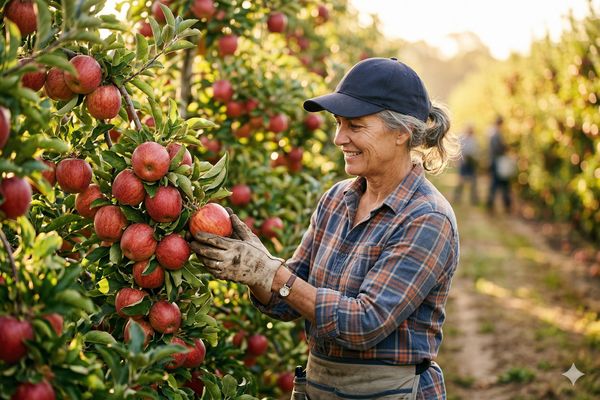
Australia’s new apple season is underway with a clear quality-first message: industry bodies are urging growers to prioritise harvest maturity over early cashflow, as consistent eating quality is seen as the key to stabilising demand and supporting prices through 2026.
Following a difficult prior season and with financial pressure still evident at grower level, the sector is starting 2026 in a more disciplined mood. The activation of APAL’s Quality Hub, combined with later-than-usual harvest timing in Tasmania and other regions, is pushing decision-making toward data-based maturity assessment rather than visual appearance alone. Early indications point to a plentiful, high-quality crop, while consumer expectations remain elevated after storage fruit has largely cleared the domestic market. Against this backdrop, prices look set to be driven more by perceived quality and repeat purchasing patterns than by outright volume constraints.
Exclusive Offers on CMBroker

Apricots dried
no: 7, sulphured (2000 ppm)
FOB 6.40 €/kg
(from TR)

Apple dried
Cubes 10-12 mm
FCA 4.35 €/kg
(from NL)

Apple dried
Cubes 8-10 mm
FCA 4.30 €/kg
(from NL)
📈 Prices & Market Tone
Market sentiment at the start of the 2026 season is cautiously constructive. Domestic fresh-apple supply is transitioning from stored 2025 fruit to new-season volumes, with industry leadership emphasising quality to protect repeat purchases and underpin price stability.
In the processed segment, dried apple cube offers ex Netherlands from Chinese origin remain stable around EUR 4.25–4.35/kg FCA, with no notable week‑on‑week changes, indicating balanced demand and comfortable raw material availability so far.
| Product | Specification | Origin | Location / Terms | Current Price (EUR/kg) | Trend (last 4 weeks) |
|---|---|---|---|---|---|
| Apple dried | Cubes 5–7 mm | CN | NL, FCA | 4.35 | Stable |
| Apple dried | Cubes 8–10 mm | CN | NL, FCA | 4.25 | Stable |
| Apple dried | Cubes 10–12 mm | CN | NL, FCA | 4.30 | Stable |
🌍 Supply & Demand Dynamics
The Australian apple category is structurally dependent on repeat purchasing; when fruit meets expectations on sweetness, texture and juiciness, demand remains steady across the season. Poor early-season experiences, by contrast, can weigh on sales for months, a risk the industry is explicitly trying to avoid this year.
Harvest in key regions is now underway but has been running later than usual, particularly in Tasmania where a cool spring and mild summer delayed fruit development. With cold‑stored fruit largely exhausted and a new crop described as plentiful and high quality, the immediate supply picture is comfortable, but the core challenge is synchronising picking dates with true maturity rather than visual colour alone.
On the demand side, domestic retail remains the primary outlet, but export opportunities—especially into Asia and, prospectively, China—are closely linked to consistent eating quality. Import buyers in premium markets continue to prioritise flavour and internal quality over being first to market, which reinforces the sector’s current stance against premature harvesting.
📊 Fundamentals & Policy Drivers
Financial pressure after a challenging previous season is encouraging some growers to consider earlier picks to generate cashflow. At the same time, appearance‑driven retail standards can incentivise harvesting based on colour rather than starch and sugar benchmarks, creating misalignment within the supply chain.
To counter this, Apple and Pear Australia Limited (APAL) has activated its Quality Hub for 2026. The platform delivers performance data on fruit quality and maturity, with monthly updates planned across the season to support more objective harvest decisions and reduce the risk of immature fruit entering retail channels. This data-led framework is designed to keep all stakeholders aligned around eating quality, not just visual appeal.
Globally, Australia competes with other Southern Hemisphere exporters such as New Zealand, Chile and South Africa for shelf space in Asian and European markets. In this context, a single weak-quality season can quickly undermine brand positioning, while a disciplined, quality-focused campaign can support improved price realisation and longer-term market share.
🌦️ Weather & Crop Conditions
Current growing conditions in key Australian apple regions are reported as generally favourable, with sufficient moisture and moderate temperatures supporting fruit sizing and colour development. The main weather-related feature of the season to date has been the cooler spring and mild summer pattern that delayed phenological stages, particularly flowering and early fruit growth in Tasmania.
This delay has two opposing effects: it has pushed back the arrival of peak volumes, but it has also allowed more gradual, even ripening. Provided growers stay patient and leverage maturity data before picking, the prevailing conditions should translate into strong internal quality—firmness, sugars and acidity—supporting the sector’s quality-led strategy.
📆 Outlook & Trading Implications
Over the next 30–90 days, market performance will hinge on how consistently growers align harvest timing with the Quality Hub’s maturity indicators. Early harvesting remains the central short-term risk: visually attractive but under‑ripe fruit at retail could quickly erode consumer confidence and depress category volumes just as the main crop hits the shelves.
Looking six to twelve months ahead, a disciplined, quality‑first season would likely encourage stronger repeat purchasing, support firmer average prices and position Australia more competitively in export channels. However, a full recovery from the sector’s recent downcycle will require sustained coordination between growers, packers, marketers and retailers, not just a single good season.
📌 Trading Recommendations
- Fresh buyers (retail & foodservice): Prioritise suppliers actively using APAL maturity data and be prepared to adjust promotional calendars if harvest is slightly later; emphasise taste and juiciness in marketing to rebuild loyalty.
- Growers: Resist cashflow-driven early harvests; use Quality Hub benchmarks to justify later picking to buyers and focus on consistent packouts rather than chasing first-to-market premiums.
- Processors & dried-apple users: With fresh quality expected to be high and dried cube prices currently stable, consider locking in medium‑term volumes at today’s levels while monitoring any shift in raw-material competition from fresh export programs.
📉 Short-Term Price Indication (Next 3 Days)
- Australian fresh apples (domestic wholesale, EUR equivalent): Sideways to slightly firmer as new-season volumes build but quality remains the key differentiator.
- Dried apple cubes CN origin, NL FCA: Stable around EUR 4.25–4.35/kg; no immediate pressure expected.
- Export-grade Australian apples to Asia: Steady, with modest upside potential where quality specifications are met and volumes are still ramping up.
Related posts:
 Stable Dried Apple Prices in Europe as Turkish Weather Stays Seasonally Mild
 Turkish Dried Figs Hold Steady Amid Quality Alerts and Softer Export Demand
 Dried Apple Prices Hold Steady as Tight Turkish Crop Supports Market
 Georgia’s Apple Exports Hit Record High on Surging Russian Demand
 Stable Dried Apple Prices as China Crop Tightens and EU Demand Holds