
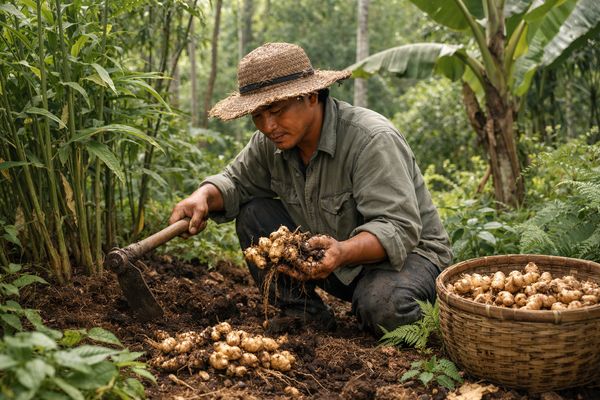
China-led supply is keeping the global ginger market firm in early April 2026, with Brazil largely absent and Peru at season’s end. Quality issues in Shandong and sharply higher ocean freight are supporting European prices in the short term, but expanding Chinese, South African and Peruvian crops point to a softer global balance over the next year.
The current market is defined by a rapid realignment of origins. China has become the default supplier to Europe and North America as Brazil enters a low-availability phase and Peru moves into residual volumes. At the same time, surging freight costs linked to Middle East logistics disruptions are altering trade economics, particularly for Europe. While spot prices in Italy, France and Germany remain elevated but mixed, increased Chinese output and strong South African and Peruvian crops are building a medium-term buffer that could cap prices once Brazilian and Thai volumes return.
Exclusive Offers on CMBroker

Ginger dried
whole
FOB 3.25 €/kg
(from IN)

Ginger dried
slices
FOB 2.90 €/kg
(from IN)

Ginger dried
Powder
FOB 3.70 €/kg
(from IN)
📈 Prices & Regional Picture
In Italy, Chinese fresh ginger 10 kg cartons are trading around €23–24 per box (≈€2.30–2.40/kg), while 5 kg packs fetch roughly €12–13 (≈€2.40–2.60/kg). Upcoming Chinese consignments landing in 50–60 days are expected to be slightly cheaper as origin costs ease by about €1.00–1.50 per box.
In France, wholesale markets such as Rungis, Nantes, Lyon and Nice are quoting approximately €3.50–5.20/kg for conventional ginger, with organic lots generally above €6.00/kg. Germany reports prices 10–15% below last year, indicating some local softness despite broader European tightness. In South Africa, Johannesburg municipal market averages are about €2.70/kg for 5 kg boxes, supported by an excellent local crop.
| Region/Market | Product | Current Level (EUR) |
|---|---|---|
| Italy (wholesale) | Chinese fresh, 10 kg | €23–24 / box (≈€2.30–2.40/kg) |
| France (RNM mid-March) | Fresh, conv. | €3.50–5.20 / kg |
| France (RNM mid-March) | Fresh, organic | >€6.00 / kg |
| Germany (wholesale) | Fresh | ≈10–15% below 2025 level |
| South Africa (Johannesburg) | Fresh, 5 kg box | ≈€2.70 / kg |
| India (FOB, New Delhi) | Dried ginger, organic whole | ≈€3.25 / kg (2026-04-04) |
| Switzerland (wholesale) | Fresh | ≈€4.40–6.90 / kg (range) |
🌍 Supply & Demand Realignment
China has recorded an estimated 20% increase in ginger production from the October 2025 harvest, consolidating its role as the dominant origin in Europe and North America. However, prolonged rains during harvest followed by freezing temperatures damaged a significant share of the Shandong crop, forcing exporters to apply strict grading and leading to uneven quality. Guangxi-origin ginger is increasingly used to compensate for Shandong shortcomings, often commanding a modest quality premium.
Brazil is in a low-availability phase, with regular seaborne shipments to Europe not expected to normalize before June 2026. Peru’s export season to Europe is effectively over, leaving only residual shipments after heavy rains in January–February delayed harvesting and pushed some older-crop volumes into May. The United States continues to absorb around 80% of Peruvian ginger exports, limiting Peru’s capacity to fill current European gaps.
South Africa, by contrast, reports an excellent crop following abundant summer rains, with sufficient production anticipated through winter and spring 2026. Storage in modified-atmosphere bags should allow South African ginger to be marketed into early 2027, adding another medium-term supply pillar alongside higher Chinese and projected Peruvian output.
📊 Fundamentals & Cost Drivers
The main non-agronomic driver is freight. Ocean shipping costs are projected to rise by roughly 50% in the short term as the conflict in the Middle East and the closure of key chokepoints disrupt fuel and container flows, amplifying Europe’s energy crisis and pushing up diesel and bunker costs. Chinese exporters are partially absorbing these logistics increases by adjusting FOB pricing to remain competitive, but delivered prices into Europe still reflect higher freight and insurance costs.
European oil price inflation further increases domestic logistics and handling expenses, particularly for refrigerated and controlled-atmosphere cargoes. For Peru, rising freight rates and tighter sanitary requirements structurally disadvantage shipments to Europe, reinforcing its focus on the US market. Dried ginger from India shows a marginal downward trend in recent FOB prices in late March and early April 2026, suggesting that outside the fresh segment, global supply is sufficiently comfortable to cap price spikes.
Quality is another key fundamental. Shandong’s freeze damage, combined with earlier harvest rains, results in more heterogeneous lots and higher rejection rates. This is driving a multi-tier market in Europe, where traceable Guangxi and Thai origins, and reliable South African supply, can attract premiums over uncertain Chinese lines from affected areas.
🌦️ Weather & Crop Conditions
Looking ahead into April, northern China, including Shandong, is transitioning out of winter, with typical daytime temperatures around 20°C and limited rainfall on average, following episodes of fog, snow and rain in March that already challenged logistics. This more moderate pattern should favor storage and handling of existing stocks rather than creating new production shocks.
In southern Africa, recent abundant summer rainfall has supported a strong South African ginger crop, underpinning the positive production outlook into winter. Across Southeast Asia, seasonal forecasts for mid- to late April 2026 point to generally typical monsoon-transition conditions, without clear indications of extreme anomalies at ginger-producing latitudes, implying weather is unlikely to tighten global supply in the very near term.
📆 Market Outlook & Trading Strategy
In the next 30–90 days, the European ginger market is expected to stay broadly firm. Continued Brazilian absence and limited Peruvian participation will keep Europe heavily dependent on China, even as some cheaper Chinese containers booked at lower origin costs arrive and put modest downward pressure on Italian and Dutch wholesale prices. Premiums for consistent Guangxi and Thai supply are likely to persist given lingering concerns over Shandong quality and logistical reliability.
Over a 6–12 month horizon, the combination of higher Chinese output, a robust South African crop and an anticipated 20% production increase in Peru should materially ease the global balance, pointing to a gradual softening of underlying prices. However, this fundamental relief may not fully translate into lower landed prices in Europe if elevated fuel and freight costs, driven by the broader energy crisis, remain entrenched. Timing and scale of Brazil’s re-entry, as well as any normalization or further escalation in ocean freight, will be the critical swing factors.
🧭 Trading Recommendations
- European importers: Secure staggered coverage through June–July, mixing Chinese (including Guangxi) and South African origins, while avoiding overcommitment at current freight peaks. Build optionality for quick volume rebalancing once Brazilian and Thai supply ramps up.
- Retailers and food manufacturers: Lock in medium-term contracts with quality-differentiated suppliers, especially for organic and premium segments, to hedge against further freight or quality shocks from Shandong.
- Producers in South Africa and Peru: Use the present firm market to forward-sell part of the 2026/27 crop but retain some exposure to potential price spikes if geopolitical tensions worsen logistics.
- Users of dried ginger: Consider stepping up purchases in the near term as Indian FOB prices are slightly easing, offering a cost-effective hedge against continued volatility in fresh markets.
📍 3-Day Directional Outlook (Key Markets)
- Italy (fresh, Chinese): Stable to slightly firm; limited nearby supply and freight pressure offset expectations of cheaper forward containers.
- France (fresh, wholesale): Mostly stable; mid-March levels likely to carry through the coming days with only minor adjustment as new imports clear customs.
- Germany (fresh): Slightly firm bias from current discounted levels as traders price in higher ocean freight despite good availability.
- South Africa (fresh, Johannesburg): Stable; strong local crop and good stocks should anchor prices near current averages.
- India (dried FOB): Mildly soft; recent incremental declines suggest a sideways-to-lower tone in the very short term.
Related posts:
 Cumin Rally Resumes as Indian Demand Rebounds and Supply Stays Tight
 Indian fennel prices spike on deep supply shock and tight farmer selling
 Tight Large Cardamom Supply Keeps Prices Firm as Export Demand Stays Strong
 Indian Dried Ginger Drifts Lower as Demand Turns Cautious
 Indian Cardamom Firms on Tight Supply and Pre-Monsoon Rains in Kerala
 Cumin Market Caught Between Tight Indian Supply and Geopolitical Shock
 Indian Dried Ginger FOB New Delhi Eases Slightly Amid Steady Demand
 Indian Green Cardamom FOB Delhi Eases Slightly as Middle East Risks Loom