
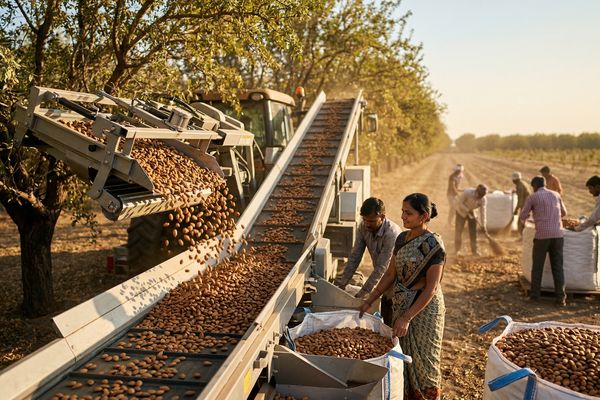
South Africa’s rapidly expanding nut export sector is tightening its grip on premium markets in Europe and Asia, as new trade data show double‑digit growth in fruit and nut exports and a sharp rise in European macadamia import demand. These shifts are reshaping tree nut trade flows, supporting firm to higher price benchmarks and reinforcing South Africa’s role as a strategic long‑haul supplier. For almond, macadamia and mixed‑nut buyers, origin diversification and logistics planning are coming into sharper focus.
According to recent trade estimates, South Africa’s fruit and nut exports reached about USD 2.7 billion in the first half of 2025, up 13.3% year‑on‑year, with macadamias, pecans and groundnuts among the strongest performers. The European Union remains the leading destination, while Asia—particularly China for in‑shell macadamias—anchors incremental demand. New Europe‑focused market reports confirm that South Africa has consolidated its position as the top macadamia supplier, capturing close to half of EU fresh shelled macadamia import value and gaining share in core hubs such as Germany and the Netherlands.
🌍 Immediate Market Impact
The combination of expanding South African supply and surging European premium nut demand is tightening availability for certain grades and formats, especially shelled macadamias for snacks, confectionery and bakery applications. In Germany, import values for fresh shelled macadamias jumped more than 80% year‑on‑year in the January–October 2025 period, with both volume and prices moving higher—an unusual signal of strong underlying consumption growth rather than simple price inflation.
South Africa’s dominance in EU macadamia supply—holding roughly 48% of the value share in the wider European fresh shelled macadamia market and about 39% into the Netherlands—means that any incremental production, shipping or policy shift in South Africa now has an outsized impact on European price discovery and nearby origins. For buyers of complementary nuts such as almonds and pistachios, this tightening in macadamias can redirect demand and budget into alternative tree nuts, providing a mild supportive undertone to almond kernel values even where local fundamentals are balanced.
📦 Supply Chain Disruptions
While there is no acute regulatory shock behind the current export surge, the structural increase in South African nut shipments is testing capacity across ports, cold‑chain and inland logistics. South African exporters move over 95% of their macadamia crop offshore, primarily via Durban and other coastal gateways. Periodic port congestion, container imbalances and extended transit times to Northern Europe can lead to staggered arrivals and short‑term tightness for specific sizes or processed grades.
Within Europe, the Netherlands and Germany function as key redistribution hubs, receiving bulk volumes from South Africa and re‑exporting to processors and retailers across the bloc. Any disruption in these gateway ports—whether operational or regulatory—could compound volatility further along the value chain. For Asian buyers, particularly in China, high reliance on in‑shell shipments from South Africa tightens exposure to freight cost swings and scheduling risks on long‑haul routes.
📊 Commodities Potentially Affected
- Macadamia nuts (in‑shell and kernels) – Directly supported by stronger EU and Asian demand, with South Africa expanding output and capturing close to half of EU shelled import value; price risk skewed to the upside for premium grades.
- Pecans – Growing South African production and export reach, together with tighter U.S. receipts reported in early 2026, could lift global pecan prices and redirect trade flows into Europe and Asia.
- Groundnuts (peanuts) – Steady South African exports into Japan and regional African markets benefit from improved logistics and trade access, adding incremental competition for other origins in premium, food‑safety‑sensitive segments.
- Almonds – Although not a major South African crop, elevated macadamia and mixed‑nut demand in Europe can channel some buyers toward almonds as a relatively price‑competitive substitute, lending support to U.S. and Spanish kernel values despite currently stable spot indications.
🌎 Regional Trade Implications
Europe is emerging as the primary beneficiary of South Africa’s export expansion, with Germany and the Netherlands leveraging their hub status to secure large volumes and re‑distribute to secondary EU markets. South Africa’s rising share in EU macadamia imports is eroding the relative positioning of suppliers such as Australia and Malawi in some segments, though Kenya and Viet Nam are increasingly contesting market share in select Northern and Western European destinations.
In Asia, China remains the dominant buyer of in‑shell South African macadamias, while newer markets such as Japan, South Korea and parts of Southeast Asia are expanding kernel imports. This diversification reduces South Africa’s dependence on single‑market demand and broadens the base of long‑term customers. For competing origins—particularly Australia in macadamias and the United States in pecans—the South African expansion raises competitive pressure in both price and reliability of supply, potentially forcing strategic shifts toward value‑added processing and differentiated marketing.
🧭 Market Outlook
Over the next 30–90 days, traders will focus on shipment pacing from South Africa and clearance rates at key European ports. With European macadamia import values and volumes both trending higher, spot markets are likely to remain firm, especially for high‑spec kernels destined for branded snacks and confectionery. Short‑term corrections could occur if arrivals cluster or if buyers temporarily switch into almonds, pistachios or lower‑priced nut mixes.
On a 6–12 month horizon, continued orchard maturation suggests further growth in South African export capacity into the 2026 marketing year. However, the sector’s ability to sustain this trajectory will depend on managing logistics bottlenecks, freight costs and any future market‑access adjustments in strict regulatory environments such as the EU. Concurrently, emerging suppliers like Kenya and Viet Nam are expected to win incremental shelf space, particularly in Northern Europe and niche Asian markets, adding a layer of competitive complexity to forward contracting.
CMB Market Insight
For commodity traders, importers and food manufacturers, South Africa’s nut export boom is less a one‑off spike and more a structural re‑weighting of global tree nut supply. The country’s expanding macadamia, pecan and groundnut footprint, combined with strong market access into Europe and Asia, positions it as a price‑setting origin for premium segments in the years ahead.
Strategically, buyers should reassess origin diversification, shipping windows and contract structures to account for South Africa’s growing influence and the rising role of alternative African and Asian suppliers. Aligning procurement and risk management with these evolving trade flows—while monitoring South African logistics and any future regulatory shifts—will be critical to securing reliable coverage and managing price volatility across the broader nut complex.
Related posts:
 California Pistachios Navigate Water Constraints and Iran Sanctions Shock as Policy Risks Reshape Global Nut Trade
 Germany’s ‘High Noon’ Fuel Price Rule Reshapes Downstream Pricing – Limited Direct Impact on Crude, Refined Product Flows
 Australia–EU Free Trade Agreement Reshapes Agri-Food Trade Flows
 Unilever’s Planned Sale of Major Foods Portfolio to McCormick Reshapes Global Processed Foods and Ingredients Trade
 US Regulatory and Demand Shift Repositions Germany as Strategic Hub for Global Nut and Dried Fruit Trade
 Policy Shifts in West Africa and Vietnam Tighten Global Cashew Balance as India Faces Demand Drag