
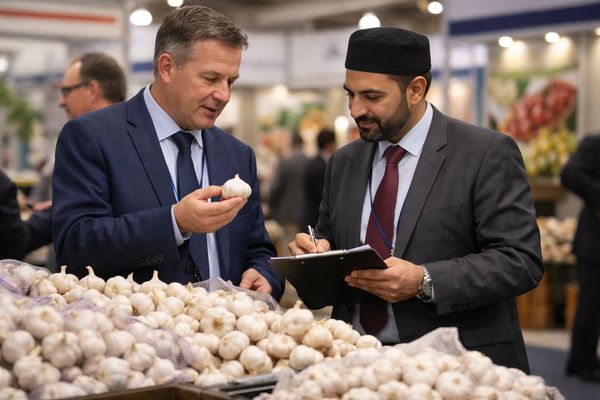
Egypt’s garlic export campaign is gaining fresh momentum as Uruguay officially opens its market to Egyptian onions and garlic, adding a new Latin American outlet just as regional freight disruptions and surcharges continue to lift logistics costs across Middle East–linked routes. For garlic buyers, the combination of expanded market access and higher transport costs is redefining competitive dynamics between Egyptian, Chinese and Spanish origins in the April–June shipping window.
According to Egypt’s Ministry of Agriculture, Uruguay has approved imports of Egyptian onions and garlic following technical negotiations and phytosanitary alignment, with early 2026 garlic exports from Egypt already reaching 5,147 tons in the first quarter. In parallel, grower‑exporter E2M reports that Egypt’s 2026 garlic season has accelerated after Easter, supported by rising production, solid demand from existing European and Middle Eastern customers, and growing interest from new destinations.
Introduction
The opening of Uruguay’s market represents a targeted policy and trade development that fits within Egypt’s broader strategy to diversify destinations for its agricultural exports. Officials highlight that new market access agreements—25 new export markets were opened across East Asia, Latin America and the Caribbean in 2025—have underpinned record farm export values of USD 11.5 billion and volumes of 9.5 million tons.
For garlic specifically, this new South American outlet coincides with a premium export window in which Egyptian product arrives early into Northern Hemisphere markets, before Spanish and other European origins peak, and competes on price with Chinese supply. At the same time, Middle East conflict‑related disruptions are pushing up freight rates and transit times on key Asia–Europe–Africa corridors, with major carriers applying emergency conflict, war‑risk and fuel surcharges.
🌍 Immediate Market Impact
The combination of expanded market access in Uruguay and stable Egyptian garlic supply is mildly bullish for trade volumes but neutral to slightly firming for FOB prices. Fresh Egyptian garlic offers for export around early April are reported at roughly USD 1.05/kg FOB Alexandria, unchanged over recent weeks, suggesting that strong demand is being offset by higher freight costs rather than translating into sharply higher origin prices. (Internal price context)
Freight surcharges introduced since late February and early March—including emergency conflict and inland fuel surcharges by major lines such as CMA CGM—are raising all‑in logistics costs from Eastern Mediterranean ports. While Antony Mina of E2M notes that garlic shipments have so far remained operationally stable, he acknowledges higher freight rates and occasional scheduling challenges, with the market nonetheless adjusting quickly. For importers, this translates into tighter delivered margins and potentially higher CIF prices, particularly on long‑haul lanes to Latin America and Asia.
📦 Supply Chain Disruptions
Ocean carriers report ongoing disruption on Middle East–linked routes, including rerouting around high‑risk chokepoints, longer voyages and increased bunker and insurance costs. CMA CGM and others have implemented layers of emergency surcharges—conflict, war‑risk and fuel—that now apply to bookings from late February and early March onward, including containers already afloat.
For Egyptian garlic exporters, these developments primarily affect cost rather than physical availability. Mina reports stable supply, smooth packhouse operations and the absence of major port‑side bottlenecks for garlic, in contrast to more sensitive perishable categories. However, elevated freight and inland transport costs compress exporter margins and may force renegotiation of freight‑inclusive contracts, especially to distant markets like Uruguay where logistics constitute a larger share of delivered value.
📊 Commodities Potentially Affected
- Fresh garlic (Egyptian origin) – Directly impacted by Uruguay’s new market access and by higher freight rates on Middle East and trans‑Atlantic lanes affecting CIF pricing and supplier competitiveness.
- Onions (Egyptian origin) – Included in the same Uruguay market opening, potentially boosting export volumes and competing with regional suppliers in Latin America.
- Processed and dehydrated garlic products – While not directly referenced in the Uruguay agreement, any sustained shift in fresh garlic trade and freight costs can filter into pricing and sourcing for dried and powdered garlic along Europe–Latin America routes.
- Competing garlic origins (China, Spain) – Could face stronger competition from Egypt in selected markets if Egypt leverages new access and relatively early season supply, though higher freight out of the Eastern Mediterranean may partly offset this advantage on specific lanes.
🌎 Regional Trade Implications
Uruguay’s decision to admit Egyptian garlic and onions strengthens Egypt’s foothold in Latin America, a region the Egyptian government has explicitly targeted through new market openings. Initial shipment volumes are modest but strategically significant, providing a reference for future sanitary protocols, brand building and potential re‑exports within the Mercosur bloc.
In Europe and the Middle East, Egypt’s premium April–June window remains anchored by strong demand and rising production, even as freight disruptions in the wider region pressure logistics costs. If freight surcharges remain elevated, nearby EU suppliers such as Spain may gain a relative advantage on intra‑European lanes, while Egypt’s long‑haul competitiveness into the Americas and parts of Asia will depend on negotiated freight rates and buyers’ willingness to absorb higher transport costs.
🧭 Market Outlook
Over the next 30–60 days, Egyptian garlic exports are expected to remain active, with exporters focusing on securing programs before the end‑June premium window for top‑quality product. Short‑term price action is likely to be driven more by freight market volatility and container availability than by field‑level supply constraints.
Looking into the second half of 2026, the structural story remains one of Egypt’s expanding production base and diversified market portfolio. Record agricultural export values and ongoing efforts to open new destinations suggest that Egypt will continue to grow its role in global garlic trade, provided logistics bottlenecks ease or at least stabilize. Traders will closely monitor freight surcharges on East‑West routes, any further policy‑driven market openings, and the competitive response from Chinese and Spanish suppliers.
CMB Market Insight
The opening of Uruguay’s market to Egyptian garlic adds another building block to Egypt’s strategy of becoming a diversified, year‑round horticultural supplier, while the concurrent rise in freight costs caps the immediate upside on producer returns. For importers, the message is mixed: origin supply and quality from Egypt look reliable, but end‑user pricing will increasingly reflect logistics risk premia.
For commodity buyers and traders, the tactical focus now is on locking in programs and freight where possible during the April–June window, evaluating delivered‑cost parity between Egyptian, Chinese and Spanish garlic across different destinations, and hedging exposure to further freight volatility. Strategically, Egypt’s latest market access gain underscores that policy‑driven diversification of trade routes can partially offset regional risk—an important lesson for garlic and wider horticultural supply chains navigating the current Middle East–centric shocks.
Related posts:
 South Africa’s Nut Export Boom Reshapes Global Tree Nut Trade Flows
 Dominican Republic Tightens Rice Import Regime as Domestic Output Softens, Re‑Shaping Caribbean Trade Flows
 Australia–EU Free Trade Agreement Reshapes Agri-Food Trade Flows
 Egyptian Lemongrass FOB Cairo Edges Higher Amid Costly Freight Environment
 Egyptian Laurel Leaves Edge Higher as Freight Costs Rise