
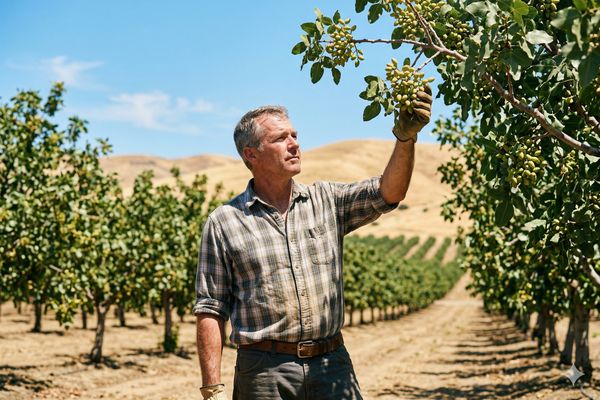
California’s pistachio sector is entering the 2026 season under acute water constraints just as the Iran war, renewed sanctions regimes and tariff threats disrupt Iranian export capacity and global nut trade flows. The combination is tightening forward supply visibility for buyers while shifting premium demand toward U.S. origin, with freight risk and policy uncertainty now as critical as agronomy in price formation.
Against this backdrop, California growers report receiving about 80% less irrigation water than contracted, turning water allocation policy into a central market variable, while Iranian exporters face a more hostile sanctions and logistics landscape that is already spilling over into food and nut supply chains.
Introduction
California remains the world’s largest pistachio producer, directly competing with Iran for share in Europe, Asia and emerging markets. Recent commentary from grower and crop adviser Rich Kreps on AgNet News Hour highlighted structural water under-delivery, forcing orchards to operate on a fraction of paid allocations and accelerating investment in nutrition and crop-protection programs to sustain yields.
At the same time, the Iran war has closed the Strait of Hormuz, disrupted regional shipping and driven up logistics costs for U.S. small businesses, including pistachio exporters with cargoes stalled at sea. Parallelly, Western sanctions on Iran have intensified, including the EU’s reimposition of nuclear-related economic and financial sanctions in late 2025 and U.S. measures targeting Iranian energy exports and related financial networks. While not aimed at agricultural goods per se, these measures materially raise counterparty, banking and freight risk for Iranian-origin pistachios.
🌍 Immediate Market Impact
The policy and business environment now converging around pistachios is tightening perceived supply even as orchards in California and Iran remain productive. In California, water allocation shortfalls function as a quasi-regulatory cap on output: producers can maintain trees and deliver a crop, but with less flexibility to push yields or respond to price incentives.
On the Iranian side, the closure of Hormuz and stepped-up sanctions enforcement increase voyage times, freight premia, insurance costs and payment frictions. For buyers dependent on Iranian pistachios, this converts into higher landed costs, longer lead times and a growing risk premium versus California origin, supporting a firmer global price floor despite last season’s abundant crop.
📦 Supply Chain Disruptions
California’s main disruption channel is upstream: constrained surface water deliveries and regulatory limits on pumping reduce irrigated acreage resilience and raise per-unit production costs. Kreps’ estimate of an 80% gap between paid and delivered water indicates that even with full reservoirs, allocations are being held back under current rules, prompting calls for policy reform and infrastructure upgrades.
For Iranian supply, the chokepoint is midstream. The closure of the Strait of Hormuz in early March stranded oil and LNG flows, and similar constraints and risk premia now affect container and breakbulk cargoes using Gulf ports, complicating shipments of agricultural goods. Elevated insurance, rerouting via alternative corridors and banking de-risking all erode the competitiveness of Iranian pistachios at destination.
Downstream, U.S. small businesses already report pistachio consignments “sitting in the water,” illustrating how freight delays and congestion ripple back into working capital and contract performance. European and Asian processors face higher uncertainty on both timing and specification of Iranian loads, increasing reliance on alternative origins and inventories.
📊 Commodities Potentially Affected
- Pistachios – inshell and kernels: Direct exposure to California water policy and Iran sanctions/logistics; higher origin risk premia and potential reshuffling of supplier portfolios.
- Other U.S. tree nuts (almonds, walnuts): Competing for constrained water in California; any regulatory changes on allocations or infrastructure will affect cost structures across nut crops.
- Middle Eastern agricultural exports transiting Hormuz: Increased freight time and insurance costs for a broad basket of food products using Gulf shipping lanes.
- Fertilizers: War-driven freight and energy shocks have already led U.S. landscapers to stockpile fertilizer, signaling wider cost pressure for growers globally.
🌎 Regional Trade Implications
For Europe and high-income Asian markets, the combination of Iran-related sanctions and war risk is likely to accelerate a structural shift in premium pistachio demand toward California and, to a lesser degree, newer suppliers such as Italy. Recent analysis of Argentina’s import mix already shows Italy emerging as a third supplier alongside the traditional U.S.–Iran duopoly.
Countries and buyers maintaining or expanding trade with Iran now face higher exposure to secondary U.S. measures and banking hurdles after Washington signaled more aggressive enforcement, including on entities facilitating Iranian energy exports. This will likely push some mainstream food and confectionery brands to downweight Iranian origin in favor of “cleaner” supply chains, even if farm-gate availability in Iran remains strong.
On the U.S. side, exporters stand to gain market share but must navigate their own logistical and cost challenges, from higher bunker and insurance rates on longer routes around conflict zones to domestic trucking and labor constraints. Freight-sensitive destinations in Latin America and Southeast Asia may rebalance between U.S., Iranian and European origins depending on how tariffs and sanctions risks evolve.
🧭 Market Outlook
Over the next one to three months, pistachio markets are likely to price in persistent freight volatility and policy risk rather than outright physical shortage. California’s orchards are expected to produce, but the combination of heat and chronic under-irrigation caps upside to yields and shifts focus to quality management.
The larger uncertainty sits on the policy front: the duration of the Hormuz closure, the trajectory of Iran-related sanctions and any further tariff moves affecting trade with Iran’s partners. Traders will closely monitor U.S. and EU designations, shipping insurance conditions into the Gulf, and any signals from California water authorities regarding allocation adjustments or infrastructure initiatives.
CMB Market Insight
For now, pistachios exemplify how policy and business decisions—rather than agronomy alone—are driving risk premia in agricultural commodities. California water allocation rules and infrastructure constraints have effectively turned irrigation into a regulatory bottleneck, while Iran’s sanctions and war environment are eroding the reliability, if not the absolute volume, of its exports.
Strategically, importers should diversify origin exposure, prioritize counterparties with clear compliance and logistics capabilities, and build longer lead times into contracts involving Iranian or Gulf-linked routes. For California-origin pistachios, early engagement and flexible shipment windows may secure better terms before the full impact of water constraints and war-related freight costs is priced into 2026 contracts.
Related posts:
 Kenya’s Sugar Act 2024 and Mill Privatisation Set to Reshape East African Sugar Trade
 Fuel Price Shock and Regulatory Transition Reshape Pakistan’s Oilseed and Edible Oil Outlook
 Pakistan’s New Grain Policies Reshape South Asian Wheat and Rice Trade Dynamics
 US Regulatory and Demand Shift Repositions Germany as Strategic Hub for Global Nut and Dried Fruit Trade
 Australian Pistachios Gain Ground as Global Supply Tightens