
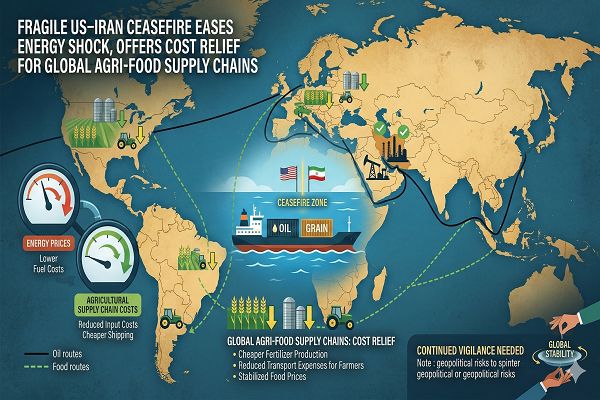
Global agricultural markets are getting short-term relief after the United States and Iran agreed to a two‑week ceasefire that includes a conditional reopening of the Strait of Hormuz. Oil prices have dropped back below USD 100/bbl from wartime peaks, easing the immediate cost shock facing grain shippers, fertiliser producers, and food manufacturers. But the truce is fragile, and tanker traffic through Hormuz remains only partially restored, keeping logistics risk and price volatility elevated.
Headline
Fragile US–Iran Ceasefire Knocks Oil Below USD 100, Offers Temporary Cost Relief to Global Agri-Food Supply Chains
Introduction
The US and Iran have agreed to a two‑week ceasefire in the 2026 Iran war, mediated by Pakistan and conditioned on reopening the Strait of Hormuz to commercial traffic. The deal, announced late on April 7 US time (April 8 in the Gulf), triggered the sharpest one‑day oil price drop in years, with West Texas Intermediate (WTI) and Brent falling well below the USD 100/bbl threshold after trading above USD 110 in prior sessions.
For commodity markets, the truce temporarily removes the worst‑case scenario of a prolonged blockage of Hormuz, a chokepoint for about one‑fifth of global oil and liquefied natural gas flows. However, early post‑ceasefire reports suggest that shipping activity, insurance cover, and mine clearance remain incomplete, and renewed military incidents around the waterway are still possible.
🌍 Immediate Market Impact
Oil markets reacted immediately. WTI and Brent futures fell by roughly 15–20% from intraday highs, with WTI sliding into the low‑USD 90s and Brent dipping below USD 100/bbl in early trading after the announcement — the sharpest one‑day decline since the 1991 Gulf War.
The shock unwinded part of the war‑risk premium embedded in energy and freight benchmarks. Asian and US equity futures rallied on the ceasefire headlines, with transport and energy‑intensive sectors leading gains, while safe‑haven demand for the US dollar eased. This combination generally supports lower input and logistics costs along agricultural supply chains, at least over the next few weeks.
📦 Supply Chain Disruptions
Despite the ceasefire, the physical logistics picture remains constrained. Market and security sources highlight that large‑scale tanker traffic through the Strait of Hormuz is only gradually resuming, and shipowners still face elevated war‑risk premiums, uncertainty over sea mines, and the risk of renewed strikes on Gulf energy infrastructure.
These bottlenecks have several knock‑on effects for agricultural commodities. High but easing bunker fuel prices and risk surcharges continue to inflate freight rates for grain, oilseed, sugar, and rice cargos moving from the Black Sea, Europe and the Americas into Asia and the Middle East. LNG flows from Qatar — critical for nitrogen fertiliser and power generation — are only partially normalizing, leaving fertiliser producers in South and South‑East Asia exposed to gas price volatility and potential feedstock shortages.
Upstream, Gulf‑based refinery and petrochemical complexes remain on heightened alert, and some assets have reported previous war‑related output losses. Even if oil prices stay below USD 100, any renewed operational disruption in Saudi, Qatari, or Emirati facilities could quickly tighten global supplies of diesel, fuel oil and ammonia — all key inputs for farming, transport, and food processing.
📊 Commodities Potentially Affected
- Wheat and coarse grains – Lower fuel and freight costs ease FOB/CIF spreads and could support resumed import demand from price‑sensitive buyers in MENA and Asia, but any relapse in Hormuz traffic would quickly re‑inflate freight and risk premia.
- Vegetable oils and oilseeds – Energy‑linked biodiesel demand and crushing margins are sensitive to crude benchmarks; lower oil reduces incentive for discretionary biodiesel blending and can cap rallies in soy oil, palm oil and rapeseed oil.
- Fertilisers (urea, ammonia, DAP) – Conditional reopening of Hormuz and Qatari LNG exports offers relief to gas‑based nitrogen producers and importers, but contract execution and shipping insurance remain key uncertainties for coming tenders.
- Sugar – Freight and energy cost declines marginally improve export margins from Brazil, India and Thailand, while also reducing refining and logistics costs for major importers in North Africa and the Middle East.
- Coffee and cocoa – High‑value, containerized shipments benefit from lower bunker fuel and some easing in insurance costs on routes transiting the Arabian Sea and Gulf of Oman, though alternative routings via the Cape remain under evaluation by some shippers.
- Dairy and meat – Chilled and frozen product exporters gain from lower fuel and refrigeration costs, with particular benefit for exporters to Gulf markets where conflict‑related air and sea freight surcharges had surged.
🌎 Regional Trade Implications
In the short term, Gulf importers of grains, oilseeds and food products may prioritize inventory rebuilding once they gain confidence that Hormuz transit is safe and insurance cover is secure. Tender activity from key state buyers in the Middle East and North Africa is likely to pick up if current freight and energy prices hold.
Major exporting regions — the Black Sea, EU, North America, and Brazil — stand to benefit from any rebound in import demand, though competition from Russia and other low‑cost origins will remain intense. Should Hormuz disruption re‑emerge, some Asian buyers could again pivot to nearer suppliers (e.g., Australia for wheat, Indonesia/Malaysia for palm oil) to minimize transit exposure and freight duration.
If the ceasefire stabilizes and a broader peace framework emerges, traditional trade routes into the Gulf could normalize, reducing the incentive for costly diversions around high‑risk zones. Conversely, a breakdown would likely harden the shift toward diversified sourcing, alternative routes via the Red Sea and Cape of Good Hope, and greater reliance on strategic grain reserves in import‑dependent states.
🧭 Market Outlook
Over the next 30–90 days, agricultural markets will track three variables: the operational status of the Strait of Hormuz, the durability of the ceasefire negotiations in Pakistan, and the trajectory of crude and LNG prices. Traders currently price in a partial normalization, but options markets and freight rates still embed a sizable geopolitical premium.
If tanker traffic increases steadily and no further attacks occur, energy benchmarks could drift closer to pre‑war levels, reducing cost‑push inflation pressure across fertiliser, freight, and processing. This would be broadly bearish for production costs and supportive of margins for importers and downstream food companies. However, any renewed closure of Hormuz, mining incidents or strikes on energy infrastructure would likely trigger a rapid rebound in oil and gas prices, re‑tightening agricultural input and logistics costs.
CMB Market Insight
The US–Iran ceasefire represents a critical but tentative turning point for commodity markets. For the agri‑food complex, the immediate effect is a sharp reduction in energy‑related cost pressure and a partial easing of shipping risk, offering short‑term margin relief to importers, processors, and logistics operators.
Strategically, though, the episode underscores structural vulnerability: a single maritime chokepoint can still transmit geopolitical shocks directly into fertiliser, grain, and food prices worldwide. Until the ceasefire translates into a durable security framework for Hormuz, risk managers in the agricultural sector should treat the current reprieve as an opportunity to rebalance hedges, diversify origins and routes, and stress‑test supply chains against a renewed energy and freight shock.
Related posts:
 Fragile US–Iran Ceasefire and Partial Hormuz Reopening Offer Limited Relief to India’s Dry Fruit Importers
 EU Clarifies PPWR: Wooden Pallets Exempt from Reuse Obligations, Easing Pressure on Commodity Supply Chains
 Pakistan–UAE Fast-Track Energy and Food Trade Amid Hormuz Shipping Crisis
 Brazil Eases Novel Ingredient Approvals, Opening Window for High-Value Food Imports
 Poland’s Emergency Fuel Price Cap Raises Cost Pressures Across Dairy and Agri‑Food Supply Chains