
Unseasonal rains, stricter quality checks and procedural disputes have sharply slowed wheat procurement in parts of north India, leaving large volumes stranded in mandis and intensifying pressure on New Delhi to relax quality norms. The bottlenecks could temporarily tighten marketable supplies, affect Food Corporation of India (FCI) stock build-up and influence near-term pricing dynamics in India’s wheat complex.
At the same time, Rajasthan has moved to assure farmers that weather-damaged wheat will be procured at the Minimum Support Price (MSP), signalling an imminent easing of central quality standards. For physical wheat markets, the key questions are the speed of policy implementation, the scale of off-spec grain ultimately accepted into the central pool, and the knock-on effects for private trade and imports.
Introduction
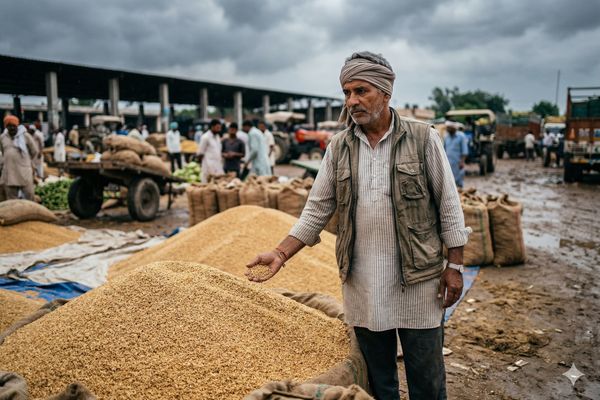
In Haryana, one of India’s core wheat-producing states, procurement has lagged sharply behind arrivals as government agencies reject loads with high moisture and discolouration following recent rains. In Karnal district, only a fraction of the more than 180,000 quintals delivered by April 5 had been purchased, as many lots failed to meet prescribed norms.
Mandis across Jhajjar, Hisar, Gurugram, Karnal and other districts have seen drenched stocks lying in the open, exposing infrastructure and process gaps at the very start of the 2026 procurement season. State authorities have written to the central government and FCI seeking relaxation in grading standards, while farmer groups and commission agents (arhatias) warn of growing financial stress as payments are delayed.
🌍 Immediate Market Impact
The procurement delays are occurring against the backdrop of broadly comfortable Indian wheat supplies, with official and trade estimates pointing to record or near-record national output and above-buffer public stocks ahead of the 2026 season. However, localised disruptions in Haryana and parts of Punjab raise the risk of temporary tightness in open-market availability in these consuming belts if government buying remains slow.
Near term, the bottlenecks are exerting downward pressure on farmgate prices for weather-affected grain that does not meet government norms, while well-spec wheat retains support from the MSP and private mill demand. If quality parameters are relaxed quickly and procurement intensifies, the impact on all-India prices is likely to remain contained; if not, distressed selling and logistical congestion could weigh on regional basis levels even as the national balance sheet stays ample.
📦 Supply Chain Disruptions
Reports from Haryana mandis highlight multiple operational constraints: high-moisture wheat (up to 15% in some centres) is being turned away or deferred, storage space is strained by wet stocks, and transporters are slow to lift purchased grain, stretching settlement cycles. In Jhajjar and Fatehabad, thousands of quintals are reported lying exposed, raising the risk of further qualitative deterioration and post-harvest losses.
Alongside quality issues, procedural disputes are also adding friction. In neighbouring Punjab, arhatias have threatened or initiated strikes over commission rates and biometric authentication rules at procurement centres, compounding the risk of slower grain intake into the central pool during the crucial early weeks of the marketing season. While mustard procurement in the same mandis is reported to be progressing normally, wheat remains the main bottleneck.
📊 Commodities Potentially Affected
- Wheat (domestic Indian) – Directly impacted by quality-related rejections and delayed procurement; near-term regional price volatility likely as markets reassess effective supply versus official targets.
- Wheat (global) – Limited immediate volume impact given India’s small export quota and export restrictions, but traders in Asia and the Middle East are watching for any policy signals that might alter India’s import or export stance later in the season.
- Mustard seed and oil – Procurement for mustard is proceeding smoothly and private prices are reportedly above MSP in some mandis, potentially drawing logistics, working capital and storage away from wheat and influencing farmers’ future planting decisions.
- Feed grains – If a significant portion of off-spec wheat is diverted from human consumption channels to feed or industrial use, local feed grain markets could see additional supply, mildly pressuring prices of alternative cereals in affected states.
🌎 Regional Trade Implications
Given India’s continued restrictions on wheat exports and its limited export quota for 2025/26, the current disruptions are unlikely to translate into immediate changes in seaborne trade flows. India remains, at most, a marginal origin in global wheat trade under current policies.
However, if quality losses from rains and hail prove substantial, India could become more cautious about future export liberalisation and may even look to safeguard domestic supplies through higher procurement targets, maintaining a neutral-to-supportive tone for global benchmark prices. For major exporters such as Australia, Russia and the EU, India’s procurement-driven stock build will be a factor in longer-term demand prospects into South Asia.
🧭 Market Outlook
Over the next 30–90 days, the key drivers will be New Delhi’s response to state requests for quality relaxation and the resolution of arhatia and biometric disputes in Punjab and Haryana. Historical precedent suggests that, in years of widespread weather damage, the centre has been willing to ease norms to avoid farmer distress, paving the way for a stronger second-half procurement push.
In the 6–12 month horizon, the actual scale of quality downgrades across Haryana, Rajasthan and Uttar Pradesh will shape India’s milling-quality wheat availability for 2026/27, but current national production and stock estimates imply that India should remain broadly self-sufficient. For now, international wheat prices are more likely to be driven by Black Sea export policy, Northern Hemisphere crop weather and macro factors than by India’s localised procurement frictions.
CMB Market Insight
For global traders, the present episode is best viewed as a domestic procurement and logistics stress test rather than a structural supply shock. Localised quality problems and policy delays in north India can generate regional price noise and basis swings, but India’s aggregate balances and restricted export regime limit the transmission to world markets in the short term.
Nonetheless, the situation warrants monitoring because it will influence India’s policy posture on buffer stocks, MSP operations and any future export openings. Physical market participants serving South Asia should track the pace of procurement recovery, the share of off-spec wheat absorbed into public stocks, and any evidence of substitution between food, feed and industrial channels as the 2026 marketing year progresses.
Related posts:
 India’s Ethanol Push and Hormuz Ceasefire Reshape Global Sugar Trade Outlook
 India’s APEDA Backs Uttar Pradesh Mango Export Push as New Irradiation Capacity Targets US Market
 Saudi Arabia Reshapes Grain Import and Food Security Policy as SALIC Prepares to Take Over Wheat Purchasing
 India’s Weather-Hit Wheat Crop: Quality Risks and Modest Upside for Prices
 Ghana Grain Policy Mix Reshapes Corn, Rice and Wheat Market Signals
 Indian Basmati Rice Rallies on Export Buying as Government Procurement Surges
 India Fast-Tracks AI-in-Agriculture Policy Push, Reshaping Smallholder Supply Chains and Price Discovery