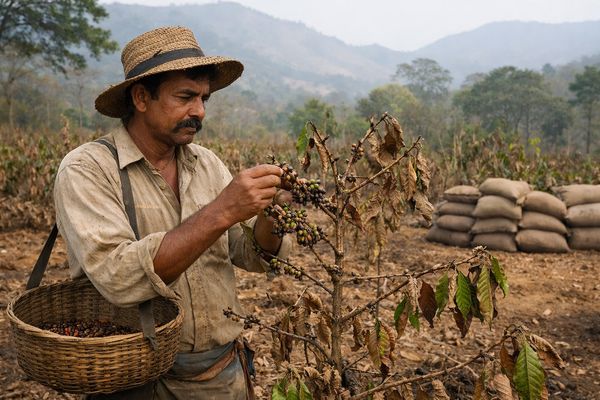
India’s coffee export growth in FY 2026-27 is set to cool after a record FY 2025-26, as a weaker crop—particularly in robusta—tightens exportable supplies and caps volume growth. Export values may remain resilient on firm prices and premiums, but shipment volumes are likely to come under pressure.
India enters FY 2026-27 from a position of strength: exports in FY 2025-26 reached 407,000 tonnes and €1.96 billion (approx. conversion from $2.13 billion), driven by strong global demand and high prices. This record year creates a high base, just as adverse weather and a softer production outlook in the 2025-26 coffee year (October 2025–September 2026) begin to bite. The key challenge is that India exports around two-thirds of its production, is heavily reliant on robusta, and faces growing competition from lower-cost African origins—especially Uganda—at a time when its own premiums remain elevated.
📈 Prices & Market Context
Global coffee prices remain broadly supportive, underpinned by firm demand and a still-tight supply backdrop. Indian coffee continues to command noticeable premiums in key importing markets, particularly in Europe.
However, those premiums are becoming a double-edged sword. While they underpinned the record export value in FY 2025-26, they now risk eroding price competitiveness as buyers increasingly search for cheaper robusta alternatives. This is especially relevant for price-sensitive roasters in Italy and other European hubs.
🌍 Supply & Demand Balance
The Coffee Board’s initial estimate for the 2025-26 coffee year pegs total production at 403,000 tonnes (Arabica 118,000 tonnes, Robusta 284,000 tonnes). Industry stakeholders, however, widely view this as optimistic and expect lower realized output.
Alternative industry estimates suggest Arabica in a range of 80,000–100,000 tonnes and Robusta closer to 250,000–275,000 tonnes. This implies that the dominant export grade—robusta—could fall by 40,000–50,000 tonnes versus earlier expectations, tightening the exportable surplus and limiting volume growth potential in FY 2026-27.
📊 Structure of Use & Trade
- Approximately two-thirds of India’s coffee output is exported, leaving roughly one-third (just over 100,000 tonnes) for domestic use.
- India also imports coffee for value-added processing and re-export, particularly blends and soluble products.
- This high external orientation means even modest production shortfalls translate quickly into export constraints.
🌦️ Weather & Crop Conditions
The weaker crop outlook is closely linked to adverse weather in key growing regions across Karnataka and Kerala. A prolonged monsoon from May to October, coupled with excess rainfall, has generated moisture stress, disrupted flowering and fruit setting, and negatively affected both yields and quality.
These weather-related impacts hit robusta hardest, amplifying the downside risk to output of India’s main export variety. Even if Arabica edges slightly higher, it cannot fully offset the shortfall in robusta, keeping the overall balance tight.
🌐 Competition & Premium Dynamics
India remains a respected origin and enjoys a strong reputation, especially with European buyers who value quality and consistency. This underpins continued preference for Indian grades despite elevated prices.
Yet competitive pressure is rising. Uganda, in particular, is strengthening its position in robusta, offering improving quality at relatively lower premiums. As Ugandan supply and other African origins grow, European roasters—especially in Italy—are increasingly willing to switch some volumes away from higher-priced Indian robusta.
⚖️ Bullish vs Bearish Drivers
📌 Bullish Factors
- Strong underlying global coffee demand, especially in Europe.
- Persistently high international coffee prices support export values.
- Ongoing growth in India’s value-added and processed coffee exports.
- Established relationships and quality perception favour Indian coffees in traditional markets.
📉 Bearish Factors
- Lower robusta output (potentially 40,000–50,000 tonnes below earlier expectations) tightening exportable supply.
- Weather-related crop damage and quality issues in key producing regions.
- High Indian premiums risking demand destruction among price-sensitive buyers.
- Rising competition from African robusta origins, notably Uganda, in core EU markets.
📆 Export Outlook for FY 2026-27
After a record FY 2025-26—with exports at 407,000 tonnes and an approximate value of €1.96 billion—India’s coffee sector faces a much tougher export environment. The high statistical base alone makes repeating last year’s growth unlikely, even without factoring in the weaker crop.
In FY 2026-27, exports are expected to remain robust in value terms due to firm global prices and sustained premiums, but physical volumes are likely to stagnate or edge lower. The main constraints will be a smaller robusta crop, reduced exportable surplus, and increasing buyer willingness to diversify into cheaper origins.
🧭 Trading & Risk Management Outlook
- Exporters: Prioritise long-term relationships and quality differentiation to defend premiums, while hedging price risk given tighter physical availability. Be selective in forward commitments until the crop size is clearer.
- Roasters/Importers: Consider partial origin diversification, especially into African robusta, to manage cost risk, but maintain core Indian coverage for quality-sensitive blends.
- Growers & Processors: Focus on quality upgrades and value-added products to capture more margin per tonne, compensating for lower volumes.
- All market participants: Monitor monsoon progress and any further weather disruptions closely, as additional crop losses could further tighten the balance and support prices.
📍 3-Day Directional Price & Market Tone Outlook (Indicative, EUR Basis)
Given the current fundamentals—tight robusta outlook, strong demand, and elevated premiums—market sentiment for Indian coffee over the coming 3 days is expected to remain:
- Domestic spot markets (Karnataka/Kerala): Slightly firm bias in EUR-equivalent terms, supported by concerns over the true size of the 2025-26 crop.
- Export offers (FOB India, robusta-based blends): Steady to marginally higher in EUR, with sellers reluctant to discount given limited forward visibility on supply.
- European import parity: Stable to slightly firmer, but with growing resistance at the margin as alternative robusta origins remain actively offered.