
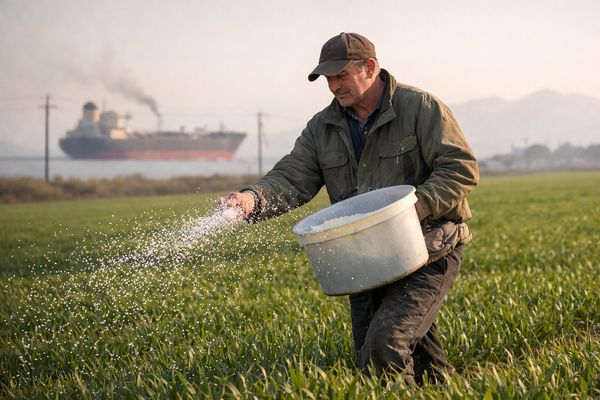
Hormuz Conflict Chokes Fertiliser Flows as Urea Hits Four‑Year Highs: Risks for Polish and EU Agriculture
The ongoing Iran war and effective closure of the Strait of Hormuz have triggered a sharp spike in nitrogen fertiliser prices, with urea now at its highest level in four years. Despite a fragile two‑week ceasefire and partial reopening for managed transits, shipping backlogs and security risks mean fertiliser supply to Europe, including Poland, remains highly vulnerable ahead of key application windows.
For agricultural producers, traders and input suppliers, the Gulf crisis is no longer just an energy story: it is rapidly evolving into a fertiliser affordability and availability shock. With Middle Eastern exporters unable to move normal volumes of urea, ammonia and sulphur through Hormuz, and Chinese export restrictions tightening the global balance, import‑dependent markets face higher costs, tighter credit needs and elevated price risk for the 2026/27 season.
Introduction
The Strait of Hormuz crisis escalated after coordinated US–Israeli strikes on Iran at the end of February, prompting Tehran to close the waterway to foreign shipping and mine key approaches. The strait is a critical chokepoint not only for crude oil and LNG, but also for nitrogen and phosphate fertilisers and sulphur used in fertiliser production.
Although Iran has now accepted a two‑week ceasefire and pledged to allow limited, military‑supervised transits, maritime traffic remains heavily constrained and insurers are cautious. Hundreds of tankers and other vessels are still queued or stranded in the Gulf, and analysts warn that flows of oil, gas and chemicals will not return to pre‑crisis levels quickly. For agricultural markets, the disruption coincides with a period of rebuilding fertiliser demand after earlier price corrections.
🌍 Immediate Market Impact
The near‑total blockade of Hormuz in March slashed seaborne exports of urea, ammonia and sulphur from Gulf producers that rely almost entirely on this route. Qatar, one of the world’s key nitrogen exporters, has no alternative outlet for urea other than through Hormuz, making its supply to global markets particularly exposed.
PKO Bank Polski analysis cited by Polish sector experts indicates that global urea prices surged from about 472 USD/t in February to around 725–730 USD/t in March, an increase of roughly 54%, taking levels to their highest since April 2022. At the same time, the World Bank fertiliser price index rose more than 25% month‑on‑month, with urea accounting for most of the jump. This price escalation is occurring even as natural gas prices in Europe had been expected to stay relatively benign in 2026, underlining that the current shock is primarily logistical and geopolitical rather than purely energy‑cost driven.
📦 Supply Chain Disruptions
Shipping data show that, even after the ceasefire announcement, around 1,000 ships remain stuck in and around the Gulf, including almost 190 laden tankers, with estimates of at least six to eight weeks needed to clear the backlog under stable conditions. War‑risk premiums, limited insurance coverage and the risk of residual mines or renewed attacks continue to deter many operators from entering the area.
For fertilisers, this translates into delayed and uncertain loading schedules out of Gulf ports, force majeure declarations by some energy and downstream producers, and a renewed scramble among importers to secure cargoes from alternative origins. European buyers, including Polish distributors, must now compete more aggressively with Asia and Latin America for non‑Gulf supply, with longer transit times and higher freight costs from alternative exporters such as North Africa or the Americas.
International agencies and NGOs have warned that disrupted Hormuz traffic and higher input costs are already constraining food and aid supply chains, particularly for countries heavily reliant on Gulf imports. While core food commodity prices have not yet spiked to 2022 levels, the widening gap between stable crop prices and surging fertiliser costs is squeezing farm margins globally.
📊 Commodities Potentially Affected
- Urea and other nitrogen fertilisers – Directly hit by curtailed Gulf exports, Chinese export controls and temporary Russian restrictions, driving price spikes and availability concerns for importers, including Poland and wider EU markets.
- Ammonia – Reduced Gulf shipments and higher gas‑related production risks elsewhere are tightening global ammonia balance, impacting downstream nitrate and urea producers in Europe.
- Phosphate fertilisers (DAP/MAP, TSP) – Dependence on Gulf sulphur and some phosphates means higher input costs; prices are already registering double‑digit year‑on‑year gains, although below nitrogen’s surge.
- Sulphur – A large share of seaborne sulphur passes through Hormuz; disruptions have driven sharp price increases, raising production costs for phosphates and other industrial chemicals.
- Cereals and oilseeds – Indirect impact via higher fertiliser costs and potential application cutbacks, which could trim yield expectations in 2026/27 if high prices persist into key procurement windows.
🌎 Regional Trade Implications
For Poland and other EU member states, the Hormuz crisis intersects with existing trade shifts: additional EU duties on Russian and Belarusian fertilisers and the full introduction of CBAM for nitrogen products from January 2026 have already reduced the bloc’s flexibility to pivot to eastern suppliers. The simultaneous constraint on Gulf volumes increases Europe’s dependence on intra‑EU production and on third‑country exporters not transiting Hormuz.
In the near term, North African producers (e.g. Egypt, Algeria, Morocco) and some American producers could gain market share in Europe, but their spare export capacity is finite, and freight to the Baltic and Black Sea region remains costly. Poland, situated within the EU internal market, will likely rely more heavily on regional producers and long‑term contracts, while smaller distributors and cooperatives may struggle to secure spot volumes at acceptable credit terms.
Asian and Australian markets, which normally receive a significant portion of their fertiliser imports from the Gulf during the April–June window, are already facing sharper delivered‑price pressure and may increasingly turn to Black Sea and North African suppliers, intensifying global competition for non‑Gulf tonnes.
🧭 Market Outlook
Analysts note that, even if the ceasefire holds and limited transits continue, clearing the shipping backlog and restoring confidence will take weeks or months, not days. The risk of renewed military escalation or new incidents in the strait remains elevated, which will keep war‑risk premiums, freight rates and price volatility high.
For fertiliser markets, this suggests elevated urea and nitrogen prices through at least the next application cycle, with downside scenarios dependent on a durable reopening of Hormuz and clearer export policies from China and Russia. Some demand rationing is likely, particularly among price‑sensitive growers in emerging markets, while European producers may consider adjusting cropping patterns and fertilisation intensity if high prices persist into summer tendering.
Traders will closely watch: (1) operational status of key Gulf export terminals and actual vessel throughput; (2) policy signals on export restrictions from major producers; (3) credit availability for importers facing higher working‑capital needs; and (4) any sign of yield‑threatening fertiliser cutbacks in key grain and oilseed regions.
CMB Market Insight
The Hormuz conflict has transformed quickly from a regional security crisis into a systemic shock for global fertiliser logistics. For Poland and the wider EU, where fertiliser markets were already reshaped by sanctions and carbon‑related border measures, the added Gulf disruption materially tightens the supply–demand balance and raises the cost floor for nitrogen inputs ahead of the 2026/27 season.
Strategically, market participants should assume a prolonged period of higher‑than‑expected fertiliser prices and freight costs, with intermittent bouts of extreme volatility linked to military and diplomatic developments. Importers and large farm groups in Central and Eastern Europe may wish to accelerate diversification of supply sources, lock in logistics capacity early, and strengthen risk‑management frameworks, including greater use of structured contracts and, where available, fertiliser price hedging instruments.
Until shipping through Hormuz normalises in both volume and perceived risk, fertilisers—not just oil and gas—will remain at the centre of the global commodity story, with direct implications for production costs, planting decisions and ultimately food inflation through 2027.
Related posts:
 Strait of Hormuz Conflict Tightens Gulf Chokepoint as Saudi Rail Corridor Offers Overland Relief
 Middle East War Chokes Key Sea Lanes, Raising New Food and Fertilizer Cost Risks
 Iran War Chokes Hormuz, Diverts Diesel Cargoes and Tightens Global Middle Distillate Supply
 Hormuz Conflict Triggers Energy Shock for India’s Spice and Agri Export Chain
 Hormuz Conflict Chokes Fertilizer and Energy Flows, Raising Global Crop Cost Risks
 Middle East War and Hormuz Blockade Send Fertilizer Costs Soaring, Polish Farm Margins Squeezed