
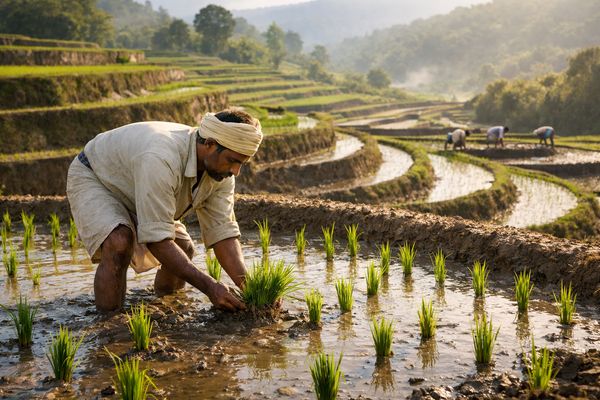
Indian premium basmati rice prices have turned quietly but decisively firmer, as stronger exporter demand and a tightening paddy market push key grades modestly higher and establish a well-supported price floor for the coming weeks.
Following a period of softness linked to Middle East export disruptions, India’s basmati complex is now regaining upward momentum. On 9 April, benchmark 1121 and 1509 grades moved higher by about $2.16–$3.24 per quintal, with mills increasingly reluctant to sell into weakness as paddy costs trend up. Export buying from the Middle East, Europe and North America remains broadly stable, while competition from Pakistan and competitive Vietnamese long-grain offers cap the upside but do not derail the firm tone. Overall, basmati prices look set to trade firm to moderately higher into late April, underpinned by acreage shortfalls and cost support in India.
Exclusive Offers on CMBroker

Rice
red
FOB 0.70 €/kg
(from VN)

Rice
paper dried
FOB 1.75 €/kg
(from VN)

Rice
long, white, 5%
FOB 0.43 €/kg
(from VN)
📈 Prices & Spreads
The latest domestic move has lifted India’s most traded basmati benchmarks into a higher, but still orderly, trading band:
- 1121 sella basmati: now around $101.6–$102.7/quintal.
- 1121 steam basmati: around $110.3–$112.5/quintal, acting as the near-term reference for export deals.
- 1509 sella: approximately $88.7–$89.8/quintal; 1509 steam about $96.3–$97.4/quintal.
- Sharbati sella: up roughly $3.2 to $69.2–$70.3/quintal; Sharbati steam: $74.6–$77.9/quintal.
FOB offers from New Delhi for key basmati lines in early April broadly align with this firm undertone, with 1121 steam, 1509 steam and 1121 sella all showing a modest week-on-week uptick when converted from USD to EUR. By contrast, Vietnamese 5% long white remains cheaper on a FOB basis, with recent export indications around $361–$365/ton (≈€0.34–€0.35/kg), preserving a clear price gap between premium basmati and mainstream long-grain origins.
| Product | Origin | Spec | Indicative level (EUR/kg, FOB) |
|---|---|---|---|
| Basmati 1121 steam | India | Premium long-grain | ≈0.80–0.82 |
| Basmati 1509 steam | India | Premium long-grain | ≈0.75–0.77 |
| Basmati Sharbati steam | India | Shorter-grain basmati | ≈0.57–0.59 |
| White rice 5% broken | Vietnam | Long, white, 5% | ≈0.40–0.42 |
🌍 Supply & Demand Drivers
The key short-term driver is India’s tightening paddy balance. Summer paddy transplanting has fallen to 30.12 lakh hectares from 32.59 lakh hectares a year earlier, also below the seasonal norm of 31.49 lakh hectares. This acreage deficit reinforces a perception of underlying tightness in the paddy supply chain, even as other rabi crops are being harvested.
With paddy prices on a bullish trajectory, rice mills are recalibrating minimum acceptable selling levels, limiting aggressive offers and effectively lifting the floor under basmati prices. Export demand into the Middle East, Europe and North America is described as steady rather than booming, but sufficient to absorb supplies at current levels. Recent Gulf-region conflict has introduced logistical friction and cost uncertainty, yet overall global basmati exports from India and Pakistan are still projected only slightly lower, around 6.4–6.5 million tons versus 6.85 million tons in FY 2024–25, suggesting resilience in core demand.
Outside the basmati segment, Vietnam and Thailand continue to anchor the global long-grain price structure. Vietnam’s 5% broken white is quoted in the low-to-mid $360s/ton FOB and Jasmine around $431–$435/ton, keeping them competitive against Thai and Indian non-basmati offers. At the same time, reports from the Mekong Delta highlight stockpiling and credit constraints after recent price softness, indicating that further downside in export quotes may be limited near term despite domestic pressure.
📊 Fundamentals & Weather
Structurally, India’s basmati sector faces tighter input costs and a slightly constrained acreage outlook. The current transplanting shortfall implies that, unless monsoon conditions are exceptionally favorable and farmers catch up later, paddy availability for the next cycle could remain snug. That would keep mills defensive on offers and sustain a risk premium in basmati relative to other rice types.
In the global context, India’s basmati competes head‑to‑head with Pakistan in the European and Middle Eastern markets. Any disruption to Pakistani supply chains or adverse currency moves would add a further tailwind to Indian export competitiveness. Recent regional conflict and higher freight and insurance premia affecting Gulf routes are already complicating flows for both origins, but also underline the premium nature and inelastic core demand for basmati in these destination markets.
On the weather side, early‑April forecasts point to increased rain and thunderstorms across northern India, including Punjab, Haryana and western Uttar Pradesh, over the next few days. For now this is more relevant for soil moisture recharge and short-term logistics than for paddy yield prospects, but persistent anomalies into May–June will be watched closely as they could influence farmers’ planting decisions and input application schedules.
📆 Short-Term Outlook (2–4 Weeks)
Market participants expect firm to moderately higher basmati prices over the next 2–4 weeks. The 1121 steam grade trading around the equivalent of €0.80–€0.82/kg (≈$110–$112/quintal) is likely to serve as the key reference for international buyers. A further upside of roughly €0.02–€0.03/kg cannot be ruled out if exporter offtake accelerates while paddy prices remain on an upward path.
Downside risk appears limited as long as paddy stays firm and mills resist discounting. The main near‑term bearish risk would be a sudden improvement in logistics and freight conditions that unleashes deferred basmati cargoes from both India and Pakistan into the market at once, temporarily widening supply. Conversely, any renewed weather or geopolitical shock in South Asia could tighten sentiment further and extend the current firming trend.
🧭 Trading & Procurement Recommendations
- Importers (EU, Middle East, North America): Consider staggered coverage for nearby shipments around current 1121 steam benchmarks, as the risk skew is mildly upward in late April. Avoid waiting for significant dips that are unlikely while paddy remains tight.
- Indian millers/exporters: Use the present firm tone to lock in forward sales in small tranches, particularly for 1121 and 1509 steam, but maintain some upside exposure in case paddy tightness intensifies or Pakistani supply stumbles.
- Non-basmati buyers: Continue to leverage the price spread between Vietnamese/Thai 5% and premium basmati. Medium‑term tenders can still be weighted toward competitively priced long-grain origins while keeping a quality niche for basmati.
📍 3-Day Regional Directional Outlook (in EUR)
- India – New Delhi (FOB, basmati): Mildly firmer bias; 1121 steam and 1509 steam seen holding current levels with a slight upside tendency as mills test higher offers.
- Vietnam – Hanoi (FOB, 5% long white/Jasmine): Largely steady with a slightly firm tone, tracking competitive global long-grain values and stable export interest from key Asian buyers.
- Pakistan – basmati export hubs: Neutral to mildly firm, with direction closely tied to Gulf logistics and currency moves; any fresh disruption would support offer ideas, while smoother shipments could cap near-term gains.
Related posts:
 Basmati Rice Rallies as Export Demand Recovers and Bangladesh Eyes Indian Supply
 Basmati Rice Squeeze in India Tightens Global Premium Rice Market
 Indian Basmati Rice Rallies on Export Buying as Government Procurement Surges
 Rice Markets Split: India Softens, Vietnam Firms on Tighter Supply
 Indian Basmati Rice Tightens Sharply as Flood Losses Squeeze Supply
 Rice Market Firms as CBOT Futures Rally and Asian FOB Prices Ease