
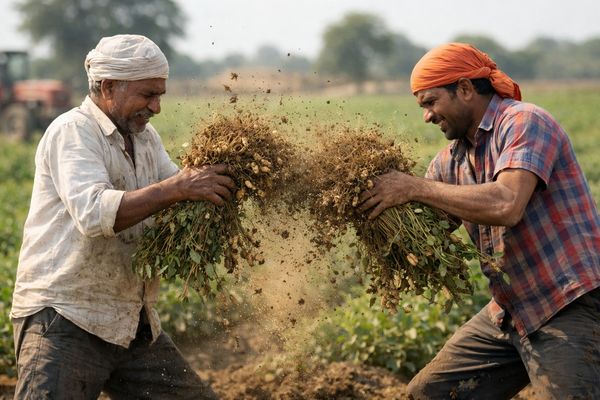
India’s peanut market is entering the summer season on a structurally firm footing, with acreage up, farm-gate price signals still supportive and export prospects improving into late 2026.
At the same time, near-term raw peanut prices are expected to trade broadly sideways as the market waits for clearer information on crop progress in Gujarat’s Saurashtra belt and other key regions. For European buyers, the combination of higher Indian summer acreage and competitive kernel offers versus Argentine and US origins points to better supply availability for the second half of 2026, but weather during June–July remains a key risk.
Exclusive Offers on CMBroker

Peanuts
birdfeed
CFR 1.07 €/kg
(from IN)

Peanuts
raw
FOB 1.29 €/kg
(from BR)

Peanuts
java 70-80
FOB 1.20 €/kg
(from IN)
📈 Prices & Relative Value
In Mumbai on 9 April, peanut oil was quoted at about EUR 2.09 per quintal, versus roughly EUR 1.86 per quintal for soya refined oil, maintaining a meaningful premium that reflects peanut oil’s flavour and functional advantages in premium household and food service demand. The spread to other refined oils remains wide enough to keep peanut oil in a strong niche, without yet destroying demand.
Export-oriented kernel indications from India are broadly steady. Recent FOB offers for Indian bold and java kernels cluster around EUR 1.00–1.31/kg depending on count and type, while Brazilian raw peanuts are around EUR 1.29/kg FOB, leaving India competitively placed on both birdfeed and edible grades. Overall, price action over recent weeks has been remarkably stable, consistent with a market that is well supplied in the short term but watching new-crop risks.
| Origin / Type | Location / Terms | Latest Price (EUR/kg) | Trend vs Previous |
|---|---|---|---|
| Peanuts, bold 60–70 | IN, New Delhi, FOB | 1.00 | Stable |
| Peanuts, java 50–60 | IN, New Delhi, FOB | 1.31 | Stable |
| Peanuts, birdfeed | IN, New Delhi, CFR | 1.07 | Stable |
| Peanuts, raw | BR, Brasília, FOB | 1.29 | Stable |
🌍 Supply & Demand Drivers
India’s summer peanut cultivation has expanded to 4.59 lakh hectares as of 3 April, up from 4.20 lakh hectares a year earlier, a robust year-on-year increase of roughly 9.3%. This reflects strong farm-gate returns from the previous kharif season and favourable soil moisture in core producing states such as Gujarat, Andhra Pradesh and Rajasthan.
Within Gujarat, the Saurashtra region – especially Porbandar, Junagadh and Amreli – is seeing particularly active sowing, with planted area running above the three-year average in most districts. This expanded area underpins a structurally positive production outlook for the July–August harvest window, assuming normal weather, and supports expectations of comfortable raw material availability for Indian crushers, shellers and exporters into late 2026.
On the demand side, peanut oil continues to benefit from loyal premium household and food service users who prioritise flavour and a higher smoke point, even at a notable price premium to competing soft oils. In export markets, especially Europe, Indian kernels are positioned against Argentine and US origins for confectionery, snack and peanut butter uses. The prospect of a larger Indian summer crop should enhance India’s export competitiveness and allow European buyers more choice on origin in the second half of 2026.
📊 Fundamentals & Risk Factors
Fundamentals for the coming months are best characterised as balanced to moderately bearish on price, but with a clear weather-related upside tail. Expanded acreage and good initial moisture argue for higher production potential, which would normally weigh on prices. However, market participants are reluctant to bid prices down ahead of the critical June–July growing phase in Saurashtra, where any moisture stress or unseasonal rainfall could materially trim yields.
The current wide price gap between peanut oil and rival refined oils also requires monitoring. If soft oil prices stay subdued while peanut oil holds firm, some substitution at the margin could emerge among more price-sensitive consumers and industrial users, capping further price appreciation. For now, though, the premium appears sustainable given the specific culinary use cases where peanut oil is preferred.
🌦️ Weather & Crop Outlook
Short term, field conditions across Gujarat and other key states are reported as favourable, with adequate soil moisture supporting early crop establishment. Over the next two to four weeks, weather is not expected to be a major driver, and prices at the raw material level are likely to remain range-bound as the crop develops.
The main inflection point will arrive in the June–July window, when kernel filling and yield formation in Saurashtra become highly sensitive to rainfall distribution and temperature extremes. Any significant disruption – such as prolonged dry spells or heavy rains at critical stages – would quickly shift market sentiment, supporting both kernel and oil prices and tightening export availabilities for the 2026/27 marketing period.
📆 Price & Trading Outlook (Next 2–4 Weeks)
- Price bias: Sideways to mildly softer for raw kernels, with India FOB offers expected to hover near current EUR 1.00–1.31/kg bands, barring early weather shocks.
- Volatility: Low in the immediate term, but with asymmetric upside risk tied to Saurashtra weather from June onwards and any surprise in domestic edible oil policy or import dynamics.
- Export basis: India likely to remain competitive versus Brazil and the US, particularly on java counts for European snack and confectionery demand.
🧭 Strategy Pointers for Market Participants
- European buyers: Use current stability to secure partial coverage for Q4 2026 and early 2027 Indian shipments, while keeping flexibility to add on dips if the crop performs well. Monitor Gujarat’s summer harvest closely from July onwards.
- Indian processors/exporters: Consider forward coverage of raw material at current levels, which are supported yet not excessively high, to hedge against potential June–July weather-driven spikes.
- Birdfeed and industrial users: With birdfeed-grade peanuts steady around EUR 1.07/kg CFR, maintain rolling coverage but avoid over-committing before clearer signals on yield; use any short-lived price weakness to extend positions.
📍 3-Day Directional Outlook
- India FOB kernels (bold & java): Stable; narrow intraday ranges around current levels, limited fresh fundamental news expected in the next three days.
- Brazil FOB raw peanuts: Stable to slightly firm, tracking broader oilseed sentiment but with no immediate supply shock visible.
- India CFR birdfeed: Stable; trade flows continue normally with no short-term disruption anticipated.
Related posts:
 Indian Rabi Peanuts: Gujarat Acreage Surge Sets Stage For Softer Prices
 Stable Walnut Kernel Prices as Buyers Weigh China–US–India Supply Signals
 China Pine Nuts FOB Dalian: Stable but Tight Market Signals in Early April
 Brazil & India Peanuts Hold Steady as Weather Risks Loom in April
 Chinese Pine Nut FOB Prices Ease Slightly Amid Stable Export Interest
 Indian and Brazilian Peanut Prices Edge Up on Firm Export Demand