
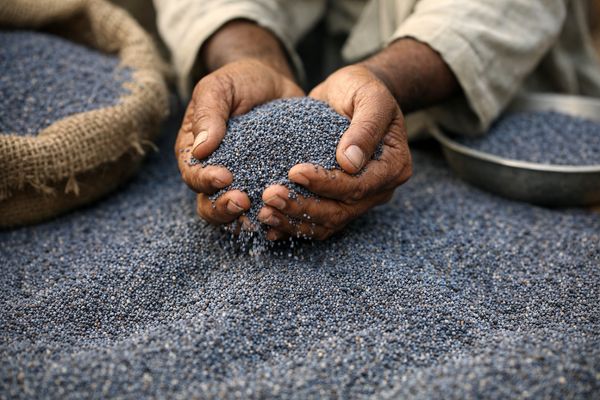
Poppy seed prices have come under mild pressure in early April, with India’s licensed domestic market and key import flows both reflecting a seasonal post-festive demand lull and cautious institutional buying. In Europe, Czech FCA indications for blue and white poppy seeds are edging lower but remain within a tight range, pointing to a generally soft-to-stable global tone.
Across the Indian wholesale kiryana segment, reduced footfall from institutional buyers and spice blenders is weighing on khaskhas/postadana, while the April demand trough after the Diwali–Holi sweet-making season removes an important price support. At the same time, major export origins such as the Czech Republic report calm spring weather and no acute production shock, allowing buyers to test slightly lower bids. Over the next two to four weeks, the balance of evidence points to sideways-to-soft pricing, with only modest upside potential from pre-Eid and summer wedding demand.
Exclusive Offers on CMBroker

Blue poppy seeds
morphin < 20 ppm
99,9
FCA 1.88 €/kg
(from CZ)

Blue poppy seeds
morphin < 20 ppm
99,9
FCA 1.88 €/kg
(from CZ)

White Poppyseeds
morphin < 20 ppm
99,9
FCA 2.86 €/kg
(from CZ)
📈 Prices & Recent Moves
On 9 April, Indian wholesale poppy seed in Delhi’s grocery and dry spice market slipped by about USD 0.54 per kilogram, as softer buying interest triggered mild selling pressure. Domestic-origin seed settled around USD 12.43–12.97/kg, while imported-origin material closed higher at USD 14.06–15.14/kg, reflecting its larger grain size and higher oil content.
In the Czech Republic, FCA offers for food-grade poppy seed have eased incrementally over recent weeks. Blue poppy seed is currently indicated around EUR 1.88/kg, down from roughly EUR 1.98/kg in mid-March, while white poppy seed has slipped from about EUR 2.95/kg to EUR 2.86/kg. This confirms a mild downward drift rather than a sharp correction, consistent with cautious end-user demand and the absence of weather or policy shocks in key European origins.
| Product | Origin | Term | Latest price (EUR/kg) | 1–3 week change (EUR/kg) |
|---|---|---|---|---|
| Blue poppy seeds (morphin < 20 ppm) | CZ – Vysoké Mýto | FCA | 1.88 | −0.10 |
| Blue poppy seeds (morphin < 20 ppm) | CZ – Chropyně | FCA | 1.88 | −0.07 |
| White poppy seeds (morphin < 20 ppm) | CZ – Chropyně | FCA | 2.86 | −0.09 |
🌍 Supply & Demand
India’s poppy seed supply is structurally tight on the production side: cultivation is strictly licensed and concentrated in Madhya Pradesh and Rajasthan, leaving domestic output insufficient to meet culinary demand. As a result, India remains a consistent net importer, sourcing primarily from Turkey, Spain, and the Czech Republic to serve both the food processing industry and wholesale trade.
Demand is highly seasonal. Consumption peaks from Diwali through Holi, when traditional sweets and gravies drive bulk purchases by confectionery manufacturers. April typically marks a post-festival trough, which is clearly visible in current market behaviour: institutional buyers and spice blending companies are passive, and hand-to-mouth coverage dominates. This seasonal slack explains the modest price retreat in Delhi and aligns with only moderate liquidity in European trade, where buyers are reluctant to commit to large forward volumes.
📊 Fundamentals & Weather Context
Global poppy seed fundamentals currently appear balanced. Stocks in major origins like Central Europe are adequate, and spring fieldwork is progressing under seasonally cool and largely dry conditions. In the Czech Republic, early-April weather has been typical for the season, with daytime highs around 9–12 °C and near-freezing nights but no extreme frost episodes reported, a pattern that does not threaten existing stocks or sowing operations.
For India, the key external risk channel remains export-origin supply from Turkey and Central Europe. Any significant weather disruption or policy shock in these regions would quickly feed into higher import parity and, by extension, domestic wholesale prices. However, with no acute stress evident in current European weather data and broader agricultural markets transitioning from La Niña toward a more neutral ENSO phase, the near-term risk balance for poppy seed leans towards stability rather than abrupt shortages.
📆 Short-Term Outlook (2–4 Weeks)
In the coming two to four weeks, poppy seed prices are likely to trade in a soft-to-sideways band. The prevailing domestic Indian ranges around the equivalent of EUR 11–12/kg for licensed domestic seed and a premium band for imported material can be regarded as fair value within the current seasonal cycle. With no strong demand catalyst, sellers may need to accept marginally lower bids to move volume, particularly in lower grades.
Some support may emerge ahead of Eid and the summer wedding season, when confectionery manufacturers typically begin rebuilding inventories. Nonetheless, any rally is expected to be modest and potentially short-lived, with more pronounced upside risk reserved for the pre-Diwali stocking phase later in the year. In Europe, continued calm spring weather and steady export capacity from the Czech Republic suggest that FCA prices will remain confined to a narrow corridor, with buyers using dips to secure nearby needs rather than chasing the market higher.
💡 Trading Outlook & Recommendations
- Indian importers & large buyers: Use the current soft phase to cover near-term needs, but avoid overstocking ahead of the summer, as structural imports and stable European supply limit upside risks in the next few weeks.
- Food manufacturers (India): Consider incremental inventory building for Eid and early wedding-season requirements at current levels, particularly for preferred imported grades, while keeping flexibility to add more should prices drift lower.
- European producers & exporters: Maintain disciplined offers; with buyers testing lower bids and no crop scare in sight, defending current FCA ranges may be preferable to deeper discounts that could be hard to reverse before the main pre-festive demand phase.
- Speculative participants: The risk–reward profile currently favours range-trading strategies, with limited justification for aggressive long positions until there is evidence of stronger demand or weather-related concerns in Turkey or Central Europe.
📍 3‑Day Directional Price View
- India – Delhi wholesale (khaskhas/postadana): Mildly soft bias; small further downside possible as institutional and blending demand remains thin.
- Czech Republic – blue poppy FCA: Broadly stable with a slight downward tilt; buyers may secure limited additional volume if offers soften, but no sharp move is expected.
- Czech Republic – white poppy FCA: Sideways within the current narrow band; a modest discounting tendency may continue if export interest stays cautious.
Related posts:
 Sunflower Market Softens on SAFEX Losses but Black Sea Flows Stay Tight
 Czech Poppy Seeds Ease Lower as Buyers Stay Cautious
 Sunflower Market: SAFEX Softens While Black Sea Seed Prices Hold Firm
 Rapeseed Market Holds Firm as Canola Slips and Biofuel Demand Softens
 India’s tightly regulated poppy seed market keeps prices firmly elevated
 Rapeseed Market Holds Firm as Energy Rally Meets Cautious Fund Selling
 Czech Blue and White Poppy Seeds Edge Lower as Buyers Stay Cautious
 Ukrainian Rapeseed Edges Higher as EU Market Softens