Varcli Pinares’ direct-retail banana model in Costa Rica is proving resilient on quality and sustainability, but El Niño-linked climate volatility and a stronger local currency are squeezing margins in 2026. While global trade flows are shifting toward Ecuador and Asia, retailers’ demand for traceable, low-impact bananas is creating a premium niche that players like Varcli are well-positioned to capture.
Costa Rican bananas remain structurally competitive, yet production planning is challenged by erratic weather and a four-year strengthening of the Costa Rican colón against the US dollar. At the same time, European and North American retailers are sharpening their sustainability and due-diligence requirements, opening space for differentiated supply models that deliver carbon reductions, social compliance, and brandable origin stories. Against this backdrop, dried banana chip prices in Europe have inched up in early April, signaling steady demand but also persistent cost pressure across the value chain.
Exclusive Offers on CMBroker

Banana dried chips
Chips, whole
FCA 2.90 €/kg
(from NL)

Banana dried chips
Chips, broken
FCA 1.87 €/kg
(from NL)

Banana dried chips
Chips, whole
FCA 2.37 €/kg
(from NL)
📈 Prices & Market Signals
Spot indications for processed banana products in Europe show marginal firming into 9 April 2026. Organic banana dried chips (whole, PH origin, FCA NL) last traded around EUR 2.90/kg, up slightly from EUR 2.88/kg a week earlier. Conventional whole chips (PH, FCA NL) are quoted near EUR 2.37/kg, with broken chips at about EUR 1.87/kg, both up EUR 0.02/kg over the same period. Vietnamese whole chips (FOB Hanoi) are stable around EUR 3.43/kg, pointing to relatively tight regional supply and firm freight and input costs.
| Product | Origin | Term | Latest price (EUR/kg) | 1-week change (EUR/kg) |
|---|---|---|---|---|
| Banana dried chips, organic, whole | Philippines | FCA NL | 2.90 | +0.02 |
| Banana dried chips, whole | Philippines | FCA NL | 2.37 | +0.02 |
| Banana dried chips, broken | Philippines | FCA NL | 1.87 | +0.02 |
| Banana dried chips, whole | Vietnam | FOB Hanoi | 3.43 | 0.00 |
On the fresh side, early April wholesale banana prices in Europe hover just below EUR 1.00/kg on average, with a modest 1% week-on-week decline amid mixed origin availability, including increased volumes from Ecuador and pressure from logistics disruptions linked to Middle East trade routes.
🌍 Supply & Demand Dynamics
Varcli Pinares illustrates a shift from bulk commodity trade toward direct-retail supply, bypassing traditional multinationals. After exiting transnational trading (most recently via Del Monte) around 2016, Varcli built direct programs first in Germany, then the UK, Italy, Japan and ultimately the US. Its current anchor relationship is with Walmart, where weekly shipments have scaled from one to about seven containers, with a strategic ambition to reach 1% of Walmart’s total banana volume.
Globally, supply growth is increasingly driven by Ecuador and emerging Asian origins. Ecuadorian exports rose nearly 10% year-on-year in January 2026, benefiting from production setbacks in Central America since 2025 linked to climatic instability. Costa Rica has partially recovered volumes but still faces very low supermarket pricing in Europe, putting margin pressure on growers even as export volumes stabilise. Demand remains robust in key import markets (EU, US, Asia), with retailers using bananas as price leaders while increasingly layering sustainability and living-wage initiatives into sourcing policies.
📊 Fundamentals: The Varcli Model
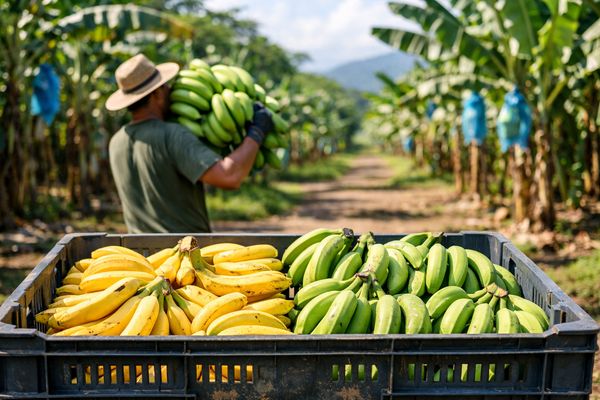
Varcli’s cost and quality strategy centres on agronomic and processing innovations rather than scale. Planting density of 1,333 plants/ha is materially below the Costa Rican norm of 1,600–1,800, but improved light and airflow allow the farm to reach roughly 3,800 boxes/ha, underscoring that lower density need not mean lower yield. The company also mows inter-rows instead of sowing cover crops, letting natural biodiversity establish and enabling a 95% reduction in herbicide applications managed by a dedicated four-person team.
In the packing house, Varcli has removed water pools entirely, redesigning the flow so latex drains naturally as bunches move from field to station. The result is a roughly 90% cut in water use, saving about 36 million litres per year, and eliminating pumps so that the facility can run fully on solar power. All organic residues return to the fields, delivering a closed-loop model with zero packing waste. These operational efficiencies underpin a premium sustainability narrative that resonates with retailers and consumers seeking low-footprint bananas.
Land use and biodiversity are also central. Alongside 150 ha of banana plantation, Varcli manages 80 ha of Melina reforestation and 100 ha of protected rainforest as active carbon sinks. A full carbon-footprint assessment is under way with a net-zero production target, aligned with Walmart’s climate agenda through participation in Project Gigaton. On plant health, Varcli has employed drones for Sigatoka control for around nine years and is investing in soil biodiversity as a defensive strategy against Fusarium TR4, banking on competitive biological communities to limit disease establishment.
🌦️ Weather, FX & Policy Backdrop
In the next 30–90 days, Varcli’s production planning is directly exposed to climate unpredictability tied to El Niño-type conditions, which heighten rainfall variability on Costa Rica’s Caribbean coast. April 2026 weather forecasts indicate a seasonal transition with high humidity and episodic heavy showers, increasing operational risk for field work and post-harvest logistics. Such variability can translate into uneven fruit filling, elevated disease pressure, and tighter windows for harvest, potentially constraining exportable volumes if not tightly managed.
Currency moves are a second key headwind. Over roughly four years, the Costa Rican colón has appreciated from around 620 to 480 per US dollar, eroding export revenues when contracts are dollar-denominated but costs are local. For a direct supplier like Varcli, which relies on premiums for quality and sustainability, FX strength compresses margins even as farm-gate prices from retailers remain under pressure. Meanwhile, the removal of selected US farm tariffs on Costa Rican processed products, including certain banana-based items, strengthens incentives to move up the value chain into higher-value formats such as purées and snacks.
🧩 Social Responsibility & Retail Alignment
Varcli’s social profile is a key differentiator in a sector under scrutiny for labour and living-wage gaps. The farm employs around 100 workers, many Nicaraguan migrants, and provides transport, above-average wages, and active support for regularising legal status in Costa Rica. The packing house workforce is about 80% female, with women also leading field leaf-sanitation teams, which directly supports income opportunities for single mothers in rural communities.
This social model dovetails with European and North American retailer initiatives that emphasise responsible purchasing, living wages and improved working conditions in banana supply chains, particularly in Latin America. As EU due-diligence regulations tighten, traceable farms that can document both environmental and social impacts are increasingly attractive as anchor suppliers or pilot partners in retailer programmes.
📆 Outlook & Trading Recommendations
In the near term (30–90 days), Varcli’s priority is operational survival under climate and FX stress. Production risks from erratic rainfall and disease pressure, coupled with a strong colón and low supermarket shelf prices, imply little room for margin expansion despite efficient on-farm practices. Export volumes from Costa Rica are expected to remain steady to slightly constrained, while Ecuador and some Asian origins capture incremental demand growth, particularly where logistics to Europe and Russia are favourable.
Over the medium term (6–12 months), Varcli aims to scale its model through partner farms in other countries, as domestic land expansion is limited by Costa Rica’s 62% forest coverage and strict land-use policies. If direct relationships with retailers like Walmart deepen further and weekly container volumes continue to grow, the Varcli brand could secure a stable niche of labelled, low-impact bananas across US and European specialty outlets. This trajectory suggests a gradual increase in the share of bananas sold under origin-specific and sustainability-certified programs, even as mainstream commodity pricing remains highly competitive.
🎯 Trading & Procurement Guidance
- Retail buyers: Lock in medium-term programs with proven sustainable suppliers in Costa Rica and Latin America, prioritising partners with direct carbon and social reporting; use current flat-to-soft EUR wholesale prices to secure origin diversification.
- Importers & traders: Maintain balanced sourcing between Ecuador (volume, price competitiveness) and Central America (sustainability narratives) to hedge climate and logistics risks; consider premium retail channels for differentiated brands like Varcli.
- Processors (dried chips/purées): Expect mildly firm input costs given FX, freight and climate uncertainties; short-term EUR price upticks argue for staggered purchasing rather than aggressive forward coverage.
- Producers: Invest in water-, energy- and agrochemical-efficient systems and social compliance, positioning for upcoming EU and US due-diligence and living-wage benchmarks that can unlock price premiums.
📍 3-Day Directional Price Outlook (EUR)
- EU wholesale fresh bananas: Sideways to slightly soft (−0.5% to −1.5%) as supply from multiple origins remains ample and retailers continue price-led promotions.
- Dried banana chips, FCA NL: Stable to marginally firm (+0% to +1%) with modest support from freight and energy costs, but no acute supply shock.
- Processed banana products ex-Central America: Steady, with potential medium-term upside from tariff exemptions into the US favouring value-added exports over raw fruit.