
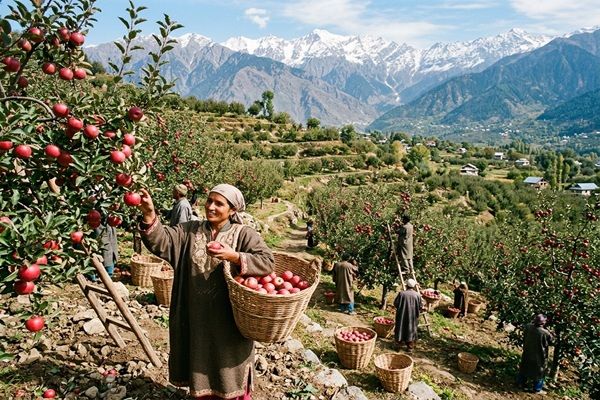
India’s apple market is entering a strategic transition: Jammu & Kashmir’s new 2047 horticulture roadmap targets chronic productivity and post‑harvest problems, but import dependence is likely to increase before any meaningful reversal is visible. For buyers, this points to structurally firm underlying fundamentals even as near‑term prices remain governed by trade policy and logistics rather than local yields.
India’s planning body has set out an ambitious plan to turn Jammu & Kashmir into a high‑value, export‑oriented horticulture hub centred on apples, walnuts, cherries and saffron. The strategy recognises that land for new orchards is largely exhausted and that future growth must come from yield and quality gains, backed by modern planting systems, cold chain and processing. Yet today, massive post‑harvest losses and a widening apple trade deficit constrain domestic supply, keeping India a price‑taker on the world market for both fresh and processed apple products.
Exclusive Offers on CMBroker

Apple dried
Cubes 10-12 mm
FCA 4.35 €/kg
(from NL)

Apple dried
Cubes 8-10 mm
FCA 4.30 €/kg
(from NL)

Apple dried
Cubes 5-7 mm
FCA 4.40 €/kg
(from NL)
📈 Prices & Market Tone
European dried apple prices provide a useful real‑time signal of underlying demand for processed apple ingredients. Offers for Chinese origin, conventional dried apple cubes delivered FCA Dordrecht (Netherlands) on 9 April 2026 show a mildly firmer structure across sizes, with all grades trading in a tight EUR 4.30–4.40/kg range and edging up by about EUR 0.05/kg versus early April:
| Product | Origin | Location / Terms | Latest Price (EUR/kg) | Previous Price (EUR/kg) | Update Date |
|---|---|---|---|---|---|
| Dried apple cubes 5–7 mm | China | Dordrecht, NL (FCA) | 4.40 | 4.35 | 2026‑04‑09 |
| Dried apple cubes 8–10 mm | China | Dordrecht, NL (FCA) | 4.30 | 4.25 | 2026‑04‑09 |
| Dried apple cubes 10–12 mm | China | Dordrecht, NL (FCA) | 4.35 | 4.30 | 2026‑04‑09 |
This incremental firming fits with India’s structural supply gap: India has become the sixth‑largest apple importer globally, with the apple trade deficit widening from roughly USD 108 million to USD 404 million as domestic production lags fast‑rising consumption, including in rural areas. While dried apple is a separate segment, sustained import demand for fresh fruit in a major consumer country underpins global utilisation and limits downside for processing‑grade material.
🌍 Supply, Demand & Structural Constraints
Apples remain the backbone of Jammu & Kashmir’s horticulture economy, but recent growth has been driven mainly by expanding orchard area rather than improving yields. The new roadmap explicitly acknowledges that available land for further expansion is now constrained, meaning any additional output must come from productivity gains in existing orchards rather than new plantings. This constraint tightens the long‑term balance: without a significant yield uplift, domestic supply will struggle to keep pace with India’s broadening consumer base.
On the demand side, India’s consumption of apples has grown strongly in both urban and rural markets, with rural growth now outpacing urban. The result is a fast‑widening gap between domestic production and demand, forcing higher imports not only of apples but also of other temperate horticultural products such as walnuts and almonds. Given the long investment cycles in perennial crops, this imbalance cannot be corrected quickly, embedding a multi‑year reliance on foreign supply despite the new roadmap.
📊 Fundamentals: Productivity, Losses & Trade Deficit
The most immediate drag on India’s apple balance is not acreage but efficiency. Annual post‑harvest losses for apples in Jammu & Kashmir are estimated at around 500,000 tonnes, translating into about USD 180 million in economic losses. When combined with similar‑scale losses in vegetables, the horticulture sector forfeits roughly USD 367 million every year simply because produce fails to reach markets in saleable condition. These losses effectively erase a sizeable share of theoretical output from the balance sheet.
Cherries illustrate the severity of infrastructure gaps: 40–49% of cherry production is lost post‑harvest, largely due to limited cold chain capacity, while only 39% of the region’s registered food processing units handle fruits and vegetables, and horticulture accounts for just 20.3% of processed food volume. For apples, this underdeveloped cold chain and processing base means more fruit must be sold quickly into fresh markets, amplifying price volatility and constraining value addition into juices, concentrates and dried products.
At the macro level, these structural inefficiencies feed directly into India’s widening apple trade deficit, which has ballooned to about USD 404 million. Despite Jammu & Kashmir being the country’s principal apple region, domestic supply cannot fully meet the surge in demand, forcing India to rely on imported fruit and temperate nuts. Recent commentary around trade agreements and import duties confirms that policymakers are trying to balance farmer protection with consumer interests, but until productivity and post‑harvest systems improve substantially, India will remain a net apple importer.
🏗️ Policy Response: Operation Golden Greens
The centrepiece of the new strategy is Operation Golden Greens, a mission‑mode initiative designed to tackle productivity and value‑chain weaknesses across apples, walnuts, cherries and saffron. It promotes a cluster‑based model, assigning specific crops to well‑suited geographic pockets to concentrate agronomic expertise, infrastructure investment and market access. This spatial specialisation is intended to raise average yields and quality by aligning crop choice with micro‑climatic advantages.
Key infrastructure proposals include establishing 40–50 ha nurseries in each district, creating tissue culture labs to ensure reliable supplies of high‑quality planting material, and expanding cold storage, packhouses and logistics systems. Training programmes for growers and post‑harvest operators, together with stronger farmer organizations and innovation networks, are meant to accelerate the adoption of high‑density orchards, improved varieties and precision agriculture. If executed, these measures could gradually shift India from import substitution alone towards a more export‑competitive position in premium apples and processed products.
🌦️ Weather & Short‑Term Risk Factors
In the next 30–90 days, implementation planning and budget allocation for the roadmap will be more decisive for the market than weather alone. Apple orchards in Jammu & Kashmir are currently in the pre‑season window where any severe unseasonal frost or hail could impact blossom and fruit set, but such events would affect the 2026/27 crop rather than immediate processed‑apple availability. For now, structurally high post‑harvest losses and logistics bottlenecks remain the dominant short‑term risks.
The roadmap identifies cold chain expansion for apples and cherries as the most commercially urgent investment, precisely because it can curb the large, recurring physical losses that tighten effective supply. Early progress on cold storage, reefer logistics and packhouse upgrades would reduce volatility in fresh‑market prices and could gradually free up more fruit for processing, including for dried apple production destined for export markets.
📆 Outlook & Trading Guidance
Over the next 6–12 months, the critical question is whether Operation Golden Greens moves from policy document to fully funded programme with measurable milestones. Structural shifts in orchard productivity, cold chain coverage and processing capacity typically unfold over a decade or more, so the medium‑term baseline remains one of continued import dependence. In that context, global processing‑grade apple balances are likely to stay relatively tight, especially if competing uses such as juice concentrate draw on similar raw material pools.
- Industrial buyers (EU dried apple): Use current EUR 4.30–4.40/kg range to secure partial cover for Q2–Q3 needs; downside appears limited while India’s import gap persists and logistics costs remain elevated.
- Exporters serving India: Anticipate steady demand for both fresh and processed apple products as domestic supply issues and post‑harvest losses continue; watch India’s tariff and MIP decisions closely for timing of shipments.
- Growers & processors in J&K: Prioritise participation in nursery and high‑density orchard programmes and invest early in basic on‑farm storage and grading to capture potential policy incentives and improve market access.
🧭 3‑Day Directional Price View (EUR)
- Dried apple cubes, China → EU (FCA NL): Stable to slightly firm around EUR 4.30–4.40/kg as buyers cautiously restock and freight remains steady.
- Fresh apples, India domestic (indicator): Locally supported by structural supply tightness and trade‑policy uncertainty; no clear short‑term easing signal.
Related posts:
 Chinese Dried Apple Cubes Edge Higher on Firm Demand and Stable Logistics
 India’s APEDA Backs Uttar Pradesh Mango Export Push as New Irradiation Capacity Targets US Market
 Australian Apple Season 2026: Quality First as New Crop Arrives
 Stable Dried Apple Prices in Europe as Turkish Weather Stays Seasonally Mild
 Jammu & Kashmir Apples: Rising Output, Falling Exports and Flat Prices
 Dates Market 2025/26: Rising Supply Meets Softer EU Demand
 Dried Apple Prices Hold Steady as Tight Turkish Crop Supports Market