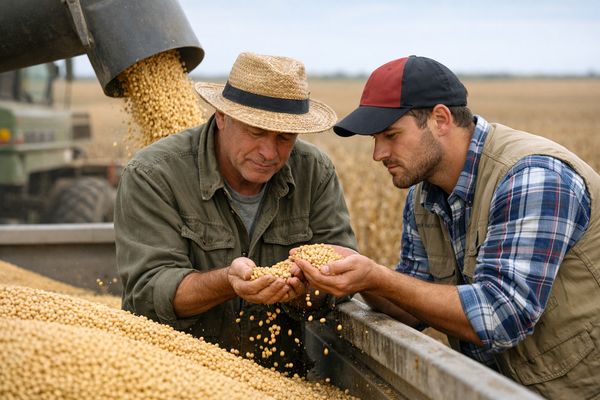
Uruguay’s 2025/26 soybean crop has collapsed under severe drought, but the impact on global prices remains muted as record South American production keeps the world soybean balance comfortably supplied.
Uruguay’s sharp production losses and delayed harvest highlight extreme local stress, yet the wider soybean complex is still driven by Brazil’s record crop, firm crush demand and only modest price support. For traders and physical buyers, the key message is that Uruguay’s problems tighten regional availability and FOB differentials more than they move the global curve. In the near term, logistics, basis moves and meal premiums in South America matter more for pricing than flat-price rallies on the futures side.
Exclusive Offers on CMBroker

Soybeans
No. 2
FOB 0.60 €/kg
(from US)

Soybeans
sortex clean
FOB 1.00 €/kg
(from IN)

Soybeans
FOB 0.34 €/kg
(from UA)
📈 Prices & Market Tone
Global soybean prices remain capped by ample supply despite episodic weather issues. Recent grains commentary and the April 9 USDA WASDE update show 2025/26 global soybean stocks and production essentially steady, with Brazil’s crop near record levels around 180 million tonnes and no major tightening of the world balance sheet. On the product side, soybean meal futures for 2026 delivery trade roughly around USD 309–317 per short ton, consistent with a low- to mid-range pricing environment.
Recent CBOT action reflects this comfort: soybeans have been trading in a relatively narrow band, with short-lived rallies being sold as export demand underperforms and South American crop prospects stay broadly favorable. At the physical level, South American meal and bean premiums have firmed recently on harvest delays and short-covering in Brazil and logistical frictions in Argentina, but this has not yet translated into a sustained global flat-price uptrend.
🌍 Supply & Demand: Uruguay vs. the World
Uruguay is facing a severe soybean production shock. For marketing year 2025/26, soybean output is now estimated at 2.6 million metric tonnes, down 16% from last month and 38% below last year’s 4.35 million tonnes. Yield has been revised to 2.0 t/ha, 36% below the previous season, while harvested area at 1.3 million hectares is marginally lower year on year. Harvest progress was only about 5% by mid-March 2026 versus a typical 25%, as drought-delayed maturity and poor field conditions slowed fieldwork substantially.
This collapse contrasts sharply with the prior 2024/25 season, when favorable moisture delivered yields well above the five-year average. In 2025/26, below-average rainfall in February and March created a major soil moisture deficit during the critical reproductive and grain-filling stages, cutting pod and bean set and pushing many fields below commercially viable thresholds. Satellite-based NDVI readings confirm below-average crop vigor across principal growing regions, validating ground reports of widespread stress.
In the global context, however, Uruguay is a relatively small producer. World soybean production for 2025/26 is projected at roughly 427–428 million metric tonnes, underpinned by Brazil’s record ~180 million tonne crop and solid output in Argentina and the United States. This means Uruguay’s 1.75 million tonne year-on-year loss is easily absorbed in the global balance. As a result, the drought primarily hits Uruguayan export revenue and domestic crush programs, rather than re-pricing the global market.
📊 Fundamentals & Regional Dynamics
The drought’s severity in Uruguay is underscored by soil moisture anomaly data showing moderate to extreme dryness across much of the agricultural belt during February–March 2026, precisely when soybeans were filling pods. At the same time, La Niña delivered abundant rainfall and a near-record corn harvest in South Africa, underlining how the same climate driver has produced sharply divergent regional outcomes. Within the southern cone, Uruguay has borne the heaviest agricultural impact this season.
Meanwhile, South American soybean fundamentals remain broadly heavy. Brazil’s 2025/26 harvest is advancing more slowly than last year but still tracks close to the five-year average, with production estimates clustering around 178–182 million tonnes. Argentina’s crop, while facing localized obstacles that have temporarily boosted meal premiums, is still expected to deliver large exportable supplies of soybean meal and oil. Combined with strong U.S. crush and stable U.S. ending stocks, the world soybean complex enters mid-2026 with comfortable availability.
For Uruguay, this global backdrop is doubly challenging: the country loses volume just when international prices remain under pressure from large competitors. Domestic crushers and exporters will be forced to scale back programs, while livestock producers may see some feed substitution effects via increased availability of drought-damaged corn silage but tighter soybean meal flows.
⛅ Weather Outlook & Local Risk
Looking ahead through May, the critical window for meaningful yield recovery in Uruguay’s soybeans has essentially closed; crops are already at or past late grain fill, and yield potential has largely been set. Late-season rainfall may improve harvest logistics and prevent further quality downgrades, but it will not materially rebuild a crop that has already been structurally damaged by February–March moisture deficits.
Over the next 6–12 months, the main risk for Uruguay is not further yield loss in 2025/26, but rather the impact on producer balance sheets and planting decisions for 2026/27. Repeated drought losses could push some farmers to trim soybean area or shift toward lower-risk livestock systems if credit is constrained. Production recovery to normal levels will depend heavily on a return to neutral or more favorable rainfall patterns as the current La Niña phase evolves.
💶 Current Indicative Prices (FOB, Converted to EUR)
The following table summarizes recent indicative FOB offers for physical soybeans (latest quotes as of April 9, 2026). USD prices have been converted to EUR using an approximate rate of 1 USD = 0.92 EUR for illustration:
| Origin | Specification | Location / Terms | Latest Price (EUR/kg) | Move vs. Previous (EUR/kg) |
|---|---|---|---|---|
| United States | No. 2 | Washington D.C., FOB | ~0.55 | Stable |
| India | Sortex clean | New Delhi, FOB | ~0.92 | Stable |
| Ukraine | Standard | Odesa, FOB | ~0.31 | Slightly lower |
| China | Yellow, conv. | Beijing, FOB | ~0.64 | Stable |
| China | Yellow, organic | Beijing, FOB | ~0.73 | Slightly lower |
The table reinforces that spot physical markets are broadly steady to slightly softer, consistent with a well-supplied global complex where regional weather shocks like Uruguay’s are absorbed without major repricing.
📆 Trading & Risk Management Outlook
Near-Term (Next 30–90 Days)
- Flat price: Expect largely sideways trade with a mild upward bias only if additional South American logistical issues emerge. Comfortable global stocks and a record Brazilian crop limit sustained rallies.
- Basis & spreads: Watch South American FOB premiums and nearby spreads, particularly for soybean meal, where Argentina and Brazil are already seeing firmer quotations on harvest delays and short-covering.
- Uruguay-specific risk: For buyers exposed to Uruguayan origin, prioritize coverage as local supply tightens and exporters re-negotiate programs to reflect lower availability.
Medium Term (6–12 Months)
- Planting risk in Uruguay: Monitor credit conditions and farmer sentiment ahead of 2026/27 planting; reduced soybean area would marginally tighten regional supply but is unlikely to shift the global balance without broader South American weather problems.
- Global balance sheet: With the April WASDE holding U.S. soybean ending stocks steady and raising soybean crush on strong meal demand, any tightening is more likely to come gradually through demand than suddenly via supply.
- Weather watch: Keep a close eye on the evolution of La Niña/ENSO conditions into late 2026; another dry southern cone season would turn localized shocks like Uruguay’s into a more systemic regional issue.
🧭 Practical Guidance for Market Participants
- Importers & crushers: Maintain diversified origin coverage across Brazil, Argentina, U.S. and Black Sea to capitalize on exporter competition; treat Uruguay as a marginal, higher-risk origin in 2025/26 due to production losses.
- Feed users: Consider layering soybean meal coverage on price dips rather than chasing rallies; current futures around USD 309–317 per short ton argue for a disciplined, incremental buying strategy.
- Producers (Uruguay and region): Focus on balance-sheet protection through crop insurance, forward pricing on weather rallies and tight cost control ahead of the next planting cycle, given the combination of local yield risk and globally capped prices.
📍 3-Day Directional Outlook (Key Hubs, in EUR Terms)
- CBOT-linked benchmarks: Slightly bearish to sideways; strong global supply and soft export sales argue against a sustained near-term rally.
- Brazil/Argentina FOB beans: Sideways to mildly firm basis on ongoing harvest and logistics issues, but with limited upside in flat EUR terms due to global competition.
- European imports (CIF, various origins): Mostly stable in EUR, with marginal downside risk if freight softens and South American flows normalize through late April.