
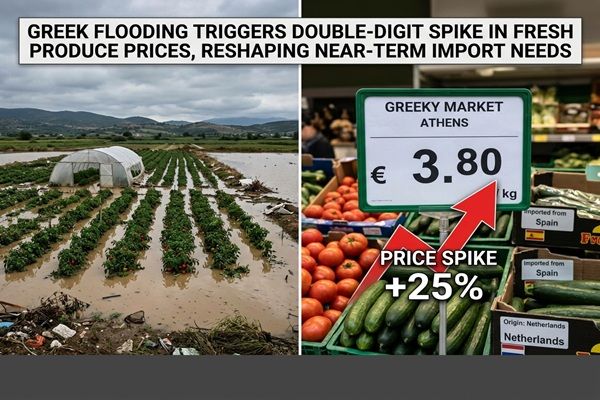
Flood-related supply shocks have driven a sharp 10.45% month-on-month jump in Greek fresh fruit and vegetable retail prices in March 2026, even as headline supermarket inflation edged down 0.15% from February, according to new data from the Institute of Retail Consumer Goods (IELKA). The divergence underscores how localized production and logistics damage are tightening fresh produce availability and lifting prices, while broader grocery categories show early signs of disinflation.
The floods followed a period of prolonged heavy rainfall that inundated key agricultural zones, including the Evros River basin in northeastern Greece, where more than 60,000 hectares of farmland were submerged and winter crops severely damaged. Beyond immediate field losses, disrupted harvest operations, damaged rural roads and delayed market arrivals have reduced volumes at wholesale and retail level, amplifying price pressure in an already weather‑sensitive segment of the food basket.
🌍 Immediate Market Impact
The primary impact is a sharp, short-term tightening of Greek domestic supply for fresh vegetables and fruits, particularly winter and early spring crops. With open‑field production hit by flooding and logistical bottlenecks, supermarkets and traditional markets have faced lower availability and higher procurement costs that are now visible in March retail prices.
At the same time, IELKA’s data show overall supermarket prices up 2.4% year-on-year but down 0.15% month-on-month in March, signalling easing pressure in processed and ambient grocery categories. Fresh produce therefore emerges as the key inflation outlier, and its volatility is likely to translate into heightened price risk for buyers active in Greek and regional fruit and vegetable trade during Q2 2026.
📦 Supply Chain Disruptions
Flooding in February and early March has caused direct crop losses and forced delays or cancellations of harvests in low-lying areas, particularly in northeastern Greece. Inundated fields, damaged access roads, and local infrastructure outages have complicated farm-to-packhouse movements and slowed downstream flows into wholesale markets serving Athens, Thessaloniki and export channels.
With volumes constrained, exporters have limited surplus to allocate abroad, while domestic buyers increasingly turn to import substitution. The timing is sensitive: Greek early-season supply usually helps bridge the gap between winter shortages in northern Europe and the full Mediterranean spring flush, so any shortfall can magnify price volatility across regional spot markets for leafy greens, brassicas and salad crops.
📊 Commodities Potentially Affected
- Leafy vegetables and brassicas (lettuce, cabbage, spinach, broccoli) – Highly exposed to open‑field flooding and transport delays, tightening near‑term supply into Greek retail and regional wholesale hubs.
- Salad crops (tomatoes, cucumbers, peppers, courgettes) – Early field-grown and some protected-crop supply may be disrupted, lifting prices for Class I and II product in domestic and export programs.
- Root and bulb vegetables (onions, carrots, potatoes) – Waterlogging and storage challenges may trim usable output and raise shrink, adding upward pressure on wholesale quotes.
- Citrus and other seasonal fruits – Logistics disruptions and prioritization of domestic markets over export commitments could tighten availability for regional buyers reliant on Greek supply.
- Processed fruit and vegetable products – While less immediately affected, reduced fresh throughput can constrain raw material supply for canners and processors later in the year, potentially nudging contract prices higher.
🌎 Regional Trade Implications
Greece’s role as both a Mediterranean producer and importer of fresh produce means domestic shocks quickly spill into regional trade flows. With weather damage curbing output, Greek retailers are expected to increase short-notice imports from Spain, the Netherlands and other EU suppliers, often at a premium to typical seasonal prices due to tight shipping windows and limited surplus in competing origins.
For exporters elsewhere in the EU, this shift offers incremental demand in the near term, particularly for greenhouse vegetables and counter‑seasonal fruit. However, reduced Greek availability could also limit shipments to Balkan neighbours and selected Middle Eastern buyers traditionally supplied from Greek packers, forcing those markets to re‑source from Italy, Turkey or North Africa and potentially paying higher logistics and quality-adjusted costs.
🧭 Market Outlook
Over the next 30–90 days, fresh produce prices in Greece are likely to remain elevated but gradually normalize as spring harvests accelerate and replanted fields come into production. The pace of relief will depend on how quickly flooded areas can be brought back into commercial use and how effectively supply chains clear backlogs and restore regular shipping patterns.
For the 6–12 month horizon, traders will monitor whether 2026 flooding proves a one-off or part of a trend toward more frequent extremes in Greece and the wider Mediterranean, a region where weather‑driven supply shocks have already been linked to increased fruit and vegetable price volatility. Procurement strategies are likely to tilt further toward geographic diversification, stronger import contracts and enhanced storage to buffer against future localised disruptions.
CMB Market Insight
The March 2026 surge in Greek fresh produce prices illustrates how quickly localized flooding can translate into an acute supply shock for high‑perishability categories, even as broader food inflation eases. For commodity traders, importers and retailers, the episode reinforces the need for flexible sourcing portfolios that can pivot between domestic and regional origins, as well as for risk-management tools that account for increasingly frequent climate‑related disruptions in Mediterranean horticulture.
Strategically, Greece’s growing reliance on short‑term imports during weather events may deepen commercial ties with key EU producing countries and alter seasonal trade patterns, particularly for vegetables and citrus. Participants across the value chain should anticipate intermittent spikes in Greek and regional fresh produce prices, calibrate inventory and contract positions accordingly, and invest in logistics resilience to maintain supply continuity in the face of future flooding episodes.
Related posts:
 Carrefour Spain Emerges as Strategic Export Hub for EU Fresh Produce Supply
 Polish Bakers Pivot to Direct Sourcing as Organic Flour Tightens, Reshaping Local Grain Trade
 Ukraine’s Early Vegetable Import Wave from Turkey and Egypt Intensifies Competition on Domestic Market
 Taiwan’s Food Waste Ban and ASF Recovery Recast Feed Grain Demand, Keep Import Needs Steady
 Lebanon stabilises potato market with short-term imports from Egypt
 EU Tightens Pesticide Residue Regime for Vietnamese Produce, Reshaping Tropical Fruit Trade into Europe
 India Fast-Tracks AI-in-Agriculture Policy Push, Reshaping Smallholder Supply Chains and Price Discovery