
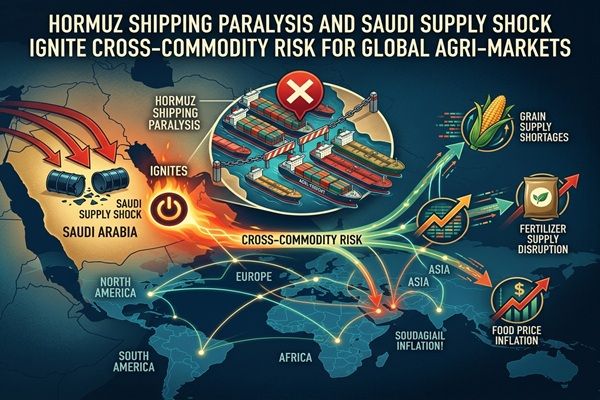
Global agricultural markets are facing a compounded energy and logistics shock as tanker and dry bulk traffic through the Strait of Hormuz remains a fraction of normal levels despite a US–Iran ceasefire, while attacks on Gulf energy infrastructure curb regional production capacity. Crude benchmarks have surged toward the mid‑$90s, elevating fuel, fertiliser and freight costs into Q2 2026 and forcing importers and processors to reassess risk exposure in key food and feed supply chains.
Persistent uncertainty over safe passage, mine risks and Iranian military control of routing has kept most shipowners, insurers and charterers on the sidelines even after Tehran and Washington agreed to a two‑week truce and a conditional reopening of the waterway. Only a handful of vessels have transited Hormuz in recent days, compared with more than 100–150 per day in peacetime, leaving hundreds of tankers and bulk carriers effectively stranded and tightening global shipping capacity for both energy and agricultural commodities.
Introduction
Since late February, Iran’s closure of the Strait of Hormuz in response to US and Israeli airstrikes has largely halted traffic through the 21‑mile‑wide chokepoint, which normally handles roughly a fifth of the world’s seaborne oil and a significant share of liquefied natural gas (LNG) exports. Although a two‑week ceasefire announced earlier this week requires Iran to reopen the strait, passage is now subject to Iranian military supervision and routing, and mine clearance concerns remain.
Data from maritime analytics firms and market intelligence providers show that only a small number of tankers and bulkers have crossed Hormuz since the ceasefire took effect, while hundreds of vessels remain queued or at anchor inside the Gulf. Some estimates suggest around 800 ships are trapped in the region, with a 95% drop in traffic compared with pre‑war norms.
🌍 Immediate Market Impact
The partial paralysis of Hormuz, combined with recent drone and missile attacks on Gulf energy facilities, has driven a sharp rally in crude prices and refined products such as diesel and gasoil. Analysts note that even limited vessel movements are insufficient to normalise flows, keeping a risk premium embedded in oil benchmarks and by extension in agricultural input and freight markets.
Agricultural commodity supply chains are exposed through multiple channels: higher bunker fuel and road diesel costs raise ocean freight and inland logistics rates; constrained LNG exports from Qatar and neighbouring producers increase the cost base for nitrogen fertilisers; and elevated crude supports biofuel margins, underpinning vegetable oil prices. Early indications from Europe and Asia point to rising freight quotations for grains, oilseeds and containerised food products loading in alternative routes outside the Gulf as shipowners reprice risk or redeploy tonnage.
📦 Supply Chain Disruptions
With tanker and bulk carrier transits still far below normal despite the truce, port congestion is intensifying at Gulf terminals as vessels wait for clarity on safe passage and insurance cover. Shipping data cited by multiple outlets highlight that only a handful of ships – in some cases fewer than 10 per day – have crossed Hormuz since the ceasefire, versus more than 100 in typical conditions.
This effective gridlock is removing significant tanker and bulker capacity from the global fleet, tightening availability on other lanes used to move grains, oilseeds, sugar, rice and containerised foodstuffs. Simultaneously, fresh drone strikes on critical facilities in Kuwait and other Gulf states have damaged energy and desalination infrastructure, complicating operations at key industrial and export hubs and creating additional uncertainty over fuel supplies and port services.
For importers in Europe, South Asia and East Africa that rely heavily on Middle Eastern fuels and fertilisers, voyage times and costs are rising as cargoes are rerouted via longer paths or alternative bunkering hubs. Some shippers are already diverting flows through the Red Sea and Mediterranean or via ports in Oman and the western Indian Ocean, adding transit days and elevating working capital needs along the food supply chain.
📊 Commodities Potentially Affected
- Grains (wheat, corn, barley): Higher bunker fuel prices and reduced vessel availability increase Black Sea, European and Australian FOB-to-CIF freight, particularly into MENA and South Asia, potentially widening import parity costs and basis volatility.
- Oilseeds and vegetable oils (soybean, rapeseed, sunflower, palm): Elevated crude supports biodiesel economics, underpinning demand for soybean and rapeseed oil, while freight and risk premiums tighten nearby spreads for sunflower oil into Europe and MENA.
- Sugar: Freight-sensitive raw and white sugar flows from Brazil, India and Thailand into the Middle East and North Africa face higher shipping costs and possible delays, affecting refining margins and regional availability.
- Rice: South Asian exporters shipping to the Gulf and East Africa must contend with increased voyage times and insurance costs, especially for cargoes that would normally bunker or tranship near the Gulf.
- Pulses and edible nuts: Containerised shipments into Gulf markets encounter schedule disruptions, with rerouting through alternative hubs adding cost and elongating supply chains.
- Fertilisers (urea, ammonium nitrate, NPKs): Reduced LNG flows and risk to regional gas infrastructure lift nitrogen production costs globally, while logistical constraints on outbound cargoes from Gulf producers threaten temporary tightness in key importing regions.
🌎 Regional Trade Implications
Middle Eastern importers of grains, oilseeds and food products face the most immediate exposure, as inbound cargoes are delayed and local logistics systems absorb higher fuel costs. At the same time, some Gulf producers of fertilisers and petroleum-linked feedstocks may struggle to maintain regular export programmes, forcing buyers in Europe, South Asia and Latin America to seek alternative origins.
Producers outside the conflict zone may benefit from stronger demand. Black Sea, EU and North American exporters could see increased interest for grains and oilseeds from risk‑averse buyers seeking diversified supply lines, while nitrogen fertiliser exporters in North Africa and North America may capture additional market share if Gulf shipments remain constrained. Freight markets on Atlantic and Pacific routes not involving Hormuz could tighten as charterers bid for available tonnage, particularly in the Handymax and Panamax segments used for agri‑bulk.
🧭 Market Outlook
Over the next 30–90 days, agricultural markets are likely to price a persistent risk premium linked to Hormuz transit uncertainty and further infrastructure attacks in the wider Gulf. Even if negotiations advance, shipping and insurance communities may require weeks or months of incident‑free passage before redeploying vessels at scale, implying prolonged tightness in tanker and bulker availability and structurally higher bunker-linked freight costs.
For the 2026 northern hemisphere planting and input season, sustained disruption to LNG and fuel supplies through Hormuz would transmit directly into nitrogen fertiliser pricing and on‑farm diesel costs, potentially curbing application rates and raising production risk for the 2026/27 grain and oilseed cycle. Market participants will closely track ceasefire implementation, mine clearance assurances, insurer positions on war‑risk cover, and any further strikes on energy and port infrastructure as key drivers of volatility across energy, freight and agri‑commodity curves.
CMB Market Insight
The current Hormuz and Gulf security crisis represents a structural rather than a transient shock to agricultural commodity markets, because it simultaneously affects core inputs (energy and fertiliser), critical shipping capacity and regional demand centres. For traders, importers and processors, the episode underscores the need to price in chokepoint risk more explicitly – via diversified origins and destinations, flexible freight strategies, and closer integration of energy and agri‑hedging.
Until vessel flows through the strait normalise and Gulf energy infrastructure is demonstrably secure, agricultural markets are likely to maintain elevated sensitivity to geopolitical headlines from the region. Strategic positioning around fuel, fertiliser and freight exposures – rather than flat price alone – will be central to managing risk and capturing opportunity in the months ahead.
Related posts:
 Strait of Hormuz Conflict Tightens Gulf Chokepoint as Saudi Rail Corridor Offers Overland Relief
 Iran War and Hormuz Strait Closure Ignite Petrochemical Shockwave for Global Packaging Supply Chains
 Red Sea and Strait of Hormuz Escalation Rekindles Shipping Risk for Food and Feed Trade
 Hormuz Conflict Triggers Energy Shock for India’s Spice and Agri Export Chain
 Hormuz Crisis Deepens as Iran War Hits Gulf Shipping and Food Import Routes