
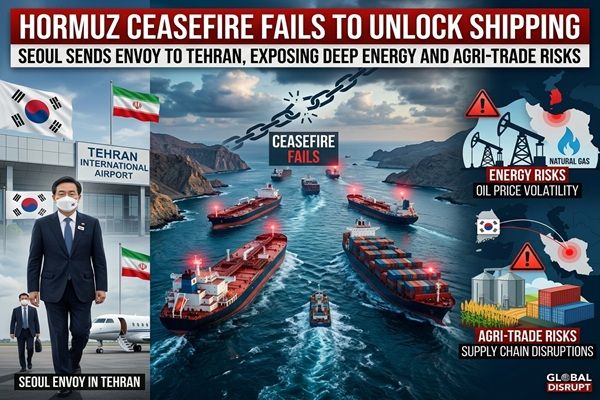
South Korea’s decision to dispatch a special envoy to Iran comes as the Strait of Hormuz remains effectively closed to mainstream commercial traffic despite a two-week ceasefire between Iran and the United States–Israel coalition. Shipping data show only a trickle of vessels using Iran-controlled corridors under tight vetting and proposed tolls, leaving hundreds of tankers and bulk carriers stranded and global supply chains for energy and food commodities under acute strain.
For South Korea, which imports virtually all of its energy needs and sources around 70% of those flows via Hormuz in normal times, the impasse has become a strategic supply crisis. The stranded fleet reportedly includes 26 Korean‑linked vessels, underscoring the exposure of Asian importers not only in oil and LNG but also in bulk food and feed imports moving through Middle Eastern transshipment hubs and Gulf ports. (Internal trade structure based on industry data; shipping context from recent reports.)
Introduction
The U.S.–Iran ceasefire announced on 8 April 2026 was conditioned on the reopening of the Strait of Hormuz, the world’s most critical chokepoint for seaborne oil and a key route for LNG and dry bulk shipments. In practice, however, Iran has maintained tight control over transit, demanding the right to levy substantial tolls and requiring advance approval for ships to pass, which has deterred most international operators.
Against this backdrop, Seoul is sending a high-level envoy to Tehran to seek safe passage for Korean vessels stuck in or near the Gulf. The move parallels stepped-up engagement by other Asian importers, notably Japan, and highlights how the military and political crisis in the Gulf is translating into commercial risk across energy, petrochemicals and agricultural commodity supply chains.
🌍 Immediate Market Impact
Despite formal language about reopening Hormuz, ship-tracking firms report that traffic volumes remain a fraction of normal levels, with only a handful of tankers and cargo vessels — largely Iran-linked or from politically aligned states — attempting the new coastal corridors. Mainstream liner and tanker operators continue to hold back, citing unresolved security, insurance and legal uncertainties around IRGC oversight and toll payments.
This de facto closure keeps upward pressure on crude benchmarks, freight rates and risk premia across Gulf‑origin cargoes. For agricultural commodities, the immediate impact is seen in extended voyage times, high rerouting costs via the Cape of Good Hope for shipments that would normally combine Red Sea and Hormuz legs, and localized tightness in regions dependent on Gulf transshipment — including North and East Asia.
📦 Supply Chain Disruptions
Industry estimates suggest around 1,000 commercial vessels — including more than 400 tankers and dozens of LPG and LNG carriers — remain clustered in and around the Gulf, waiting for clear, insurable passage. Backlogs are especially acute for energy cargoes, but they also affect dry bulkers carrying grains, oilseeds and sugar either into the Middle East or on east–west legs that typically cross Hormuz.
Key Gulf load ports for oil, gas and some grain and feed shipments are effectively operating under constrained export capacity because available berths and storage are tied up by vessels that cannot exit. Port congestion and high war-risk premiums ripple through to charter markets, particularly for VLCCs, LR tankers and Panamax/Handymax bulkers, tightening available tonnage globally.
South Korean refiners and utilities face mounting risks of feedstock shortfalls and elevated replacement costs, while food importers must contend with delayed arrivals and expensive rerouting, especially for cargoes sourced from or transshipped via Gulf terminals. Similar dynamics are emerging in Japan and other East Asian markets with high Middle East dependence.
📊 Commodities Potentially Affected
- Crude oil: Hormuz normally handles about one-fifth of global seaborne oil; restricted flows and Iran’s proposed tolls are sustaining higher flat prices and volatility, with Asian refiners particularly exposed.
- LNG and LPG: Limited movements of gas carriers through the strait constrain Qatari and other Gulf exports, pressuring spot LNG prices in North Asia and widening regional spreads.
- Grains (wheat, corn, barley): Disruptions at Gulf transshipment hubs and on east–west routes increase freight costs and transit times, affecting import economics for Asian buyers like South Korea and Japan.
- Oilseeds and meals (soybeans, rapeseed, soymeal): Longer, riskier routes and higher bunker costs raise delivered prices into Asian feed markets, with potential rationing effects in sensitive demand segments.
- Sugar and edible oils: Many sugar and veg‑oil cargoes use mixed routes that intersect Gulf or Red Sea risk zones; war-risk premia and rerouting add to already elevated freight components.
- Petrochemical feedstocks and fertilizers: Disruptions to NGLs, ammonia and urea exports from Gulf producers tighten availability and complicate procurement for Asian and European buyers.
🌎 Regional Trade Implications
Asian importers are accelerating diversification away from single‑route dependence on Hormuz. South Korea and Japan are leaning on Atlantic Basin crude, LNG from the U.S. and Africa, and alternative grain origins via Pacific routes, even at the cost of higher freight and potential basis volatility.
For agricultural exporters in Europe, the Black Sea, and the Americas, the disruption creates both opportunities and challenges. On one hand, demand from Asian buyers could tilt toward origins that can load outside the Gulf and route via safer passages; on the other, longer voyages and tight vessel supply will keep delivered costs elevated and complicate sales programs.
Middle Eastern importers of food staples, many of whom rely on backhaul dry bulk capacity and intra‑Gulf logistics, face higher landed prices and intermittent supply as shipowners reprice or withdraw tonnage. Countries seen as closer to Iran politically may secure preferential transit, but at the risk of higher compliance and sanctions exposure for trade counterparties.
🧭 Market Outlook
In the next 30–90 days, the key variables for commodity markets will be whether Iran’s vetting and toll regime is softened under diplomatic pressure, and whether major insurers restore cover for transits under any new framework. Until then, energy and agri‑bulk flows through Hormuz are likely to remain heavily restricted, preserving a tight freight market and supporting risk premia across oil, gas and selected softs.
Over a 6–12 month horizon, the crisis is likely to accelerate structural diversification in trade flows: more long‑haul crude and LNG from the Americas to Asia, greater emphasis on Pacific and Atlantic agri‑routes that bypass Gulf risks, and sustained investment in storage and strategic reserves by import-dependent states. For traders, this implies persistently higher volatility in freight and basis, wider inter‑regional spreads, and more complex routing and compliance considerations.
CMB Market Insight
The stalled reopening of the Strait of Hormuz, combined with South Korea’s urgent diplomatic outreach to Tehran, underscores that the current crisis is as much a logistics and insurance shock as it is a geopolitical one. For agricultural and energy market participants, the central takeaway is that chokepoint risk is now being actively priced into freight, basis and optionality structures — and may remain embedded well beyond the current truce window.
Strategically, traders, importers and exporters should treat Hormuz exposure as a long‑term portfolio risk, adjusting contract terms, origin mixes and routing options accordingly. The envoy missions from Seoul and Tokyo may yield incremental relief for specific cargoes, but the broader re‑rating of Gulf transit risk is likely to endure, reshaping global commodity flows for seasons to come.
Related posts:
 Hormuz Shipping Paralysis and Saudi Supply Shock Ignite Cross-Commodity Risk for Global Agri-Markets
 Pakistan–UAE Fast-Track Energy and Food Trade Amid Hormuz Shipping Crisis
 Hormuz Conflict Triggers Energy Shock for India’s Spice and Agri Export Chain
 Hormuz Crisis Deepens as Iran War Hits Gulf Shipping and Food Import Routes