
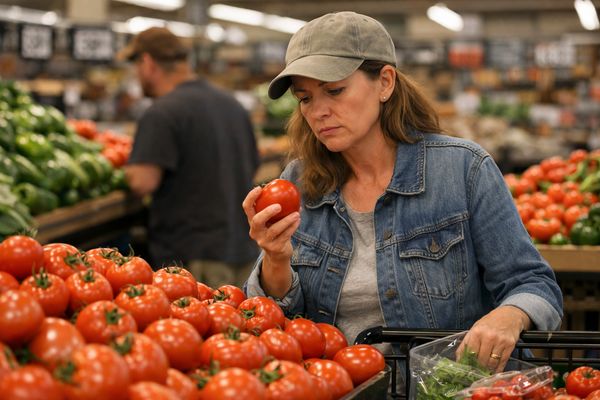
U.S. fresh tomato prices are moving higher as a 17% duty on Mexican imports, elevated diesel costs and fertiliser risks combine to push up supply chain costs, particularly for Roma tomatoes. With Mexico still covering roughly two-thirds of U.S. fresh tomato demand, the new tariff regime and fuel shock are feeding directly into higher retail prices and limiting prospects for near-term relief.
The market is now facing a layered cost structure: tariffs at the border, minimum export prices in Mexico, record-high diesel across key corridors, and rising nitrogen fertiliser costs driven by Strait of Hormuz disruptions. Roma tomatoes already trade above last year’s levels, while buyers increasingly turn to canned products and alternative fresh tomato types to manage budgets. Domestic U.S. supply offers only partial relief, as California’s fresh market volume and high in-state diesel prices constrain its ability to offset more expensive Mexican imports.
📈 Prices & Trade Structure
Roma tomatoes are currently assessed around USD 2.75 per pound nationally and about USD 2.49 per pound in Los Angeles, both above prior-year levels. Converted into euros per kilogram, this implies approximate retail benchmarks of:
| Market | Indicative Roma Price (EUR/kg) |
|---|---|
| U.S. national average | ~EUR 5.60/kg |
| Los Angeles | ~EUR 5.10/kg |
The increase is being driven less by sudden demand growth and more by structural cost additions. The withdrawal from the 2019 Tomato Suspension Agreement in July replaced a managed trade framework with a straightforward duty of roughly 17% on most Mexican fresh tomato imports. This duty applies to an import flow valued at around USD 3 billion annually, covering roughly two-thirds of U.S. fresh tomato consumption, making the change systemically important for price formation.
🌍 Supply, Demand & Policy Shocks
On the policy side, the end of the Suspension Agreement removes negotiated price floors and disciplines and replaces them with a uniform tariff that increases the cost of every box entering via border points such as Nogales and Laredo. In parallel, Mexico has introduced minimum export prices, adding origin-side cost before the U.S. duty is even applied. Industry projections suggest that, if fully passed through, retail prices for affected Mexican tomato categories could rise by up to 52%, although more conservative estimates cluster in the 7–10% range.
On the demand side, U.S. tomato consumption remains relatively stable, but purchasing behaviour is adjusting at the margin. Some retailers and foodservice operators are selectively downgrading or promoting alternative lines, while consumers show early signs of shifting part of their tomato usage from fresh Roma to processed formats and smaller tomato types. Nonetheless, given the structural reliance on Mexican supply, aggregate demand cannot easily pivot away from imported fresh product in the short run.
⛽ Energy & Fertiliser: Cost Stack Intensifies
Energy is amplifying the tariff shock. Diesel prices have climbed to a national average slightly above USD 5.64 per gallon (roughly EUR 5.20 per gallon), with California — a central hub for receiving and distributing Mexican fresh produce — seeing prices above USD 7.50 per gallon. Tomato logistics are especially fuel-intensive: refrigerated trucks run on fixed schedules, and loads cannot easily be consolidated or delayed without compromising product quality.
This means higher diesel costs pass almost one-to-one into higher delivered costs, with limited ability for growers, shippers, or distributors to absorb them. Economists indicate that margins across the chain are too thin to fully internalise these increases, forcing a pass-through into retail prices. For buyers, the result is a structurally higher landed cost base for imported fresh tomatoes, particularly into high-fuel-cost distribution hubs on the U.S. West Coast.
Beyond transport, the Iran conflict is feeding through to fertiliser via the energy channel. Around one-fifth of global liquefied natural gas supply transits the Strait of Hormuz; disruptions there tighten gas markets, pushing up input costs for nitrogen fertiliser — the main nutrient input for commercial tomato production. If these disruptions persist, they risk not only lifting current-season costs but also inflating budgets for the next 6–12 months of plantings, embedding a higher cost base into future supply.
🍅 Buyer Responses & Substitution
Market participants are responding with a combination of product and origin diversification:
- Shift to processed tomatoes: Canned and processed tomato products, largely sourced from domestic California production under longer-term contracts, currently offer comparatively more price stability versus fresh imports.
- Product substitution: Grape and cherry tomatoes, which draw on a broader mix of domestic and international origins, are being tested as partial substitutes for Roma tomatoes in both retail and foodservice channels.
- Domestic seasonal supply: California’s field tomato season provides some additional fresh availability, but the state is structurally oriented toward processing, limiting the volume that can realistically backfill lost or more expensive Mexican fresh imports.
California’s elevated diesel prices further erode its competitiveness as a fresh market alternative, as in-state distribution costs can exceed those attached to imports routed through lower-fuel-cost corridors. This constrains the ability of domestic supply to cap price rises, particularly during periods when Mexican volumes are seasonally dominant.
🇪🇺 European Market Angle
For European market stakeholders, the U.S. tomato situation is relevant via trade diversion and shared input risks. If U.S. access becomes less commercially attractive for Mexican exporters due to tariffs and logistics costs, some export capacity could be reoriented toward Europe. This would stiffen competition for established suppliers in Spain, Morocco and the Netherlands in key supermarket programmes and wholesale channels.
At the same time, the fertiliser risk emanating from Strait of Hormuz disruptions is global. European fresh tomato producers, from southern Spain to the Netherlands and North African suppliers into the EU market, face similar exposure to higher nitrogen costs. The U.S. experience — where tariffs, fuel and fertiliser pressures arrive simultaneously — offers a live case study in how geopolitical shocks can cascade into consumer prices for perishable produce.
📆 Market Outlook
In the near term (next 30–90 days), U.S. fresh tomato prices are unlikely to soften meaningfully. The 17% tariff structure remains in force, Mexican minimum export prices create an origin-side floor, diesel shows no clear path to rapid normalisation, and California’s fresh market supply is not yet at peak volume. Together, these factors point to sustained firmness in Roma tomato prices and continued tightness in landed costs for retailers and foodservice buyers.
Over the medium term (6–12 months), three variables will shape direction:
- Any adjustment, renegotiation or partial rollback of U.S. tariffs on Mexican fresh tomatoes.
- Resolution or easing of the Iran conflict and a normalisation of shipping routes that could relieve diesel and fertiliser cost pressure.
- Domestic supply response, particularly acreage and yield expansion in Florida and California for both fresh and processing markets.
Given the entrenched U.S. reliance on Mexican imports for roughly two-thirds of fresh tomato consumption, substantial and broad-based price relief appears unlikely without either a material policy shift on tariffs or a rapid, large-scale expansion of domestic production capacity — scenarios that are difficult to realise within the current growing season.
📊 Trading & Procurement Outlook
- Retailers & foodservice buyers: Plan for elevated Roma tomato costs through at least the next quarter. Consider rebalancing assortments toward processed products and alternative fresh tomato types to manage basket pricing.
- Importers & distributors: Reassess contract structures to accommodate tariff and diesel volatility, including fuel surcharges and shorter pricing windows where possible.
- European buyers: Monitor Mexican offer levels and volume availability closely; potential trade diversion into Europe could pressure local producers but may also open tactical buying opportunities if competition increases.
📍 3-Day Directional Price Indication (EUR)
- U.S. national Roma benchmark: Stable to slightly firmer in EUR terms as tariffs and diesel keep the cost base elevated.
- U.S. West Coast (Los Angeles): Firm bias; high regional diesel costs continue to support a premium over the national average.
- U.S. East Coast hubs: Stable with mild upside risk, reflecting the same tariff and fuel dynamics but slightly lower transport cost pressure than California-linked flows.
Related posts:
 Russia Courts South Asian Buyers With Discounted Sanctioned LNG Amid Hormuz Crisis
 Basmati Rice Squeeze in India Tightens Global Premium Rice Market
 War-Driven Supply Squeeze Sends Indian Basmati Rice Prices Sharply Higher
 Ukraine Wheat Market Steady but Tight as Sowing Costs Rise
 Chinese Buckwheat Prices Edge Mixed as Freight Squeeze Meets Firm Demand
 Indian Basmati Rice Tightens Sharply as Flood Losses Squeeze Supply
 Middle East War and Hormuz Blockade Send Fertilizer Costs Soaring, Polish Farm Margins Squeezed