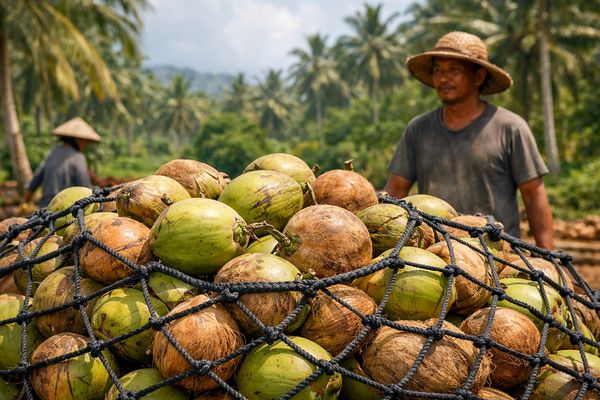
Coconut desiccated and flakes prices are holding steady in early April, with no immediate supply shock priced in. Markets are watching weather signals in Indonesia and broader demand for tropical oils, but current spot offers suggest a sideways bias over the next few days rather than a sharp move.
Global desiccated coconut trade flows remain dominated by the Philippines, Indonesia and Vietnam, and recent export and price data point to generally adequate supply. European buyers see stable FCA levels for both conventional and organic Philippine material, while Indonesian desiccated offers are flat and competitive. In the short term, attention is turning to changing rainfall patterns in Indonesia and the emerging El Niño risk for the second half of 2026, which could tighten medium‑term supply but are not yet disrupting physical flows. Demand from food and confectionery users in Europe appears steady, supporting a narrow trading range.
Exclusive Offers on CMBroker

Coconut dried
flakes
FOB 4.65 €/kg
(from VN)

Coconut dried
flakes
FCA 3.10 €/kg
(from NL)

Coconut dried
flakes
FCA 2.70 €/kg
(from NL)
📈 Prices & Spreads
All prices approximate, expressed in EUR/mt.
| Product | Origin | Location / Term | Latest price (EUR/mt) | WoW change |
|---|---|---|---|---|
| Coconut dried, flakes (conventional) | Vietnam | Hanoi, FOB | ≈ 4,350 | Stable |
| Coconut dried, flakes (organic) | Philippines | Dordrecht, FCA | ≈ 2,900 | Stable |
| Coconut dried, flakes (conventional) | Philippines | Dordrecht, FCA | ≈ 2,525 | Stable |
| Desiccated coconut, standard | Indonesia | Dordrecht, FCA | ≈ 1,870 | Stable |
| Desiccated coconut, medium grade | Indonesia | Dordrecht, FCA | ≈ 1,820 | Stable |
Week‑on‑week, all listed quotations in Europe and Vietnam are unchanged, reflecting balanced short‑term supply and demand. This stability contrasts with recent volatility in related coconut oil markets, where prices have softened on weaker demand earlier in 2026.
🌍 Supply & Demand Snapshot (ID, PH, VN)
Indonesia (ID)
- Indonesia is a key supplier of desiccated coconut into Europe and intra‑Asian trade; current export logistics are normal with no major port disruptions reported in early April.
- The Indonesian meteorological agency (BMKG) highlights a transition period with locally heavy rains from 10–16 April 2026 across many islands, but also warns about an emerging El Niño pattern and elevated hotspot counts, signalling drier‑than‑normal risks later in 2026.
- For now, these are medium‑term concerns: harvest and processing for desiccated coconut are proceeding, and no immediate supply cuts are visible at origin.
Philippines (PH)
- The Philippines remains the largest global desiccated coconut exporter, with strong positions in Europe, including the Netherlands as a key hub.
- Recent industry and government reports point to generally improving medium‑term production prospects thanks to replanting programmes and investment, though these are longer‑dated and do not affect current April supply.
- There are no fresh reports of typhoon damage or acute weather stress on the main coconut‑growing regions in the first days of April 2026, and export channels to Europe are functioning normally.
Vietnam (VN)
- Vietnam is expanding its coconut product exports, using both domestic production and imported nuts for processing and re‑export.
- Trade data for early 2026 show broader softness in some Vietnamese export categories (e.g. plastics, fruits and vegetables), reflecting weaker global demand, but there is no specific sign of disruption in coconut shipments.
- Stable FOB prices for coconut flakes from Hanoi indicate processors are able to source raw nuts without major cost shocks and that buyers are accepting current levels.
🌦️ Weather Watch for Key Growing Regions
- Indonesia (Sulawesi, Java, Sumatra, eastern islands): BMKG forecasts patchy to heavy rainfall during 10–16 April, typical of the seasonal transition, which can briefly hamper on‑farm access and drying but also replenishes soil moisture for coconut palms.
- El Niño risk (2H 2026): BMKG has warned about the potential development of El Niño in the second half of 2026, which historically brings reduced rainfall and drought risk in parts of Indonesia. If confirmed, this could tighten Indonesian coconut supplies later, but has no immediate impact on April output.
- Philippines & Vietnam: No significant new tropical cyclones or severe weather systems affecting coconut belts have been reported in the first 10 days of April 2026. Normal seasonal conditions imply neutral short‑term production risk.
📊 Fundamentals & Market Sentiment
- International market reviews show that desiccated coconut prices strengthened through 2024 on robust global demand and tighter supply, especially from Asian origins. Current flat prices suggest that this earlier rally has paused, with the market now consolidating.
- Coconut oil benchmarks, which often move in tandem with kernel products, eased in Q1 2026 due to weaker demand from food and personal‑care sectors. This reduces immediate upside pressure on desiccated prices but also limits downside because processors can switch between oil and desiccated depending on margins.
- Europe continues to be a key demand centre, with Switzerland and the Netherlands among important importers; import data confirm a strong role for the Philippines and Indonesia as suppliers. This underpins stable European FCA indications for both Philippine flakes and Indonesian desiccated grades.
📆 Short‑Term Outlook (3 Days)
- Indonesia (ID) – Desiccated, FCA Europe: With no fresh supply shock and only localized heavy rains at origin, prices are likely to remain in a narrow, sideways band around current levels over the next three trading days.
- Philippines (PH) – Flakes (organic & conventional), FCA Europe: Export flows to Europe are regular, and buyers have already covered nearby needs; offers should remain stable, with only minor adjustments driven by freight or FX.
- Vietnam (VN) – Flakes, FOB Hanoi: Stable raw nut availability and soft global demand in some food categories point to unchanged FOB quotes in the immediate term.
🎯 Trading Recommendations
- Buyers (food & confectionery manufacturers): Use the current stability to secure near‑term coverage at flat prices, but avoid over‑extending coverage far into 2H 2026 until El Niño risks for Indonesia become clearer.
- Origin sellers (ID, PH, VN): Maintain offer discipline; with coconut oil values off recent highs but not collapsing, there is limited justification for price cuts as long as demand from Europe holds steady.
- Traders: Monitor Indonesian weather updates and any early confirmation of El Niño conditions; these could provide a catalyst for firmer forward values and justify building modest optionality in Q4 2026 positions.
Over the next three days, desiccated and flakes coconut prices from Indonesia, the Philippines and Vietnam are expected to remain broadly stable in EUR terms at European and FOB Asian benchmarks, with no significant directional breakout anticipated.