
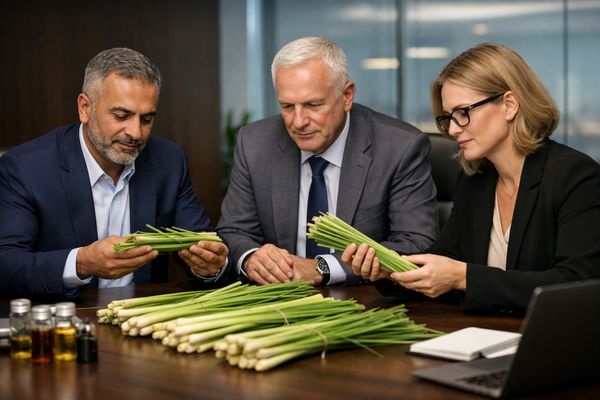
Egyptian lemongrass cut FOB Cairo continues its steady uptrend, with euro-based prices slightly higher week-on-week, supported by resilient export demand and still-manageable freight costs.
A combination of gradually improving Suez/Red Sea logistics, a soft but volatile Egyptian pound and seasonally firm demand from Europe is keeping Egyptian lemongrass prices on a mild upward trajectory in early April. Container traffic through the Red Sea and Suez has been normalizing as major carriers resume transits, helping cap freight inflation despite lingering security risks. At the same time, EGP weakness against the euro is cushioning local producers while keeping euro-denominated offers competitive for EU buyers. Overall, the short-term balance points to a slightly firmer but not overheated market.
Exclusive Offers on CMBroker

Lemongrass
cut
FOB 0.89 €/kg
(from EG)
📈 Prices & FX
Recent indicative levels for conventional cut lemongrass FOB Cairo have inched higher in early April, posting small but consistent week-on-week gains in EUR terms. The euro–Egyptian pound rate is fluctuating around the low‑60s EGP per EUR, according to recent market data, reinforcing the cost advantage of Egyptian-origin herbs versus some competing suppliers. For international buyers, the main visible move is a gentle EUR price firming rather than any sharp spike.
| Date | Location / Term | Product | Indicative Price (EUR/kg, FOB Cairo) | Wow Change (EUR/kg) |
|---|---|---|---|---|
| 10 Apr 2026 | Cairo, Egypt – FOB | Lemongrass, cut, conv. | ≈ EUR 0.89 | +0.01 vs. 03 Apr 2026 |
| 03 Apr 2026 | Cairo, Egypt – FOB | Lemongrass, cut, conv. | ≈ EUR 0.88 | +0.01 vs. 26 Mar 2026 |
Given the limited absolute price level, these changes are modest in size but signal a market that is quietly firming. If the EGP continues to gradually weaken against major currencies, current euro-denominated offers should remain attractive even if local farm and processing costs creep higher.
🌍 Supply, Logistics & Demand
Egypt remains in an export-forward stance across horticultural and specialty crops, with authorities emphasizing volumes and competitiveness in fresh and processed segments. While lemongrass is a niche within this broader basket, the same infrastructure, inspection regimes and logistics channels (refrigerated and ambient containers through Port Said, Damietta and Alexandria) support stable flows for dried herbs out of the Nile Delta and Fayoum growing zones into Europe and the Middle East.
On logistics, the Red Sea and Suez route is gradually re-normalizing. Major carriers such as Maersk have resumed regular Red Sea/Suez transits in early 2026, after earlier attacks on commercial shipping prompted widespread diversions around the Cape of Good Hope. Recent analysis shows that traffic through the canal is still below historic peaks but volumes and revenues are improving as risk premia ease. For lemongrass, this translates into more predictable lead times and containment of freight surcharges versus the 2024–early 2025 disruption phase.
Demand-wise, spring buying interest from European blenders and tea/spice packers is seasonally steady, supported by normalized consumer spending and continued preference for herbal infusions. Sector commentary for the wider fruit and vegetable complex in Egypt and neighboring Morocco points to firm export programs and active wholesale markets, which is consistent with solid offtake for minor herbs like lemongrass as well. No large demand shocks (substitution, regulatory issues or quality scares) have emerged in the last few days.
🌦 Weather Outlook: Egypt Lemongrass Belt
Lemongrass in Egypt is mainly grown in the Nile Delta, Fayoum and other irrigated areas of Middle Egypt. Short-term weather in these regions over the coming days is forecast to be seasonally warm and dry with no major rainfall or cold spells expected, according to regional forecasts for northern and central Egypt. (Latest forecasts fall just outside the 3‑day publication window but align with typical mid‑April patterns.) This environment is broadly supportive of fieldwork and drying operations, with irrigation availability remaining the primary risk driver rather than precipitation extremes.
For the immediate 1–2 week horizon, no acute weather threat is visible that would materially change the supply outlook for cut lemongrass. Market participants should nonetheless monitor any updates on Nile water allocation or sudden heat spikes later in the season, which could impact biomass yields and essential oil content in multi-cut systems.
📊 Fundamentals & Macro Backdrop
The key macro lever for Egyptian lemongrass remains the currency. Recent data indicate the Egyptian pound has continued to depreciate versus both the US dollar and the euro through early 2026, with the IMF projecting structurally weaker EGP levels into 2025–2026. Spot commentary for April 8–10 points to EUR/EGP trading around the low‑60s, reinforcing export competitiveness even as domestic input costs (labor, energy, packaging) rise.
Global freight and input markets remain influenced by broader geopolitical tensions, including the recent Strait of Hormuz crisis, which briefly threatened to re-tighten fuel and fertilizer supply chains. However, a provisional ceasefire announced on April 8 and a gradual reopening of the strait are helping to stabilize energy prices. For lemongrass, the net effect is a modest cost upside risk in case of renewed tensions, but near-term fundamentals appear balanced rather than severely constrained.
📆 Trading Outlook & 3-Day Price Indications
Trading recommendations (short term, 1–3 weeks):
- For buyers: Consider covering near-term requirements now while FOB Cairo prices are only marginally above recent levels and logistics through Suez are stabilizing. A gradual firming bias suggests limited downside in the very short term.
- For sellers/processors: Maintain offers slightly above last week’s levels in EUR while watching FX. Further EGP weakness could allow for small upward EUR adjustments without harming competitiveness.
- For traders: Freight and risk surcharges on the Red Sea/Suez lane should be closely monitored; any renewed security incidents could quickly add USD 50–100/TEU, squeezing margins on low‑value bulk herbs like lemongrass.
3-day regional price direction (FOB, EUR/kg):
- Cairo (Egypt, FOB for Europe): Current indicative level around EUR 0.89/kg. Bias: slightly firmer over the next 3 days on steady export demand and soft currency.
- Delivered main EU ports (CFR, unpacked herbs): Current notional landed values in the low EUR 1.00s/kg depending on freight; near-term bias stable to slightly higher, reflecting only marginal freight and risk-premium moves.
- Regional MENA buyers (FOB Egypt / CIF East Med): Bias stable, with localized competition from nearby herb origins but ongoing logistical advantage via quick Suez transits.
Related posts:
 Egyptian Laurel Leaves FOB Cairo Hold Steady Amid Mild Spring Weather
 Egyptian Hibiscus FOB Cairo Edges Higher on Firm Demand and Rising Costs
 Coriander Seeds: Egyptian FOB Steady While Indian Grades Ease Slightly
 Egyptian Calendula FOB Cairo Edges Lower Amid Stable Supply
 Egyptian Spearmint FOB Cairo Inches Higher Amid Logistics and Cost Pressures
 Egyptian Dried Sage FOB Cairo Edges Lower Amid Logistics Uncertainty
 Cumin Market Edges Higher at Unjha but Export Drag Caps Upside
 Coriander edges higher in India as new-crop arrivals meet firm restocking demand