
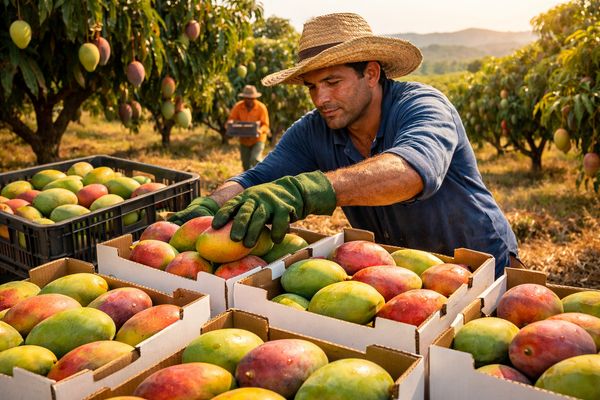
Dried mango prices from Vietnam and Thailand are holding broadly steady in early April, with only marginal week‑on‑week moves, as exporters balance strong raw‑mango availability against strengthening heat stress in key growing areas. The immediate price outlook over the next three days remains side‑ways to slightly firm in EUR terms, with no acute supply disruption yet visible.
Physical mango supply in Thailand and Vietnam is seasonally abundant, supported by peak harvest in Thailand and active orchards in Vietnam’s southern and central provinces. At the same time, a pronounced heatwave over both countries is increasing concerns over fruit size and quality if dryness persists into late April, which could gradually underpin dried‑product prices into Q2. For now, export pipelines and trade flows remain functional, but buyers should be alert to potential tightening of high‑quality grades.
Exclusive Offers on CMBroker

Mango dried
slices: 5 – 9 cm. Chunks: : 2 – 3 cm. Thickness: 2 mm. – 15 mm
FOB 5.83 €/kg
(from VN)

Mango dried
chunks: : 2 – 3 cm. Thickness: 2 mm. – 15 mm MOISTURE 13 – 19 %
FOB 5.63 €/kg
(from VN)

Mango dried
normal sugar, 8-10 mm
FCA 4.53 €/kg
(from NL)
📈 Prices & Short-Term Moves
Based on the latest offers (10 April 2026), benchmark dried mango prices convert approximately as follows:
| Product | Origin | Location / Term | Latest Price (EUR/kg) | 1-week Change |
|---|---|---|---|---|
| Dried mango slices & chunks, conventional | Vietnam | FOB Hanoi | ≈ 5.83 | Flat vs 3 April |
| Dried mango chunks, moisture 13–19% | Vietnam | FOB Hanoi | ≈ 5.63 | Flat vs 3 April |
| Dried mango, normal sugar 8–10 mm | Thailand | FCA NL (ex‑warehouse) | ≈ 4.53 | Flat vs 3 April |
Prices in both origins have moved very little over the past four weeks, reflecting a balanced market where increased fresh‑mango availability is offset by cautious international demand and comfortable destination stocks. Thai origin remains competitively priced versus Vietnam, in line with broader strength in Thailand’s fruit export sector, where fresh and dried fruit shipments posted strong year‑on‑year gains in early 2026.
🌍 Supply & Demand Context (TH, VN)
Thailand
March–April is the peak mango production season in Thailand, and 2026 is no exception, with local sources confirming abundant mango supply and even surplus fruit in some regions. A mango festival in Chachoengsao from 3–12 April is being used to support farmers amid pressure from cheaper Cambodian imports, highlighting strong fresh‑mango availability and some downward pressure on domestic farm‑gate prices.
The Department of Internal Trade also reports plentiful fruit supplies nationwide this season, with mango yields described as abundant and roughly half of the crop already harvested by early April. This ample raw material base underpins stable dried‑mango processing volumes and helps explain the lack of upward price pressure in export offers so far.
Vietnam
In Vietnam, key mango regions such as the Mekong Delta (including Cao Lanh mango areas in Dong Thap) are in their productive dry‑season window, typically favorable for fruit quality. Recent trade data show that Vietnam’s overall fruit and vegetable exports and imports fell sharply month‑on‑month in February 2026, suggesting a more cautious external demand environment rather than a supply crunch.
Domestic reports from the Mekong Delta note solid price performance for premium fruits such as Hoa Loc mangoes, indicating healthy internal demand and robust orchard economics. For dried‑mango exporters, this combination of steady raw‑fruit economics and softer export growth encourages stable FOB offers with limited discounting.
📊 Weather & Fundamental Risks
Thailand: Hot to Very Hot, Limited Rain
The Thai Meteorological Department forecasts hot to very hot weather with limited rainfall and daytime haze across Thailand from 9–14 April 2026, with maximum temperatures of 36–42°C in many regions. This aligns with a broader summer pattern that began in late February and is currently driving high evapotranspiration and moisture stress across multiple fruit crops.
While mature mango trees tolerate heat reasonably well, prolonged high temperatures with weak rainfall during fruit fill could reduce fruit size and increase spoilage risk, especially in non‑irrigated orchards. If the current hot, dry pattern extends into late April without compensating showers, processors may see a moderate tightening in supplies of export‑grade fruit later in the season, which would be mildly bullish for dried‑mango prices.
Vietnam: Spreading Heatwave into the South
Vietnam is also entering a significant heatwave. In the north‑central province of Nghe An, temperatures around 11 April are reported near 40–42°C, with intense heat forecast to persist. The same outlook calls for widespread hot conditions in the Central Highlands and Southern Vietnam, including key fruit zones, with maximums around 35–37°C from 9–14 April.
For mango orchards in the Mekong Delta and southeastern provinces, this pattern matches the typical dry season but with above‑average heat. Short term, this supports high sugar content and good drying characteristics for fruit already in the harvest pipeline. However, if high temperatures are sustained into May without adequate irrigation, stress on later‑setting fruit could trim medium‑term supply, again skewing the risk balance slightly to firmer dried‑mango prices.
📆 Price Outlook (Next 3 Days)
Given current fundamentals and meteorological forecasts, the dried‑mango market in both Thailand and Vietnam is likely to remain stable through the next three days (11–14 April 2026):
- Vietnam dried mango, FOB Hanoi (conventional slices/chunks): sideways; offers expected to hold near EUR 5.8–5.9/kg as exporters see no immediate change in raw‑fruit availability or logistics.
- Thailand dried mango, FCA ex‑EU warehouse (normal sugar): sideways to marginally firm; abundant Thai fruit but strong promotional activity in regional fresh markets and heat‑related quality concerns may limit downside below roughly EUR 4.5/kg.
No acute disruptions to trade flows or logistics are reported in either origin for the coming days, and broader Thai fruit exports remain robust, suggesting that current price levels are well‑anchored in the very short term.
🧭 Trading Outlook & Strategy
- Buyers (importers, packers): Consider covering near‑term requirements at current levels, as the balance of risk from the ongoing heatwave in both Thailand and Vietnam tilts slightly to the upside for Q2, particularly for higher‑spec grades.
- Origin exporters (TH, VN): With raw‑fruit supply currently ample, maintaining offer discipline and focusing on quality differentiation is advisable; aggressive discounting is not warranted unless export orders weaken further.
- Traders: The flat forward curve and weather‑related upside risk suggest favoring long bias in premium dried‑mango segments, hedged with diversified tropical‑fruit exposure to manage demand volatility.
Over the next three days, the most probable scenario is a continuation of current EUR‑denominated prices with a mild upward bias if buyers step in ahead of potential weather‑driven quality issues later in the season.
Related posts:
 Dried Pineapple Prices Soften Slightly as Thai Heatwave Meets Stable VN Supply
 Severe Mango Crop Losses in South India Tighten Global Mango Pulp Supply Outlook
 Vietnam Dried Passion Fruit Prices Flat as Heatwave Builds Weather Risk
 Vietnam Red Dragon Dried FOB: Prices Hold Firm as Export Demand Softens
 Vietnam Dried Passion Fruit FOB Hanoi: Prices Hold Steady Amid Softer Export Mood
 Stable Vietnamese Dried Pineapple Prices as Thai Offers Ease in EU
 Vietnam Dried Jackfruit Slices Hold Firm as Fruit Exports Slow
 Vietnam Dried Guava Prices Hold Steady as Fruit Exports Slump