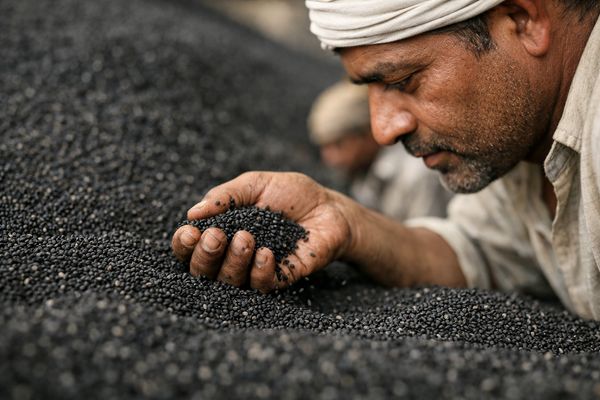
Nigella seed prices are holding firm to slightly softer on FOB basis, with Egypt easing marginally while India remains under upward pressure due to weather-hit supply and active pre‑summer stock‑building. The market tone is broadly supported, and recent gains in Delhi spot trade suggest limited downside for export offers in the very near term.
Nigella has shifted into a tighter, more price‑sensitive phase. In India, weather‑related yield losses and the tail‑end of rabi arrivals are colliding with renewed demand from food, bakery, and health segments, lifting wholesale prices and reinforcing a firm floor for export quotes. At the same time, Egypt is leveraging competitive export pricing across several agro products, helping it act as a flexible balancing origin into regional markets. Currency dynamics and freight costs remain secondary, with physical availability and quality differentials now driving most of the short‑term price action.
Exclusive Offers on CMBroker

Nigella seeds
Sortex
99.5%
FOB 2.20 €/kg
(from EG)

Nigella seeds
Machine Clean
99.80%
FOB 2.20 €/kg
(from IN)

Nigella seeds
Kalonji Sortex
99%
FOB 2.10 €/kg
(from IN)
📈 Prices & Short-Term Moves
FOB offers for conventional Nigella seeds are currently clustered in a narrow range, with Egypt and India effectively aligned once converted into EUR. Indian wholesale markets in Delhi saw a sharp jump on 9 April, with spot Nigella (kalonji) moving to roughly EUR 183–188/ton equivalent after a single-session surge, underscoring a clear tightening on the Indian side.
Meanwhile, broader evidence from regional oilseed and spice complexes shows exporters in Egypt adopting an “aggressive” pricing stance in several crops to expand market share and operate as a year-round price-setter in agro-industrial products. While this is most visible in sesame and onions, it spills over into Nigella via competitive freight and FOB structures, preventing Indian tightness from translating into an unchecked rally on the export side.
| Origin | Quality / Type | Location (FOB) | Latest Indicative Level (EUR/kg) | 1-week Trend |
|---|---|---|---|---|
| Egypt | Nigella seeds, high-clean, non-organic | Cairo, FOB | ~2.04 | Soft to stable (slight easing vs. early April) |
| India | Nigella (kalonji), machine-clean/sortex | New Delhi, FOB | ~2.04–2.05 | Firm, supported by Delhi spot surge |
🌍 Supply & Demand Drivers
In India, Nigella supply is tightening as the rabi arrival window closes and reports of weather-related production losses gain traction, particularly in Rajasthan and adjoining belts that dominate cultivation. The latest commentary points to below-normal yields and delayed arrivals in several spice crops, with Nigella specifically flagged for one of the sharpest recent price jumps in Delhi. This coincides with pre-summer stock-building from domestic processors and exporters, many of whom are replenishing inventories for health, bakery, and spice-blend demand.
Egypt, by contrast, appears focused on leveraging price competitiveness and logistics to expand exports across oilseeds and spices. Recent intelligence on sesame and broader agro-exports shows Egypt actively undercutting regional competitors to secure destination demand, particularly in North Africa and the Middle East. For Nigella, this positioning allows buyers some flexibility to switch origin at the margin, but total Egyptian volume remains insufficient to fully offset any deeper production shock in India, which continues to set the global tone.
🌦️ Weather & Crop Conditions
In Egypt, April weather around Cairo and Upper Egypt is seasonally warm, with daytime temperatures in the mid-20s to mid-30s °C and exposure to khamsin winds bringing hot, dusty spells from mid-March to mid-May. Current conditions are broadly normal for late rabi/early summer field operations and are not yet associated with acute stress reports for Nigella or related small-seed crops, though any prolonged sandstorm activity could briefly disrupt logistics and on-farm handling.
In India, March‑April has featured episodes of anomalous, slightly wetter and cooler weather in Rajasthan and neighboring states, with recent oilseed-focused analysis highlighting modestly elevated rainfall and lower-than-average temperatures. While these data are framed around sesame, they align with reports that in-season irregularities have trimmed Nigella yields and complicated harvest and drying in parts of the spice belt, contributing to the tightening balance now reflected in Delhi prices. No major fresh weather shock is flagged in the immediate 3-day window, so the current supply squeeze is more structural than event-driven.
📊 Market Fundamentals & Risk Factors
- Indian dominance: India remains the key price anchor for Nigella, with Delhi wholesale and Rajasthan farm-gate levels guiding FOB structures. The recent sharp price spike confirms that buyers had underestimated tightness and are now racing to secure coverage.
- Egyptian competitiveness: Egypt is behaving as a price-aggressive exporter across several agro lines, using competitive offers and flexible shipping windows to gain share in nearby markets. For Nigella, this caps the upside for FOB offers but does not reverse the underlying firm trend as long as Indian availability is constrained.
- Spice complex spillover: Firm signals from related spices (e.g., fenugreek, sesame) confirm a broader tightening in Indian seed and spice balances, with rabi harvests under-performing expectations and arrivals lagging historic norms. This cross-commodity strength reinforces Nigella’s resilience even if export demand turns more price-sensitive.
📆 Trading Outlook & 3‑Day Regional View
- For importers in MENA & Europe: Use the current pause in the rally to extend coverage for Q2–Q3, prioritising Indian origin where specific quality is required, but keeping some flexibility to switch to Egyptian lots if spreads widen beyond ~EUR 0.03–0.05/kg.
- For Indian exporters: Maintain firm offer ideas in the near term; Delhi wholesale strength and constrained arrivals argue against aggressive discounting. Focus on prompt shipments and quality assurance to secure premiums over competing origins.
- For Egyptian shippers: There is room to marginally undercut Indian FOB levels to capture incremental regional demand, but consider logistics and khamsin-related disruption risk when committing to tight laycans.
3‑day directional indication (all in EUR):
- Cairo FOB: Stable to slightly firm; expected to trade roughly sideways with a mild upward bias as exporters test the ceiling set by Indian offers.
- New Delhi FOB: Firm; upside risk of another 1–2% if Delhi spot remains elevated and fresh export inquiries materialise following the recent spike.