
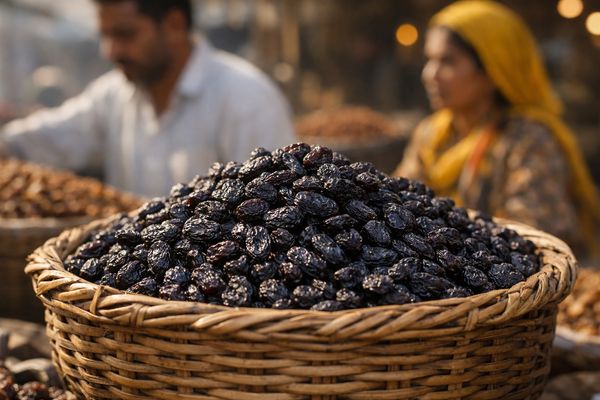
Raisin prices across key export origins are fractionally softer this week, led by small declines for Afghan, Chilean, Chinese and Indian grades, while Turkish sultanas remain broadly flat in euro terms.
The market tone is mildly bearish on nearby positions, with sufficient spot availability and cautious demand in Europe keeping a lid on offers. Turkey continues to anchor international price levels: recent market reports describe FOB Malatya sultana prices as stable, supported by manageable stocks and exporters focused on preserving competitiveness. Cool, largely frost‑free weather in core Turkish dried‑fruit regions reduces immediate crop risk, leaving macro factors and currency as the main watchpoints. India and Afghanistan remain key low‑cost suppliers into South Asia, particularly for the Indian market where Afghan-origin raisins dominate import flows. With end‑season table‑grape volumes tightening in Chile and no acute weather shocks in China’s main producing areas reported in the last few days, the short‑term global balance looks comfortable rather than tight.
Exclusive Offers on CMBroker

Raisins
feed, brown
FCA 1.87 €/kg
(from NL)

Raisins
flame jumbo
FCA 2.42 €/kg
(from NL)

Raisins
sultanas, std, no: 9, grade aa
FCA 2.12 €/kg
(from NL)
📈 Prices & Weekly Moves
All prices below are approximate, expressed in EUR/kg, and converted from prevailing trade levels where needed.
| Origin / Type | Location / Term | Current Price (EUR/kg) | WoW Change (EUR/kg) | Trend |
|---|---|---|---|---|
| Afghanistan feed brown | NL, FCA | ≈ 1.87 | -0.03 | Mildly softer |
| Chile flame jumbo | NL, FCA | ≈ 2.42 | -0.03 | Mildly softer |
| China sultanas std no.9 AA | NL, FCA | ≈ 2.12 | -0.03 | Mildly softer |
| Turkey sultanas no.9 RTU | NL, FCA | ≈ 2.82 | -0.03 | Sideways / slightly easier |
| Turkey sultanas type 9 A | TR, FOB | ≈ 2.35 | 0.00 | Stable |
| Turkey sultanas type 9 A organic | TR, FOB | ≈ 3.10 | 0.00 | Stable |
| India black AA | IN, FOB | ≈ 1.75 | -0.05 | Softer |
| India brown AA | IN, FOB | ≈ 1.81 | -0.05 | Softer |
| India golden AA | IN, FOB | ≈ 2.27 | -0.04 | Softer |
| Turkey sultanas type 9 RTU | TR, CIF | ≈ 2.40 | 0.00 | Stable |
🌍 Supply, Demand & Trade Flows
Turkey remains the pivotal supplier for industrial sultanas into Europe. Recent market commentary confirms that despite lingering memories of last year’s frost‑reduced crop, exporters are holding prices flat to defend market share, backed by disciplined farmer selling and relatively tight but manageable carryover. Domestic economic pressures and strict controls on food inflation may even encourage short‑term export dumping if local prices are capped too aggressively.
In India, Nashik and Sangli continue to dominate raisin production and trade, feeding both domestic and export demand. India is simultaneously a key customer for Afghan raisins: a fresh trade note this week describes the Afghan route as the “heart” of the Indian dry‑fruit market, underlining the importance of Central Asian supply into South Asia. This linkage helps explain the competitive pricing for Afghan feed‑grade raisins into Europe, as Afghan sellers seek alternative outlets.
Chile’s late‑season table grape shipments are reported lighter, especially from southern regions where growers typically avoid packing beyond mid‑April to reduce weather risk. While this mainly affects fresh grapes, it marginally tightens potential raw material for raisin production later in the year. China’s raisin sector remains driven by steadily growing domestic demand for both conventional and specialty products; no new disruptions have been reported in the past few days, so exports appear to be flowing normally.
⛅ Weather Snapshot in Key Origins
Turkey (TR – Malatya and key sultana regions)
Local forecasts for Malatya point to cool, partly cloudy conditions with showers and overnight lows just above freezing over 9–11 April, but with only a low probability of damaging frost. Turkish media still highlight elevated national frost risk after last year’s severe damage to grapes and other fruits, but the immediate outlook for the 2026 crop in Malatya is cautiously positive.
India (IN – Nashik, Sangli)
The Indian grape belt is transitioning out of the main harvest window (February–April), with predominantly dry and seasonally warm conditions favouring final drying and storage rather than new crop development. No acute weather shocks have been reported this week that would materially alter raisin supply.
Chile (CL) & China (CN)
In Chile, lighter late‑season table grape volumes partly reflect growers’ caution around April weather risks, notably in southern regions; this acts as a mild brake on potential raisin raw material but is not yet a major constraint. For China, no notable new weather‑related disruptions in the past three days have been flagged in trade or news channels relevant to raisin regions, suggesting a neutral short‑term weather backdrop.
Afghanistan / Central Asia (AF)
Specific near‑term weather details for Afghan raisin regions were not highlighted in the latest accessible reports, but with the main drying season long concluded, current weather has limited impact on short‑term exportable supply; logistics and demand are the stronger drivers.
📊 Market Drivers & Fundamentals
- Carryover & stock discipline in Turkey: Tight but controlled stocks after last year’s frost‑affected crop underpin stable Turkish FOB prices, preventing a deeper correction in global sultana values.
- Macro & currency in Turkey: Ongoing concerns over inflation and tighter financing conditions weigh on exporters, while a weaker lira supports euro‑denominated competitiveness; authorities’ anti‑inflation measures could temporarily increase export availability.
- India–Afghanistan trade corridor: Strong structural demand for Afghan raisins in India sustains upstream export flows, indirectly supporting Afghan pricing even as European feed‑grade offers ease slightly.
- Seasonal transition in Chile: As the 2026 table‑grape season winds down with lighter late shipments, forward expectations for raisin raw material are slightly tighter, but current‑crop availability remains adequate.
- Demand tone: No fresh bullish demand signals have emerged in the last three days; confectionery and bakery buyers appear sufficiently covered for Q2, keeping spot buying selective and reinforcing a mildly soft near‑term tone.
📆 Trading Outlook & 3‑Day Price Indications
Trading Outlook (Next 1–2 Weeks)
- Buyers (EU packers, industrial users): Use the current mild softening in AF, CL, CN and IN origins to top up nearby coverage, but stagger purchases as Turkish stability suggests limited downside from here.
- Turkish sellers: Maintain offer discipline around current FOB levels; with weather risk still on the radar and carryover not excessive, aggressive discounting is not warranted.
- Indian & Afghan sellers: Competitive pricing into Europe can continue, but watch Indian domestic pull; a pick‑up in Indian festival demand later in the year could tighten export availability.
3‑Day Regional Price Direction (in EUR, indicative)
- AF (Afghan feed brown, FCA NL): 1.80–1.90 EUR/kg, bias slightly softer to flat as European demand stays cautious.
- CL (Chilean flame jumbo, FCA NL): 2.40–2.50 EUR/kg, likely flat; lighter late grape volumes are already priced in.
- CN (Chinese sultanas no.9 AA, FCA NL): 2.10–2.20 EUR/kg, steady to marginally softer amid normal exports and no fresh demand push.
- IN (Indian AA grades, FOB IN): Black/brown around 1.75–1.85 EUR/kg and golden 2.25–2.35 EUR/kg, with a modest downward bias as export competition stays strong.
- TR (Turkish sultanas types 8–10, FOB/CIF): Conventional 2.20–2.65 EUR/kg, organic around 3.10 EUR/kg; broadly stable over the next three days given calm weather and exporter price discipline.
Related posts:
 Vietnam Banana Chips Prices Hold Firm as EU Demand Lifts Philippine Offers
 Raisins market: Turkish weather risks clash with flat prices
 Turkish Raisin Prices Hold Steady as Stable Weather Supports Supply
 Turkish Raisin Prices Hold Steady as Malatya Weather Turns Mild and Dry
 Chilean Prune Prices Ease Slightly After March Rally in Europe
 Flat Raisin Prices, Firm Fundamentals: CN-Origin Holds Its Ground in Europe
 Vietnam Red Dragon Dried FOB: Prices Hold Firm as Export Demand Softens
 Stable Vietnamese Dried Pineapple Prices as Thai Offers Ease in EU