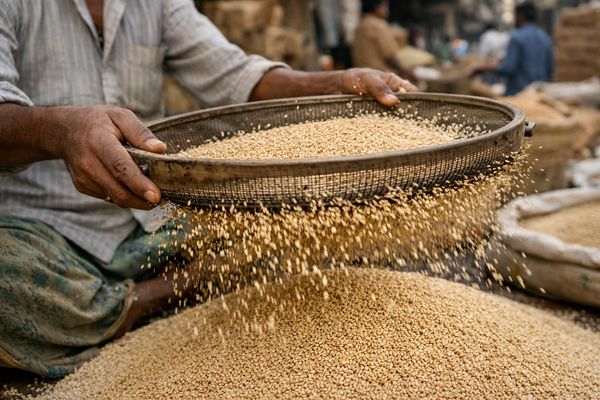
Egyptian sesame prices are drifting slightly lower from recent highs, while hulled offers in India and EU-delivered Chad origin remain broadly firm, supported by logistics costs and selective demand. Overall, the global sesame complex trades sideways in early April, with quality and freight emerging as the main differentiators rather than outright supply scarcity.
Short-term, the market is shaped by mildly softer Egyptian FOB levels, still-firm Indian hulled premiums and stable EU-border prices for African origin. Weather risks in India and Egypt are being watched but have not yet translated into concrete crop losses. At the same time, global demand remains cautious as Chinese inventories stay heavy and European food processors face tighter quality controls and logistics premiums. The balance points to a narrowly ranged market with a modest downside bias for lower grades but ongoing support for premium hulled and golden material.
Exclusive Offers on CMBroker

Sesame seeds
natural, golden
99.5%
FOB 2.00 €/kg
(from EG)

Sesame seeds
natural
99%
FOB 1.52 €/kg
(from EG)

Sesame seeds
hulled
99,95%
FCA 1.60 €/kg
(from DE)
📈 Prices & Differentials
All prices below are indicative exporter/wholesale levels converted to EUR/MT for comparability.
| Origin | Location / Term | Type | Latest Price (EUR/MT) | 1‑week Change |
|---|---|---|---|---|
| Egypt | Cairo, FOB | Natural 99% | ≈1,520 | −1.3% |
| Egypt | Cairo, FOB | Golden 99.5% | ≈2,000 | −2.0% |
| Chad → EU | Berlin, FCA | Hulled 99.95% | ≈1,600 | +1.3% |
| India | New Delhi, FOB | Hulled 99.95–99.98% | ≈1,290–1,310 | Stable |
| India | New Delhi, FOB | Natural 99–99.95% | ≈1,110–1,140 | Stable/Firm |
Egypt maintains a structural premium for golden grades over natural, consistent with recent commentary that highlights differentiated pricing for higher-spec material. Indian FOB hulled prices remain firm but broadly range‑bound, supported by solid oil values and only gradually improving seed availability into export channels. EU‑delivered Chad origin has ticked higher in recent weeks, reflecting strong 2024 production in Chad and steady European pull for non‑Indian origins.
🌍 Supply, Demand & Trade Flows
Global sesame trade is currently characterized by comfortable overall supply but tightening availability of preferred qualities and grades. Recent analysis points to high Chinese inventories and subdued end‑user demand, which cap the upside for bulk seed prices globally. However, regional markets around the Red Sea and Gulf remain relatively firm as Sudanese and other African origins find solid demand from MENA buyers, even at somewhat elevated FOB levels.
In India, rabi and summer sesame sowings in Gujarat and other states point to a broadly adequate 2026 supply, with some regional acreage shifts but no major production shock so far. Yet exports from India have recently been constrained by weaker Chinese buying and quality‑related rejections in the EU, leading to a more supply‑heavy domestic balance sheet. Egypt, by contrast, has seen a notable uptick in sesame export volumes, driven by growing demand from Middle Eastern and European food processors, even as domestic consumption faces pressure from higher logistics and insurance costs linked to regional tensions.
🌦️ Weather Watch: Egypt & India
Recent commentary highlights unsettled weather in Egypt, with heavy rain and thunderstorms reported around Cairo but no significant sesame crop damage at this stage. Over the next few days, conditions are expected to normalize toward seasonally warm and mostly dry weather in Upper Egypt, which should favor fieldwork and early crop development where sesame is already in the ground.
In India, pre‑monsoon showers across parts of Rajasthan and Gujarat have introduced some short‑term uncertainty but are generally viewed as a manageable risk factor rather than an outright threat. Agronomic guidance for Gujarat continues to recommend summer sesame sowing as temperatures rise into the optimal band, suggesting that current weather remains broadly supportive of planned acreage. At this stage, weather is more of a risk premium than a realized supply shock.
📊 Fundamentals & Market Sentiment
Recent global market intelligence underscores a sideways‑to‑soft price tone in sesame, with weak demand and high stocks in China offsetting regional firmness in MENA. South Korea’s first 2026 TRQ tender has set a benchmark for CFR prices into Northeast Asia, confirming that importers are still price‑sensitive and willing to diversify toward Nigerian, Pakistani and Mozambican origins when offers are competitive.
For Egypt, medium‑term trade data show a market that has recently faced reduced import demand and lower average prices, even as export‑oriented corridors expand. This combination explains the current mild softness in Egyptian FOB levels despite broader regional freight and insurance premiums. At the same time, India’s expanded rabi area in Gujarat and extended export harvest window from October to May indicate a relatively comfortable supply base, which curbs any strong bull narrative for prices through Q2 2026.
📆 3-Day Trading & Price Outlook
Directional view for the next 3 days (11–14 April 2026):
- Egypt, Cairo FOB natural sesame: Slightly bearish to sideways. Modest week‑on‑week easing and soft global demand suggest limited buying urgency, though any further downside is likely incremental.
- Egypt, Cairo FOB golden sesame: Sideways with a mild premium retention. Quality‑driven demand and tight premium grade availability should keep prices near current levels, with only small intraday moves.
- EU (Berlin FCA, Chad origin hulled): Sideways to slightly firmer as European buyers maintain interest in non‑Indian origins amid logistics and compliance considerations.
- India, New Delhi FOB hulled and natural: Mostly stable; expanded acreage and comfortable supply balance offset weather risk, keeping offers broadly range‑bound in the very short term.
🎯 Trading Outlook & Recommendations
- Buyers (MENA & EU): For standard natural grades from Egypt, consider staggered short‑term coverage, benefiting from the current mild softness while avoiding over‑commitment in case freight or weather shocks emerge.
- Premium buyers (golden & high‑purity hulled): Maintain at least partial forward coverage; premiums for Egyptian golden and high‑spec hulled origins (India, Chad) remain structurally supported by quality constraints and compliance demands.
- Exporters in Egypt: Monitor freight and insurance closely; with global demand still fragile, aggressive price hikes risk demand destruction, whereas small discounts on natural grades may unlock additional regional sales.
- Indian exporters: Use any short‑lived price spikes from weather headlines or logistics disruptions to scale in hedged sales, as the broader balance of high Chinese stocks and firm domestic supply argues against a sustained bull run in 2026.