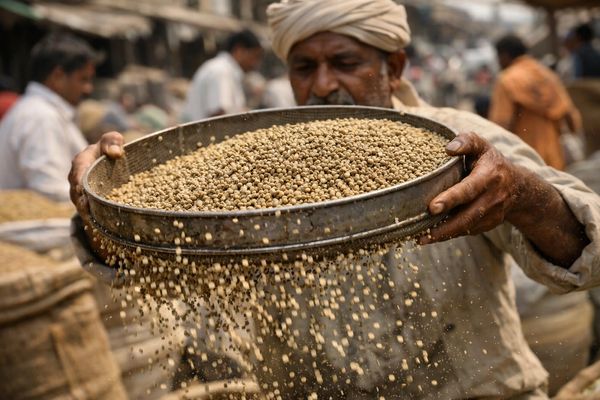
Guar gum export prices from India and Vietnam are flat, with FOB levels around EUR 3,80–3,95/kg equivalent and no meaningful week‑on‑week change. Domestic guar seed and gum markets in India have softened slightly since early April, but the correction remains shallow and fundamentals are still broadly supportive.
India’s guar complex has seen modest weakness in spot and futures as industrial buying pauses and some profit‑taking emerges, particularly in Jodhpur and Hisar. However, export demand from the oil & gas and food sectors remains resilient, and there are no fresh supply shocks. In both India and Vietnam, rising temperatures and an emerging heat phase are becoming the main watchpoints for the next sowing window rather than immediate price drivers.
Exclusive Offers on CMBroker

Guar gum
Powder
FOB 4.04 €/kg
(from VN)

Guar gum
Powder
FOB 4.10 €/kg
(from IN)
📈 Prices & Spreads
FOB offers for organic guar gum powder are steady around EUR 3,95/kg from India (New Delhi) and about EUR 3,90/kg from Vietnam (Hanoi), with no change over the past three weeks in the latest indications. Indian spot guar gum prices at Jodhpur eased modestly on 9–10 April as futures drifted lower, paring back a recent rally of roughly EUR 6 per 100 kg from March lows, but values remain near the upper end of the last month’s range.
Live mandi data for guar seed across Indian producing states indicate broadly stable to slightly easier prices into early April, consistent with reports that the market is consolidating after prior gains rather than entering a deeper downtrend.
| Origin | Location / Term | Product | Latest Indicative Price (EUR/kg) | 1-week Trend |
|---|---|---|---|---|
| India | New Delhi, FOB | Guar gum powder, organic | ≈ 3.95 | Unchanged |
| Vietnam | Hanoi, FOB | Guar gum powder, organic | ≈ 3.90 | Unchanged |
🌍 Supply, Demand & Weather
On the supply side, India remains the dominant origin and there are no fresh indications of production losses or export restrictions; exchange data earlier in the year also show that guar gum is not currently subject to additional surveillance margins on NCDEX, underlining a relatively orderly futures market. Export volumes in 2025/26 to date have been robust, driven by stable demand from US shale and global food applications, which helps absorb modest spot corrections.
Weather in key Indian guar regions (Rajasthan and adjoining areas) is shifting rapidly back towards hot and dry conditions, with forecasts now pointing to maximum temperatures near or above 40°C in several districts over the coming days after a brief spell of cloud and showers. A yellow alert for thunderstorms and gusty winds issued for Rajasthan around 9 April highlights growing volatility in pre‑monsoon weather patterns, although guar sowing is still some weeks away, limiting immediate supply impact but raising medium‑term risk if the hot phase persists into May–June.
In Vietnam, authorities report widespread heat across the Central Highlands and southern regions, with daytime temperatures generally in the 35–37°C range and northern and central provinces such as Nghe An briefly exceeding 40°C earlier this week. While Vietnam is a secondary origin for guar derivatives, prolonged heat and emerging drought signals in key agricultural belts could tighten overall regional processing capacity or raise energy and logistics costs later in the season.
📊 Market Drivers & Fundamentals
- Futures pressure: Recent weakness in NCDEX guar seed and gum futures has translated into slightly lower spot prices at Jodhpur and Hisar, but the move is corrective after strong gains in March.
- Steady export pull: Strong shipments in 2025/26 and ongoing demand from energy and food industries continue to underpin the guar complex, limiting downside in export‑grade gum.
- Weather risk premium: Building heat in Rajasthan and Central Vietnam is not yet fully priced but will become a key driver as markets start to trade the upcoming kharif sowing window and potential yield risks.
- Regulatory backdrop: With no current event‑based additional surveillance margin on guar contracts, speculative activity appears contained, reducing the risk of disorderly spikes for now.
📆 Short‑Term Outlook & Trading Ideas
Near term, the market tone is cautiously stable: recent futures softness and slightly easier mandis are balanced by firm export interest and rising weather risk. With FOB offers from India and Vietnam closely aligned, buyers retain some optionality between origins, though India remains the liquidity anchor.
- For importers/end‑users: Consider covering 4–6 weeks of guar gum needs at current flat prices, while staggering additional bookings ahead of the monsoon outlook to retain flexibility if weather risk escalates.
- For producers/exporters: Use current stability to lock in margins on nearby shipments but avoid over‑committing long‑dated volumes until there is more clarity on Indian monsoon forecasts and sustained heat patterns.
- For speculative participants: Monitor NCDEX guar seed/gum futures for signs of renewed buying; shallow corrections towards recent technical support zones may offer medium‑term long opportunities if export demand stays firm.
📉 3‑Day Regional Price Indication (Directional)
- India – FOB New Delhi (guar gum powder): Sideways to mildly soft; prices expected to hover around EUR 3,90–4,00/kg with limited volatility as futures consolidate.
- Vietnam – FOB Hanoi (guar gum powder): Stable; offers likely to remain near EUR 3,85–3,95/kg, with heat‑related cost pressures not yet feeding materially into short‑term pricing.