
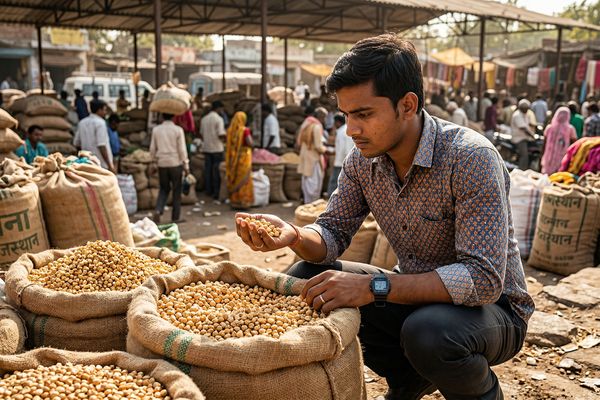
Indian chickpea prices are easing for a second session but remain underpinned by trade below the Minimum Support Price and sizeable state procurement, keeping the downside limited in the near term. For European and Middle Eastern buyers, the combination of weak Indian mill demand, ample port stocks and stable Australian offers points to a short window of range-bound, buyer‑friendly pricing.
Physical markets in Delhi and key origin states are seeing modest day‑to‑day declines as rabi arrivals build and processors cover only immediate needs. Government buffer stocks of around 300,000 tonnes, plus ongoing MSP buying, are capping fears of a sharp post‑harvest sell‑off, while imported supplies from Australia and Tanzania provide an additional cushion. Export‑oriented buyers should use the current softness to secure forward volumes, while keeping one eye on late‑season weather in Rajasthan, the main upside risk flagged by the market.
Exclusive Offers on CMBroker

Chickpeas dried
count 60-62, 8 mm
FOB 0.84 €/kg
(from IN)

Chickpeas dried
count 42-44, 12 mm
FOB 1.29 €/kg
(from MX)

Chickpeas dried
count 75-80, 8 mm
FOB 0.82 €/kg
(from MX)
📈 Prices & Short-Term Trend
Indian new-season chickpeas (chana) in Delhi have slipped by about ₹25 per quintal, leaving Rajasthan-origin lots around ₹5,500–₹5,525 per quintal and Madhya Pradesh supplies near ₹5,450–₹5,475. Jaipur-line product is trading close to ₹5,475–₹5,500 per quintal, with traders highlighting visible resistance to deeper cuts as current values are already below the official Minimum Support Price.
In international trade, Australia-origin chickpeas for April–May shipment are steady at about USD 580 per tonne C&F in containers and USD 545 per tonne on a vessel basis, while Tanzania-origin is quoted near USD 565 per tonne C&F at Nava Sheva. Converted to export parity, recent Indian FOB offers from New Delhi sit roughly in a EUR 0.82–0.96/kg band, broadly stable over the past three weeks and still at a discount to Mexican origins, which are around EUR 0.82–1.29/kg FOB Mexico City.
| Origin / Type | Location & Terms | Latest Price (EUR/kg) |
|---|---|---|
| Chickpeas, 60–62 count, 8 mm | India, New Delhi, FOB | 0.84 |
| Chickpeas, 42–44 count, 12 mm | India, New Delhi, FOB | 0.96 |
| Chickpeas, 42–44 count, 12 mm | Mexico, Mexico City, FOB | 1.29 |
🌍 Supply & Demand Dynamics
The current soft tone is driven mainly by weak mill offtake. Dal processors remain highly tactical, buying only for nearby requirements, confident they can replenish later at similar or lower cost as harvest arrivals from Gujarat, Karnataka and Maharashtra continue to build, even if somewhat below earlier expectations. Elevated stocks of imported chickpeas at Indian ports further reduce urgency on the buy side.
On the domestic policy front, total MSP procurement has already reached around 100,000 tonnes and is expected to accelerate as the rabi harvest progresses through March–May in Madhya Pradesh and Rajasthan. In parallel, the central buffer pool holds about 300,000 tonnes of chickpeas, giving the government significant capacity to smooth any short‑term supply squeeze or price spike.
📊 Fundamentals & Global Context
Global fundamentals are broadly neutral to slightly bearish for the near term. Australia, the world’s largest chickpea exporter, has seen export prices stabilise rather than tighten, removing a key potential driver for a rapid recovery in Indian domestic values. With Australian C&F offers to India steady and Tanzanian origin also holding, the international market is currently well supplied.
For European and Middle Eastern buyers of Indian chickpeas, this configuration means import programs can be paced without immediate fear of a price breakout. However, market participants are closely monitoring the next two to three weeks to determine whether the post‑harvest correction in India has already found a floor in the ₹5,450–₹5,550 per quintal range or whether an additional, limited downside leg is still possible.
🌦️ Weather & Risk Outlook
Weather is not an acute driver today but remains the key upside risk. A disruption to the late rabi harvest in Rajasthan, particularly heavy unseasonal rains or hail during the final pod‑drying phase, could quickly tighten local availability and trigger a short‑term price spike from current sub‑MSP levels. This would be felt first in Indian physical markets and then filter into export offers.
Given the state buffer and MSP operations, any weather‑induced rally is likely to be sharp but time‑limited rather than a sustained structural uptrend. Nonetheless, importers with thin nearby cover should factor this risk into their procurement timing over the next fortnight.
📆 Price Forecast (Next 2 Weeks)
Market participants widely expect chickpea prices in India to remain range‑bound around ₹5,450–₹5,550 per quintal in the coming two weeks as peak arrivals meet gradually strengthening government procurement. This implies a broadly sideways to slightly firm EUR‑denominated export parity, assuming stable FX and freight.
Upside scenarios are mainly linked to adverse weather or an unexpectedly strong pickup in mill demand if dal retail sales improve. Conversely, meaningful further downside appears limited while domestic cash prices sit below MSP and the government is actively buying to support farmers.
🧭 Trading Recommendations
- European and Middle Eastern importers: Use the current sub‑MSP, range‑bound environment to extend coverage modestly for Q2–Q3, especially for Indian origin where values remain competitive versus Mexico.
- Indian millers and traders: Continue tactical spot buying but consider incremental stocking near the lower end of the ₹5,450–₹5,550 band, given strong policy support and limited further downside.
- Speculative participants: The risk‑reward favours accumulating on dips rather than chasing further weakness, with weather in Rajasthan and potential MSP‑driven tightening offering asymmetrical upside.
📍 3-Day Directional Outlook (Indicative, in EUR)
- India – New Delhi FOB chickpeas: Slight downside to flat; prices likely to hover around current EUR 0.84–0.96/kg, with minor intra‑day volatility as arrivals continue.
- Mexico – FOB chickpeas: Mostly stable in the EUR 0.82–1.29/kg range, maintaining a premium over Indian origin for larger calibres.
- India C&F buyers (Europe/Middle East): Landed values expected to remain steady, with freight and FX the main short‑term variables rather than origin price shifts.
Related posts:
 Indian Lentil Market Finds a Floor as MSP and Tight Arrivals Offset Import Pressure
 Indian Chickpea Market Tightens as Supply Gap Widens
 Chickpeas: Soft Spot Prices but Weather and Low Stocks Put a Floor Under the Market
 Guar Seed Softens on Mill Pause but Oilfield Link Supports Floor
 Chickpea Market Pauses as Indian Weather Risks Meet Heavy Port Stocks
 India’s Pigeon Pea Market Softens but Finds a Firm Floor
 Indian Chickpea Market Pauses as New Crop Nears and Supply Outlook Improves
 Indian Chickpea Market Softens as New Rabi Crop Arrives and Mills Step Back