
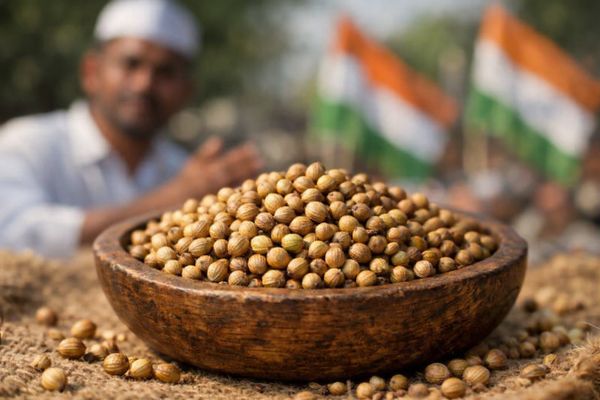
Indian coriander seed markets have shifted decisively into a bullish phase after a sharp rally in the week ending 12 April, driven by an unusual combination of disrupted trade in Rajasthan, reduced 2025/26 crop expectations and aggressive stockist buying. Domestic prices have reset higher and are expected to hold in an elevated band over the coming weeks, with upside risk for import costs into Europe.
The core of the move is a sudden tightening of India’s internal balance sheet. A politically-triggered shutdown across wholesale markets in Rajasthan – the country’s largest coriander producer – has effectively removed a major share of spot supply just as traders were already grappling with below‑normal acreage and yields. While some export FOB indications in New Delhi show only mild week‑on‑week softening in EUR terms, this reflects profit‑taking after a powerful prior rally rather than a comfortable market. For European spice users, this is a warning shot to reassess forward cover while liquidity is still available.
Exclusive Offers on CMBroker

Coriander seeds
eagle, split
98%
FCA 1.10 €/kg
(from IN)

Coriander seeds
whole
FOB 2.05 €/kg
(from IN)

Coriander seeds
single parrot
FOB 1.15 €/kg
(from IN)
📈 Prices & Market Tone
At Delhi wholesale markets, premium badami-grade coriander from Rajasthan jumped by around ₹300 during the week to reach ₹13,800–₹14,000 per quintal by 12 April. Converted at roughly ₹93.10 per EUR, this implies about 1.48–1.51 EUR/kg, underscoring how far domestic benchmarks have moved above the sub-₹100/kg levels seen before late 2025.
Export-oriented offers in New Delhi (FOB) for conventional Indian coriander now cluster around 0.93–1.30 EUR/kg depending on quality, with organic whole seed and powder trading higher near 2.05–2.38 EUR/kg. These FOB values have eased slightly (around 0.5–1.5% week-on-week) but remain significantly above March, indicating consolidation at a higher plateau rather than a reversal.
| Product | Origin / Term | Latest Price (EUR/kg) | 1–2 Week Change |
|---|---|---|---|
| Coriander seeds, eagle split 98% | India, New Delhi, FCA | ≈ 1.18 | Down from ≈ 1.20 after strong rally |
| Coriander seeds, 99.9% conv. | India, New Delhi, FOB | ≈ 0.94 | Marginally softer vs early April |
| Coriander seeds, double parrot | India, New Delhi, FOB | ≈ 1.30 | Stable to slightly lower |
| Coriander seeds, organic whole | India, New Delhi, FOB | ≈ 2.05 | ≈1–2% below early April |
| Coriander seeds, conv. 99.9% | Egypt, Cairo, FOB | ≈ 1.05 | Stable |
🌍 Supply & Demand Drivers
The immediate trigger for the rally is a trader strike across Rajasthan’s wholesale markets after the state government raised the mandi transaction tax to 1%. With merchants closing operations, arrivals have fallen sharply, effectively choking off a large share of India’s coriander flow almost overnight. This type of political disruption is more abrupt than weather-related losses and amplifies perceived scarcity.
At the same time, 2025/26 production estimates have been revised down. Acreage in Rajasthan, Madhya Pradesh and Gujarat is reported below normal, and yields are underperforming earlier expectations. Recent industry data point to coriander area in the three key states falling by around 10–12% year-on-year, with India’s total coriander crop potentially dropping from roughly 760,000 tonnes last season to near 520,000 tonnes in 2026. This structural shortfall underpins the current firmness and reduces the likelihood of a quick reversion to old price levels.
On the demand side, stockists have accelerated buying into the rally, reinforcing the squeeze. Domestic spice blenders are restocking for the new marketing year, while export interest from the Middle East and Europe remains steady. India’s coriander exports had already been strong in 2025, and even if volumes ease on tighter availability, overseas buyers remain dependent on Indian origins for key applications such as sausage, ready meals and seasoning blends in Europe.
🌦️ Weather & External Context
Weather across major rabi spice belts in Rajasthan, Madhya Pradesh and Gujarat is currently benign, with no acute harvest or post-harvest threats reported. The weather factor has therefore faded into the background; the dominant story is policy and structural supply, not climatic stress.
Globally, alternative origins such as Egypt offer some relief, with FOB coriander around 1.05 EUR/kg and broadly stable. However, volumes from these origins are limited relative to India’s export scale and cannot fully offset an Indian shortfall. Broader spice markets show mixed signals, with some seed spices like cumin easing slightly, but coriander stands out as entering a more pronounced supply-driven upcycle.
📊 Fundamentals & Forward Outlook
The current balance can be summarised as a “classic supply squeeze”: lower planted area and yields in India, a sudden policy shock in Rajasthan, and firm restocking and export demand. Market sentiment is firmly bullish, with domestic spot prices reportedly up by around 50–60% year-on-year in key mandis and analysts projecting further gains into mid-year if supply constraints persist.
Looking ahead two to four weeks, coriander prices in India are expected to trade in a firm-to-higher band of roughly ₹13,500–₹15,000 per quintal, equivalent to about 1.42–1.58 EUR/kg. A swift resolution of the Rajasthan trader strike could trigger a short-term correction as arrivals normalise, but the underlying production deficit suggests any pullback will likely be modest and short-lived rather than a full unwinding of the rally.
📌 Trading Outlook & Risk Management
- European buyers: Treat the current consolidation phase as an opportunity to bring forward coverage for 2026 needs, especially for coriander whole and powder used in processed foods. Gradual layering of purchases (rather than waiting for a major dip) looks prudent given structural tightness.
- Importers and traders: Maintain a cautiously long bias but avoid excessive leverage. Political developments around Rajasthan’s tax and strike negotiations are a key short-term risk; a partial compromise could briefly loosen supplies and create better entry points.
- Food manufacturers: Review product costing assumptions for the next 6–12 months. Consider reformulation or blending strategies to manage higher coriander input costs, and secure contracts that share price risk with suppliers where possible.
- Buyers seeking alternatives: Explore supplementary volumes from Egypt and other minor origins, but do not assume they can fully replace India; basis risk and quality differences should be factored into procurement strategies.
📆 3-Day Directional Price Indication
- India – Delhi wholesale (badami-grade): Sideways to slightly higher in EUR terms as long as the Rajasthan strike continues and arrivals remain thin.
- India – New Delhi FOB (conventional coriander): Mildly firm bias; recent marginal softening may stabilise, with buyers stepping in on any small dips.
- Egypt – FOB Cairo: Stable to slightly firmer, following Indian benchmarks with a lag as importers test non-Indian origins.
Related posts:
 Global Pepper Squeeze: Indian Stocks Tighten as Weather Hits Key Origins
 Indian Coriander Seeds Ease Slightly But Stay Firm on Tight 2025/26 Supply
 Nigella Seeds Stay Firm as Indian Supply Tightens and Egypt Competes on FOB
 Indian Coriander in a Classic Supply Squeeze – Prices Eye New Highs
 Indian Coriander Prices Firm as New Crop Meets Rising Global Demand
 Indian Coriander Prices Hold Firm as Futures Turn Bullish
 Coriander Prices Firm as Indian Supply Stays Tight Despite New Crop Arrivals