
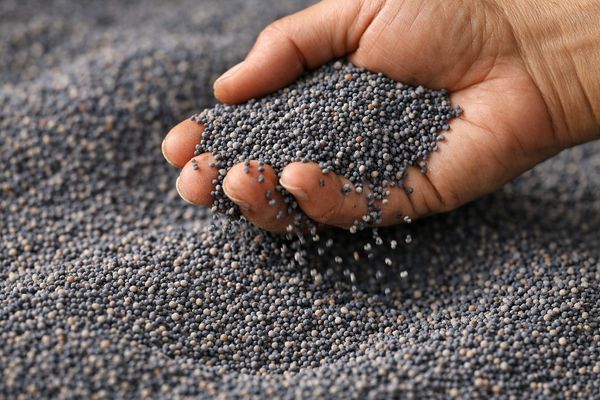
Poppy seed prices have turned mildly lower in early April, with India’s licensed domestic market correcting on softer post-festival demand while Central European FCA offers drift down in tandem. For now, the move looks like a demand-led pause rather than the start of a structural downturn, leaving near-term price risks skewed slightly to the downside but bounded by tight regulatory supply.
Domestic and imported poppy seed in India lost about ₹50 per kilogram in the week to 12 April as consumer and food-service buying faded after an earlier, sentiment-driven lift across the spice complex. At the same time, Czech blue and white poppy quotations in Europe have eased by around EUR 0.07–0.10/kg since mid-March, reflecting cautious end-user coverage but no material weather or policy shock in key origins.
Exclusive Offers on CMBroker

Blue poppy seeds
morphin < 20 ppm
99,9
FCA 1.88 €/kg
(from CZ)

Blue poppy seeds
morphin < 20 ppm
99,9
FCA 1.88 €/kg
(from CZ)

White Poppyseeds
morphin < 20 ppm
99,9
FCA 2.86 €/kg
(from CZ)
📈 Prices & Spreads
In Delhi wholesale trade, imported Turkish and Chinese poppy seed retreated by ₹50 to a range of ₹1,300–₹1,400 per kilogram. Domestic Indian material followed, easing to about ₹1,150–₹1,200 per kilogram. The decline pares back part of the gains seen earlier in the week, when broader optimism in the spice market briefly pulled additional buyers into poppy before offers approached the upper end of recent ranges.
Using an indicative rate of ₹93.10 per EUR, Indian imported poppy currently equates to roughly EUR 13.96–15.04/kg, while domestic product sits near EUR 12.35–12.89/kg. In comparison, FCA Czech blue poppy is offered around EUR 1.88/kg and white poppy at about EUR 2.86/kg, down from roughly EUR 1.98/kg and EUR 2.95/kg respectively in mid-March, confirming a gentle, not abrupt, downtrend in European benchmarks.
| Market / Product | Spec / Origin | Price range (EUR/kg) | Recent trend (3–4 weeks) |
|---|---|---|---|
| India – imported wholesale (Delhi) | Turkish / Chinese poppy seed | ≈ 13.96–15.04 | ↓ about EUR 0.54/kg (₹50) |
| India – domestic wholesale (Delhi) | Indian poppy seed | ≈ 12.35–12.89 | ↓ about EUR 0.54/kg (₹50) |
| Czech Republic – FCA | Blue poppy, morphin < 20 ppm | 1.88 | ↓ from 1.98 |
| Czech Republic – FCA | White poppy, morphin < 20 ppm | 2.86 | ↓ from 2.95 |
🌍 Supply & Demand Balance
India’s poppy seed sector remains structurally constrained on the supply side: cultivation is tightly licensed under narcotics legislation, leaving domestic output unable to fully cover culinary demand. Any incremental requirement must therefore be met through imports, with Turkey the dominant global licit producer and China providing a lower-cost alternative into the Indian market.
Current indications point to steady international availability from Turkey and China, with no significant shift in export pricing or quota policy during the review period. The relative steadiness of import-side conditions, contrasted with the domestic price dip, supports the view that the latest adjustment is demand-driven within India rather than a signal of tighter global supply.
On the demand side, poppy seed usage is concentrated in confectionery, bakery toppings, and rich gravies, all of which see a pronounced seasonal peak around major Indian festivals. The week to 12 April falls into the typical post-festival trough, when discretionary spice consumption softens. Retail and food-service demand was described as weak, and institutional buyers largely stepped to the sidelines once prices pushed towards the upper band of recent trading ranges.
Seller participation was also reported as thinner than normal, which helped prevent a sharper correction. This combination of muted consumer offtake but only moderate selling pressure has resulted in a controlled, rather than disorderly, easing of prices.
📊 Fundamentals & External Context
Global fundamentals appear broadly balanced. Central European origins such as the Czech Republic report adequate stocks and no acute weather shock affecting existing inventories. FCA offers for blue and white poppy have drifted modestly lower by around EUR 0.07–0.10/kg over the past three to four weeks, in line with cautious end-user demand and the absence of aggressive forward buying from bakeries and food manufacturers.
In Turkey, early spring weather has been seasonally cool with occasional unsettled episodes, but there have been no reports in the last few days of major field damage specifically impacting poppy sowings. Broader regional logistics remain somewhat fragile amid geopolitical tensions and intermittent weather-related disruptions, yet these have not crystallised into a clear, poppy-specific bottleneck at this stage.
European food-ingredient demand for Indian-processed poppy seed remains a niche segment compared with direct sourcing from Turkey and the Czech Republic. However, the structural tightness of Indian domestic supply means that any future tightening of Turkish export quotas or quality constraints could quickly raise the profile of Indian-processed material for specialised export channels, especially if European buyers seek alternative blends or value-added products.
📆 Short-Term Outlook (2–4 Weeks)
Over the next two to four weeks, imported poppy seed prices in India are expected to trade within a soft band of ₹1,200–₹1,400 per kilogram, equivalent to roughly EUR 12.89–15.04/kg at current FX assumptions. A sustained recovery back towards recent highs will likely require a clear improvement in retail traffic, renewed festival or wedding-season demand, or a tangible tightening in Turkish export availability.
For Central Europe, the recent easing of Czech FCA offers suggests limited immediate upside risk. With blue poppy around EUR 1.88/kg and white poppy near EUR 2.86/kg, the path of least resistance in the very short term appears sideways-to-soft, assuming weather remains seasonally benign and buyers continue to cover largely on a hand-to-mouth basis.
💡 Trading & Procurement Outlook
- Indian buyers: Consider cautiously extending coverage within the ₹1,200–₹1,400/kg (≈ EUR 12.89–15.04/kg) band, especially for high-quality Turkish origin, as the downside appears limited by regulatory supply constraints but any near-term upside catalyst is still absent.
- European food manufacturers: With Czech FCA blue and white poppy drifting lower, opportunistic spot and short-dated buying can be justified, but avoid heavy forward commitments until clearer signals emerge on 2026/27 crop conditions.
- Exporters from India: Current domestic softness offers a window to secure raw material without significant price risk; locking in volumes now could support margins if Turkish policy or logistics tighten later in the year.
📍 3-Day Directional View (Key Markets)
- India – Delhi wholesale: Bias slightly softer to stable in the next three days as post-festival demand remains subdued and buyers stay selective.
- Czech Republic – FCA blue & white poppy: Stable to marginally softer, with offers expected to hover near EUR 1.88/kg (blue) and EUR 2.86/kg (white) absent fresh demand impulses.
- Turkey export indications: Largely stable in the very short run; watch for any signs of regulatory or freight-related noise, but no immediate price shock is anticipated.
Related posts:
 China Pumpkin Seed Kernels: FOB Prices Ease While Freight Stays Elevated
 Indian Poppy Seed Market Softens as Seasonal Lull Meets Cautious Global Buying
 Oil Curve Cools: Front-End Retreats While Long-Term Prices Slide
 Czech Poppy Seeds Ease Lower as Buyers Stay Cautious
 Sunflower Market: SAFEX Softens While Black Sea Seed Prices Hold Firm
 Rapeseed Market Holds Firm as Canola Slips and Biofuel Demand Softens
 India’s tightly regulated poppy seed market keeps prices firmly elevated
 Czech Blue and White Poppy Seeds Edge Lower as Buyers Stay Cautious