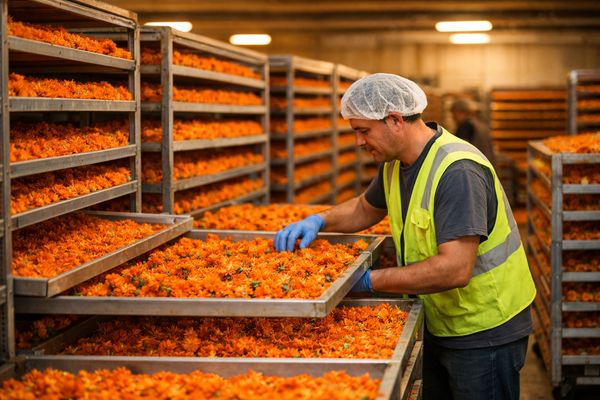
Egyptian Calendula prices FOB Cairo are broadly steady, with a mild softening in petals and flat whole-flower values, reflecting comfortable supply and only modest spot buying interest. Recent warm, dry weather around Cairo supports smooth fieldwork and drying, keeping near‑term price risks limited on both the upside and downside.
In early April, Calendula participates in the generally calm Egyptian dried-herb complex, where exporters report normal operations and resilient food export flows despite higher freight and insurance costs. Warm spring conditions in the Nile Valley and around Cairo, combined with structurally irrigated Calendula cultivation, keep production risks contained. Against this backdrop, buyers see a narrowly range‑bound market, with slight discounts on petals compared with late March and stable indications for whole flowers.
Exclusive Offers on CMBroker

Calendula flower
whole
99%
FOB 0.90 €/kg
(from EG)

Calendula
petals
FOB 2.01 €/kg
(from EG)
📈 Prices & Recent Moves
All prices are FOB Cairo and shown in EUR/kg.
| Product | Origin / Term | Latest Price (EUR/kg) | Prev. Price (EUR/kg) | Change w/w | Last Update |
|---|---|---|---|---|---|
| Calendula petals, conventional | Egypt, FOB Cairo | ≈2.01 | ≈2.05 | ‑1.9% | 10 April 2026 |
| Calendula flower whole, 99% purity | Egypt, FOB Cairo | ≈0.90 | ≈0.90 | 0.0% | 11 April 2026 |
Recent external price reporting also points to slightly lower Egyptian Calendula petal prices FOB Cairo in early April, with whole flowers unchanged week on week, confirming a modest easing rather than a sharp correction. The move in petals essentially reverses a late‑March uptick, leaving the broader price trend sideways.
🌍 Supply, Weather & Export Context
Calendula around Cairo and the Nile Delta is grown under irrigation, so short‑term rainfall deficits matter less than temperature and wind conditions during harvest and drying. Current forecasts for Cairo from 13–15 April show hazy sunshine, very warm afternoons (around 29–32°C) and cool nights, with limited rain risk but some breezy periods. This is broadly supportive for fieldwork and drying, and does not pose an immediate threat to yields or quality.
Specialized herb market commentary highlights that Egypt’s herb belt near Cairo has just moved through a period of dusty winds but is now in generally stable warm conditions, which support Calendula and other dried herbs. At the export level, Egypt’s food sector remains active: official data show 266,000 tons of food exports in the week of 4–10 April across more than 5,500 shipments, underscoring that logistics chains are functioning despite regional freight cost pressures.
Broader sector analysis confirms that medicinal and aromatic plants (MAPs) are a high‑value export segment for Egypt, with established, quality‑focused exporters in herbs and dried flowers. This structural backdrop suggests that short‑term Calendula availability is more likely to remain comfortable than to tighten abruptly, barring an external logistics shock.
📊 Market Fundamentals & Drivers
- Supply: No current signals of field stress or crop losses in the Calendula regions around Cairo; irrigated systems and normal farm operations point to balanced spot availability.
- Demand: Export demand is described as modest to solid but not aggressive, in line with a broader herb market where buyers are well covered and purchasing hand‑to‑mouth.
- Costs & logistics: Higher freight and insurance costs in the wider Red Sea region continue, but flows of food and herb cargo out of Egypt remain stable, limiting immediate cost‑push pressure on Calendula FOB prices.
- Macro backdrop: Egypt’s wider trade environment is characterized by a higher trade deficit and efforts to support agro‑exports, which encourages maintaining competitive herb pricing to sustain volumes.
📆 Short-Term Outlook & Trading View
With warm, dry weather expected over the next three days around Cairo and no fresh supply shocks in view, Calendula prices are likely to remain in a tight range. Petals may see small, negotiation‑driven adjustments, but the recent modest decline already reflects current demand and cost conditions, while whole flowers appear anchored at prevailing levels.
🧭 Trading Recommendations (Next 1–3 Weeks)
- Buyers: Use the current slight softness in petal prices to secure short‑ to medium‑term coverage; consider staggered purchases rather than waiting for significantly lower levels, as fundamentals are neutral rather than bearish.
- Sellers: For whole flowers, defend current indications and focus on quality and reliability rather than price increases; for petals, accept small discounts to stimulate volume but avoid deep cuts given firm structural demand for medicinal plants.
- Logistics planning: Lock in freight options early where possible, as regional cost volatility could re‑emerge even if FOB price levels stay relatively flat.
📍 3‑Day Directional Price Indication (FOB Cairo, EUR/kg)
- Calendula petals, conventional: ≈2.00–2.05 EUR/kg, bias: slightly softer to sideways.
- Calendula flower whole, 99%: ≈0.88–0.92 EUR/kg, bias: stable.