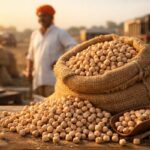
Indian and Mexican chickpea export prices are broadly steady in early April, with India holding a clear discount to Mexican origins and no fresh policy shocks or weather threats emerging over the last few days. Tight but comfortable nearby supply, plus strong imports into India from Russia, are keeping a lid on any immediate upside.
The chickpea market is consolidating recent gains rather than breaking into a new trend. In India, export-grade Kabuli values have recovered from earlier lows and are now tracking a firm but stable range, supported by structurally high domestic demand yet capped by ample imports and the absence of new stock limits or tariff moves in the last 72 hours. In Mexico, Sinaloa’s dry and seasonally hot conditions are normal for this time of year and do not pose acute yield risks, allowing FOB offers to remain flat. Short-term, we expect only mild, currency-driven fluctuations rather than strong directional moves.
Exclusive Offers on CMBroker

Chickpeas dried
count 60-62, 8 mm
FOB 0.84 €/kg
(from IN)

Chickpeas dried
count 42-44, 12 mm
FOB 1.29 €/kg
(from MX)

Chickpeas dried
count 75-80, 8 mm
FOB 0.82 €/kg
(from MX)
📈 Prices & Spreads
Indicative export prices converted to EUR (FOB main hubs, 11 April 2026, rounded; FX used: 1 USD ≈ 0.93 EUR for context-based conversions):
| Origin | Grade / Count | Location / Term | Price (EUR/kg, FOB) | 1-week Trend |
|---|---|---|---|---|
| India | 60–62, 8 mm | New Delhi, FOB | ≈ 0.78 | Unchanged w/w |
| India | 42–44, 12 mm | New Delhi, FOB | ≈ 0.89 | Unchanged w/w |
| Mexico | 42–44, 12 mm | Mexico City, FOB | ≈ 1.19 | Flat to slightly firmer vs early April |
| Mexico | 75–80, 8 mm | Mexico City, FOB | ≈ 0.76 | Flat to slightly firmer vs early April |
Recent mandi and wholesale indications in India confirm a recovery from earlier seasonal lows in key Kabuli-producing states, with Maharashtra’s Kabuli chana now trading significantly above the depressed levels seen earlier in the marketing year. Mexican origin continues to command a notable premium over Indian export offers for large counts, reflecting quality perception and freight advantages into the Americas.
🌍 Supply, Trade Flows & Weather
On the demand side, India remains the key driver of global chickpea and pulses trade. Fresh data from early April show a sharp year-on-year increase in Russian pulse exports, with chickpea shipments up 54% to 61,000 tonnes in Q1 2026. This underpins comfortable import availability for Indian buyers and reduces immediate concerns over nearby tightness.
Policy-wise, there have been no new chickpea-specific duty or stock-limit changes reported over the last three days. Broader pulse policy remains accommodative, with India recently extending free-import status for other pulses like urad and tur to secure domestic supplies. While this does not directly cover chickpeas, it signals the government’s continued willingness to lean on imports if prices spike, which is a bearish overhang on any sharp rally.
Weather in key producing zones is seasonally hot but not disruptive. In Sinaloa, Mexico, forecasts for 13–19 April point to very warm but largely dry to overcast conditions, with daytime highs around 37–39°C, typical for the region and not associated with acute flooding or storm risks at present. In India’s chickpea belt (Madhya Pradesh, Rajasthan, Maharashtra), there are no new official agromet warnings or extreme events reported over the last 72 hours; current discussions center on anticipated summer heat rather than immediate damage to the already-harvested rabi crop.
📊 Fundamentals & Market Mood
The fundamental setup is one of firm but not tight supply. Earlier Indian stock limits on chana and kabuli chana in 2024 helped prevent hoarding and smoothed domestic availability. Since then, improved domestic output and stronger imports from Russia have reduced the urgency for further restrictive measures, which is helping cap prices.
Internationally, buyers have more origin choice. Russian chickpea exports, ongoing availability from Australia, and steady Mexican offers together form a diversified supply base. This keeps global buyers in a relatively strong negotiating position even as Indian domestic demand stays robust.
Market sentiment is therefore balanced. Merchants in India report sizeable private stocks in some states, including exportable kabuli in Gujarat, which can be mobilized quickly if prices rise. On the other hand, memories of last year’s heat and policy swings are preventing aggressive forward selling by farmers and traders, lending an underlying floor to current valuations.
📆 Short-Term Outlook (3–7 Days)
With no major weather or policy shocks visible in the last few days, we expect only modest, range-bound moves in both Indian and Mexican chickpea export prices over the coming week. Any volatility is more likely to come from FX moves and cross-commodity pulses pricing (e.g., peas, lentils) than from chickpea-specific news.
🔎 Trading Outlook
- Importers (MENA/EU): Use current stability in Indian FOB offers to secure short-to-medium term coverage, especially for 8–9 mm counts, while keeping some volume open in case of further softening from Russian competition.
- Indian exporters: Focus on timely execution rather than aggressive forward pricing; the combination of stable domestic demand and ample Russian supplies argues for cautious, incremental sales.
- Mexican exporters: Maintain premiums for large-count Kabuli into the Americas but be prepared for increased price sensitivity if India discounts to move stocks.
📍 3‑Day Regional Price Indication (Directional)
- India – New Delhi (FOB export, Kabuli, 8–12 mm): Prices expected to remain broadly stable in EUR terms over the next three days, with a bias to very mild softness if rupee weakens or Russian offers undercut. No major upside catalysts identified in the past 72 hours.
- Mexico – Mexico City / Sinaloa-linked FOB: Prices likely flat to marginally firmer in EUR over the next three days, mainly reflecting currency moves and steady export interest rather than local weather or supply shocks.