
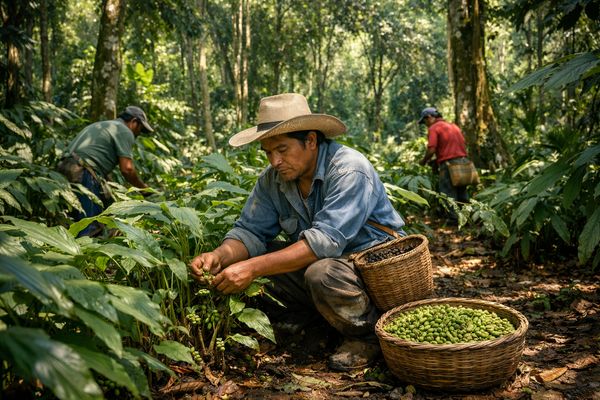
Indian green cardamom prices in India are drifting mildly lower, with FOB New Delhi offers softening by around 1% week-on-week in EUR terms, tracking steady auction arrivals and a lack of near-term demand spikes. Futures on Indian exchanges are broadly range-bound, pointing to a market that is well supplied but not under strong selling pressure.
Physical trade flows from Kerala auctions remain healthy, with robust volumes sold and average prices still firm in rupee terms, but buyers are showing more price sensitivity at higher grades. Extremely hot but mostly dry weather in much of Kerala is raising concern for the upcoming crop, yet no immediate production shock is visible. In the next few days, the market is likely to stay slightly soft to sideways, with FOB offers in New Delhi adjusting at the margin rather than breaking sharply.
Exclusive Offers on CMBroker

Cardamom powder
FOB 24.00 €/kg
(from IN)

Cardamom whole
green,7.5-8 mm
FOB 17.90 €/kg
(from IN)

Cardamom whole
green 6.0-6.5 mm
99%
FOB 16.10 €/kg
(from IN)
📈 Prices & Spread Overview
Current indicative FOB New Delhi prices (organic/conv., EUR/kg) show a mild week-on-week easing across most grades, with the largest nominal declines in higher-value conventional whole cardamom:
| Product | Specification | Organic | FOB New Delhi (EUR/kg) | WoW Change (EUR) |
|---|---|---|---|---|
| Cardamom powder | Green | Yes | 24.00 | -0.30 |
| Cardamom whole | Green 6.0–6.5 mm, 99% | Yes | 16.10 | -0.25 |
| Cardamom whole | Green 7.5–8 mm | Yes | 17.90 | -0.20 |
| Cardamom whole | Green 6.5–6.8 mm | No | 21.00 | -0.25 |
| Cardamom whole | Green 7–7.2 mm | No | 21.85 | -0.25 |
| Cardamom whole | Green 7.5 mm | No | 23.20 | -0.25 |
| Cardamom whole | Green 8 mm | No | 24.10 | -0.25 |
MCX cardamom futures for nearby contracts are trading broadly sideways, indicating that the modest softening in physical FOB offers is more a function of steady arrivals and cautious restocking than a sharp swing in fundamentals.
🌍 Supply, Auctions & Demand Signals
Recent small cardamom auctions in Kerala (Idukki, Kumily, Thekkady and Kochi-linked platforms) show solid arrivals and high sell-through ratios, with maximum prices often near ₹2,800–3,100/kg and average prices in the ₹2,250–2,350/kg band. This indicates a well-functioning pipeline, with growers still achieving remunerative prices despite the recent softening at the margins.
Export demand for green cardamom remains underpinned by strong shipments in the current marketing year; official data up to March show small cardamom export volumes and values running well above the previous year, especially to Gulf markets. Specialist exporters report that global demand for Indian green cardamom is structurally firm, with buyers in the Middle East and Europe continuing to seek premium 7–8 mm and 8 mm+ grades.
On the domestic side, demand from retailers and kiryana wholesalers in North India, including Delhi, has been steady into April, supported by marriage-season consumption and regular blending demand from the food and beverage industry. However, there is no major festive trigger in the immediate term, which limits upside momentum and encourages more selective restocking at slightly lower price points.
🌦 Weather & Crop Outlook (India)
Kerala is currently experiencing its most intense heat of the year, with some districts such as Palakkad recording temperatures above 40°C, triggering heat warnings across most of the state. Notably, Idukki — the core small cardamom belt — has so far been spared the highest alerts, reflecting its higher elevation and relatively milder conditions compared with the lowlands.
In the short term (next few days), the Indian Meteorological Department does not signal any severe weather event or heavy rainfall for the main cardamom-growing zones of Kerala; hot-to-very-hot but largely dry or only patchily showery conditions are expected to persist. This combination can stress plants if prolonged but is not yet causing an immediate supply shock. For now, weather is a medium-term risk factor for the next crop rather than a concrete bullish driver for spot prices.
📊 Market Fundamentals & Price Drivers
Fundamentally, the market is balancing strong export performance and healthy domestic usage against good near-term availability. Spices Board data for April–March show small cardamom export volumes and values up significantly year-on-year, supporting a structurally tighter global balance. At the same time, the expansion of cardamom area in southern states over recent years is helping cap aggressive price spikes.
Speculative positioning appears restrained: recent commentary from spice-market analysts notes that, unlike some other spices, speculative buying in cardamom has been limited so far this summer, with market participants wary of high volatility and sensitive to auction signals. With marriage-season demand already largely priced in and no immediate festival-led surge, the path of least resistance for prices over the coming days is modestly softer to sideways, particularly for mid-range grades.
📆 3–7 Day Trading Outlook
- Short-term tone: Mildly bearish to sideways for Indian green cardamom, with FOB New Delhi offers likely to track auction averages rather than futures volatility.
- Physical buyers: Food processors and packers with coverage gaps may consider staggered buying on dips, prioritising 6.5–7.5 mm grades where discounts vs 8 mm remain attractive.
- Exporters: With overseas demand stable, maintain offer levels but be prepared for small concessions on large parcels, especially if upcoming auctions show heavier arrivals.
- Growers & stockists: Avoid panic selling into minor dips; monitor auction clearances and any shift in IMD outlook for Kerala high ranges, which could quickly flip sentiment if rain delays persist.
📍 3-Day Indicative Regional Outlook (India)
Directionally, over the next three trading days (14–16 April 2026), Indian green cardamom prices are expected to show:
- Kerala auctions (Idukki, Kumily, Thekkady, Kochi-linked platforms): Average hammer prices likely to trade in a slightly softer band, roughly 1–2% below the recent upper range as arrivals stay steady and buyers remain selective.
- New Delhi FOB offers: For 6.0–7.5 mm whole cardamom and organic powder, a mildly soft bias of around 0.5–1.0% is expected, with active negotiation on bulk parcels but no sharp breakdown as export interest underpins the market.
- Higher grades (8 mm and premium lots): Prices should remain comparatively firm but can drift slightly lower if auction catalogues feature more bold material and buyers push back on recent highs.
Related posts:
 Indian Fenugreek FOB Prices Edge Mixed as Heat Builds in Delhi
 Indian Aniseed FOB Softens as Heat Builds in Key Producing States
 Indian Organic Rosemary FOB Prices Flat as Heat Builds and Seed Spices Tighten
 Indian Dill Seed FOB Prices Ease Slightly as Summer Heat Builds
 Tight Large Cardamom Supply Keeps Prices Firm as Export Demand Stays Strong
 Indian Organic Rosemary Prices Hold Steady as Export Interest Builds
 Indian Dill Seed FOB New Delhi: Prices Ease Slightly as Heat Builds
 Speculative Heat Meets Strong Supply: Cardamom Rally Runs Out of Steam