
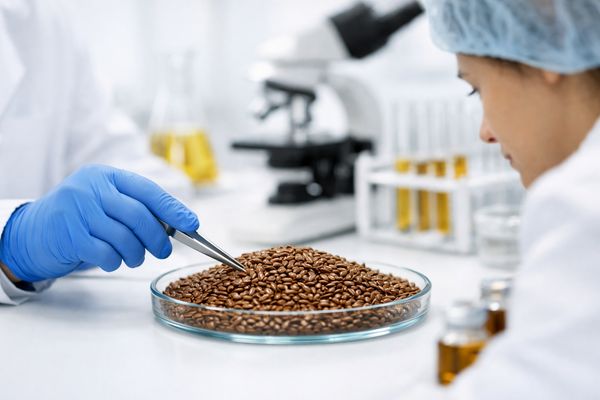
Indian flaxseed export prices have firmed modestly in early April, supported by solid domestic oilseed demand and rising temperatures in North India, while abundant Black Sea and Kazakh supplies continue to cap global upside.
Indian flaxseed is edging higher in New Delhi in both FCA and FOB terms, narrowing discounts to other oilseeds yet still competing with cheaper Ukrainian origins into Europe. Weather in North India is turning decisively hotter, with New Delhi forecast to approach 40°C and remain dry through mid‑April, which favors late harvesting and post‑harvest drying but raises storage and quality risks if logistics are delayed. Globally, linseed benchmarks in Europe linked to Black Sea flows remain broadly stable in euro terms, limiting export price inflation for Indian sellers.
Exclusive Offers on CMBroker

Flax seeds brown
brown
99,9%
FOB 0.92 €/kg
(from IN)

Flax seeds brown
brown
99.9%
FCA 0.88 €/kg
(from IN)

Flax seeds brown
brown
98%
FCA 0.66 €/kg
(from UA)
📈 Prices & Spreads
Indian brown flaxseed (non‑organic) export offers from New Delhi have risen slightly over the last week in euro terms, reflecting firmer FOB values highlighted by European trade commentary. Recent market notes confirm that Indian flaxseed prices are “edging higher” into mid‑April even as global linseed remains capped by ample Black Sea and Kazakh supply into Europe.
Domestic mandi prices for linseed in key producing states such as Madhya Pradesh have also shown a firm tone into April, suggesting decent local demand and some spillover support from the broader oilseed complex. Available mandi data for early April point to steady‑to‑firm rupee values in central India, consistent with the uptick seen in export offers from North India.
| Origin / Location | Spec (brown, non‑organic) | Delivery | Latest Price (EUR/kg) | 1‑Week Change |
|---|---|---|---|---|
| India – New Delhi | High purity export grade | FOB | ≈0.92 EUR/kg | +2‑3% |
| India – New Delhi | High purity export grade | FCA | ≈0.88 EUR/kg | +3‑4% |
| Ukraine – Odesa/Kyiv | Standard export grade | FCA | ≈0.66 EUR/kg | Flat |
| EU (ex‑Ukraine) | Cleaned linseed | FCA | ≈0.72 EUR/kg | Flat |
🌍 Supply, Demand & Trade Flows
India’s linseed area and production remain small within the national oilseed basket, but official rabi statistics show a broadly stable to slightly higher area in recent seasons, ensuring steady domestic availability. Advance estimates and acreage data point to modest linseed output growth, while total rabi oilseed production is increasing, keeping crushers well supplied.
Export demand for Indian oilseeds and meals has been robust, led by rapeseed complex flows to China, and this is indirectly supporting sentiment across minor oilseeds like flaxseed. Strong crush margins in India encourage processors to compete for seed, which tightens spot availability and underpins FOB values. At the same time, Black Sea and Kazakh linseed continue to flow aggressively into Europe, limiting how far Indian export prices can rise without losing competitiveness in EU and Mediterranean destinations.
🌡️ Weather Watch – North India
Weather in North India, including New Delhi, is shifting from the brief cool and wet spell earlier in April to a much hotter, drier pattern. The India Meteorological Department and multiple forecasts indicate clear skies, no significant rainfall, and a rapid build‑up of heat, with Delhi temperatures projected to approach or exceed 38–40°C between April 15 and 18.
This pattern is broadly favorable for completing any remaining field work and for post‑harvest drying of linseed in North India, reducing immediate moisture‑related quality risks. However, prolonged above‑normal heat can stress stored seed, increase handling losses, and raise the risk of quality downgrades if cooling and ventilation are inadequate in warehouses and during transport. Over the next week, the dominant risk factor for flaxseed in the region is heat, not rainfall.
📊 Fundamentals & Market Drivers
Globally, linseed fundamentals remain comfortable, with continued exports from the Black Sea region and Kazakhstan stabilizing benchmark prices in Europe. Recent trade commentary underscores that while India’s FOB offers have firmed, they remain constrained by these alternative origins and by muted demand growth from some EU crushers.
Within India, the broader oilseed complex is experiencing firm prices, particularly for rapeseed, where strong export demand for meal has tightened seed availability and lifted domestic values. This strength supports relative pricing for flaxseed and encourages farmers and traders to hold out for slightly higher bids. Any further rally in major edible oilseeds or a disruption in Black Sea logistics would be key upside risks for flaxseed values in the coming weeks.
📆 Short‑Term Outlook & Trading Ideas
- Price trend (India, EUR basis): Mildly bullish near term; FCA/FOB New Delhi flaxseed likely to stay firm with an upward bias as heat builds and domestic oilseed demand remains solid.
- Export competitiveness: Indian offers are at a premium to Ukrainian FCA levels, so aggressive pricing is needed to win EU business; focus may shift toward nearby Asian destinations where freight and quality advantages compensate for the price spread.
- Risk management: Sellers should lock in margins on nearby shipments where bids match current offers, given the ceiling from Black Sea supply, while keeping some upside exposure in case of weather or logistics shocks in competing origins.
- Quality strategy: With heat intensifying, prioritize rapid evacuation from up‑country warehouses and invest in aerated storage to avoid damage discounts later in the season.
📍 3‑Day Regional Price Indication (India)
- New Delhi – export grade flaxseed (FOB/FCA, EUR/kg): prices expected to hold in the ≈0.88–0.93 EUR/kg range over the next three days, with a slight upside bias if domestic crushers continue to bid actively.
- Domestic mandis (central India, linseed): rupee prices likely to remain steady to marginally firmer in the very short term, tracking the broader oilseed complex and supportive weather.
- Volatility drivers: watch for any fresh headlines on Black Sea export policy or freight disruptions, which could quickly shift buying interest back toward Indian origin.
Related posts:
 Sunflower Market: Stable Black Sea Seeds, Softer SAFEX Futures Amid Firmer Oil Complex
 Indian Flaxseed FOB Firms as Heat Builds and Global Linseed Stays Steady
 Black Sea sunflower seeds steady as Chinese kernels firm on strong demand
 Ukrainian Flaxseed Prices Hold Steady as EU Demand Supports Exports
 Chinese Sunflower Kernel Prices Edge Higher While Black Sea Seeds Stay Soft
 Sunflower Market Softens on SAFEX Losses but Black Sea Flows Stay Tight
 Stable Flaxseed Prices Mask Diverging Regional Drivers in CA, IN and KZ
 Sunflower Market: SAFEX Softens While Black Sea Seed Prices Hold Firm