
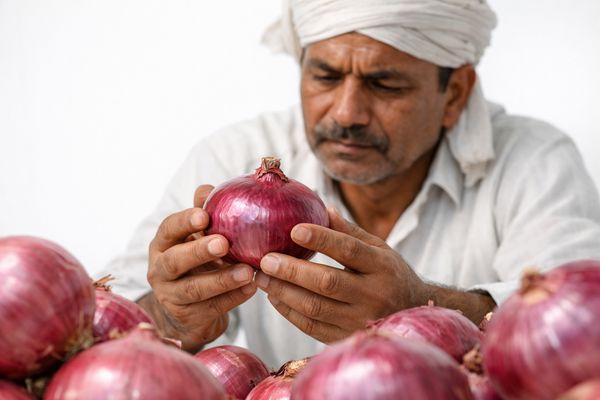
India’s onion market has swung decisively into oversupply, with late kharif prices at Lasalgaon APMC falling about 30% in a month to a one‑year low, far below production costs. Farmers are now liquidating at distress levels, while calls grow for compensation and policy support.
The current downturn is driven by heavy arrivals from key producing belts, weak export uptake and soft domestic buying, all converging just as stocks are already comfortable. Summer onions trade at a premium to late kharif but still fail to cover input costs, leaving growers in Maharashtra and beyond under intense financial strain. Unless arrivals slow or policy support and export demand improve, the near‑term bias remains bearish, even as low prices begin to underpin medium‑term recovery potential.
Exclusive Offers on CMBroker

Onions fried
crispy freid onions
FCA 2.40 €/kg
(from PL)

Onion powder
grade - B
FOB 1.27 €/kg
(from IN)

Onion powder
white
FOB 1.54 €/kg
(from IN)
📈 Prices & Market Mood
At Lasalgaon APMC in Nashik, India’s largest onion hub, average wholesale prices for late kharif onions have slumped from roughly EUR 12–13 per quintal (about ₹1,100) to around EUR 8–9 per quintal (₹775), a fall of close to 30% within a month and the lowest level in roughly a year. Summer onions are trading somewhat higher, around the earlier late kharif level (~EUR 12–13/q or ₹1,100/q), but the premium is too small to offset soaring cultivation and logistics costs.
Processed onion products show a more mixed, relatively stable picture. Indicatively, Indian FOB prices from New Delhi convert to approximately EUR 1.15–1.45/kg for conventional onion powder and about EUR 2.45–2.65/kg for organic powder, while organic onion flakes are around EUR 4.95–5.15/kg. Fresh FOB onions from Egypt sit near EUR 0.80–0.85/kg. These processed and export‑oriented segments have not mirrored the extreme farm‑gate collapse seen in Maharashtra, highlighting a widening gap between bulk domestic mandi prices and value‑added or export channels.
🌍 Supply & Demand Drivers
The core driver of the current slump is an aggressive rise in arrivals across Maharashtra’s mandis, especially Lasalgaon, against a backdrop of tepid demand. Market officials report that late kharif volumes have surged just as seasonal flows add to existing stocks, creating a classic supply glut. At the same time, domestic household and wholesale buying has not accelerated sufficiently to absorb the inflow, with consumers still broadly price‑sensitive and retailers well supplied.
Export demand is notably weak. Earlier government interventions during high‑price periods (via export curbs and minimum export prices) disrupted trade relationships and have not fully normalised, contributing to a reduced pull from key overseas markets even as prices now collapse. Traders in the Mumbai and Nashik belts point to a surplus of rabi and late kharif onions in domestic channels, with limited overseas orders and competition from other origins, keeping Indian exporters on the sidelines despite internationally competitive pricing.
📊 Farm Economics & Policy Risks
The economic gap at farm level is stark. Estimated production costs hover around EUR 21–23 per quintal (≈₹1,800/q), while realised prices in many markets are only EUR 6–10 per quintal (₹500–₹800/q). This means growers are selling significantly below cost, eroding working capital and undermining their ability to finance the next crop. For many smallholders in the Nashik belt, current prices barely cover harvest and transport to the market yard.
Farmer organisations, including the Maharashtra Onion Growers Association, highlight a structural asymmetry in policy response: prompt intervention when prices spike (through export restrictions or stock releases) but limited, slow‑moving support when prices crash. Growers are demanding compensation of roughly EUR 17–19 per quintal (about ₹1,500) on recent sales, alongside more predictable stabilisation tools such as expanded public procurement and buffer building at remunerative rates. Without such measures, there is a real risk of acreage cuts or under‑investment in upcoming seasons, which could sow the seeds for sharp price volatility down the line.
⛅ Weather & Short-Term Outlook
Recent weather in Maharashtra’s main onion belts has been broadly favourable for late kharif harvesting and storage, with no major disruptive events reported in the last days. With fields accessible and quality generally acceptable, the flow of onions into mandis has remained high, reinforcing the current oversupply.
Looking ahead over the next few weeks, the price outlook stays weak to bearish as long as arrivals remain elevated and export orders subdued. Any official announcement of large‑scale procurement for buffer stocks, targeted transport subsidies, or relaxation in export logistics could provide a floor and trigger a modest rebound. Conversely, if policy remains largely reactive and buyers continue to delay purchases in expectations of lower prices, farm‑gate levels could stay pinned near or even below current one‑year lows in the near term.
🧭 Trading & Procurement Outlook
- Importers & food processors: The current downturn in Indian farm‑gate prices improves medium‑term sourcing opportunities. However, processed onion prices (powder, flakes, fried) are relatively stable in EUR terms; consider staggered procurement to benefit if raw‑material pressure eventually filters through to processing margins.
- Exporters from India: With Lasalgaon prices deeply discounted versus historical norms and costs, exporters able to secure quality lots and competitive freight may lock in attractive spreads, especially to markets still rebuilding relationships after past export curbs.
- Retailers & wholesalers: Short term, maintain lean but continuous purchasing from mandis to capture low prices while monitoring for any government procurement or export facilitation moves that could quickly tighten supplies.
- Producers: Where storage capacity exists, selectively holding better‑grade bulbs may be preferable to immediate liquidation at steep losses, but only if farm finances can absorb a longer marketing window and spoilage risks.
📆 3‑Day Indicative Price Direction (EUR)
| Market / Product | Current Level (approx.) | 3‑Day Bias |
|---|---|---|
| Lasalgaon APMC – late kharif (farm‑gate equivalent) | ~EUR 8–9 / q | ➡ to ⬇ (sideways to slightly lower on high arrivals) |
| India – FOB onion powder (conventional) | ~EUR 1.15–1.45 / kg | ➡ (stable; oversupply not yet fully priced in) |
| India – FOB onion powder (organic) | ~EUR 2.45–2.65 / kg | ➡ (niche demand, limited near‑term change) |
| Egypt – FOB fresh onions | ~EUR 0.80–0.85 / kg | ➡ (competitive but steady versus Indian offers) |
Related posts:
 Softening Onion Complex: Poland Fried Onions Edge Lower as India and Egypt Weigh on Prices
 Automation reshapes onion markets: tech-driven efficiency, mild price firming
 Onion Market Snapshot: Mild Firming in Egypt and India as Trade Flows Shift
 Indian Onion Prices Turn Higher as Ghazipur Market Tightens
 New Ukrainian Import Control Rules Reshape Early-Season Onion and Potato Trade
 Unseasonal Rains Put India’s Onion Market on a Two-Stage Price Path
 Polish Fried Onion Prices Ease While Dehydrated Demand Firms in EU
 Onion glut in Azerbaijan squeezes farmers as exports stall