
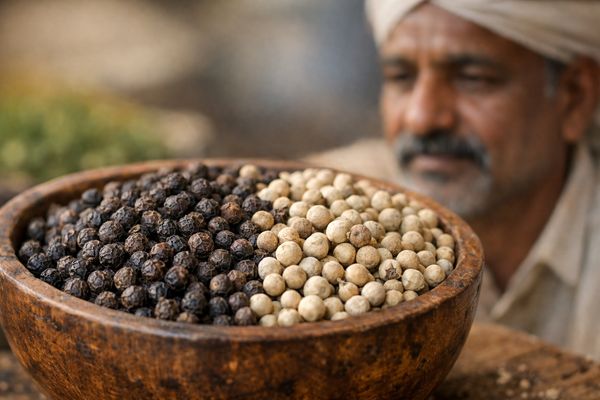
Indian and Vietnamese pepper prices are broadly steady to slightly softer in mid‑April, with only marginal day‑on‑day moves and no clear breakout from recent ranges. Export offers from Vietnam have inched higher, while Indian FOB pepper and value‑added grades around New Delhi are holding firm in euro terms, suggesting balanced nearby fundamentals and quality‑driven premiums rather than a directional trend.
Across southern India, physical black pepper markets show a firm tone with strong interest for top grades and more cautious buying for lower qualities. Regional arrivals in Kerala and Karnataka remain selective, and domestic spot benchmarks around Kochi are largely unchanged over the past few sessions, pointing to an equilibrium between mill demand and farmer selling.
Exclusive Offers on CMBroker

Pepper powder
black
FOB 8.70 €/kg
(from IN)

Pepper
white whole
FOB 7.00 €/kg
(from IN)

Pepper
green dehydrated
FOB 8.50 €/kg
(from LK)
📈 Prices & Spreads
Latest indicative levels (converted to EUR at ≈1.0 USD/EUR for simplicity) show Indian organic black pepper powder FOB New Delhi around EUR 8.70/kg and organic whole black pepper 500 g/l near EUR 8.00/kg. Conventional black 500 g/l clean FOB New Delhi trades around EUR 5.90–6.10/kg depending on terms, while comparable Vietnamese black 500–550 g/l grades out of Hanoi are quoted near EUR 5.65–6.00/kg, leaving Vietnam with a small cost advantage in bulk shipments.
| Origin / Grade | Location / Terms | Latest price (EUR/kg) | WoW change (approx.) |
|---|---|---|---|
| Black pepper powder, organic | India, New Delhi, FOB | ≈ 8.70 | ▼ 0.05 |
| Black whole 500 g/l, organic | India, New Delhi, FOB | ≈ 8.00 | ▼ 0.05 |
| White pepper whole, organic | India, New Delhi, FOB | ≈ 7.00 | ▼ 0.05 |
| Black 500 g/l clean, conventional | India, New Delhi, FOB | ≈ 5.90 | ≈ flat |
| Black 500 g/l clean, conventional | Vietnam, Hanoi, FOB | ≈ 6.00 | ▼ 0.05 |
Domestic benchmarks in southern India such as garbled black pepper at Cochin are quoted around INR 711–714/kg (≈ EUR 7.80–7.85/kg), in line with the firmness seen in premium MG1 grades.
🌍 Supply, Demand & Trade Flows
In India, spot markets in Kerala and Karnataka report concentrated arrivals with a clear quality skew: top‑grade lots are limited and attracting premiums, while mid‑grade material sees more negotiated buying. This pattern, coupled with steady offtake from domestic grinders, is helping keep Indian prices stable even as global benchmarks hover.
Vietnam, the key global benchmark, has seen domestic pepper prices edge up to around 139,500 VND/kg in recent sessions, with export quotes for both black and white pepper rising by about USD 100/ton on stronger demand from the US, China and the EU. Indian buyers remain among Vietnam’s top customers, but the recent uptick in Vietnamese export offers slightly narrows the arbitrage to Indian origins rather than creating fresh downside for Indian prices.
Logistics remain a watch point: according to a March 2026 spice market overview, Middle East routing issues and higher war‑risk surcharges have driven freight costs sharply higher, prompting some Vietnam‑linked exporters to pause new orders to affected destinations. For India‑based pepper exporters, this supports FOB values by making alternative origins relatively more attractive on a delivered basis into Europe and the Middle East.
🌦️ Weather & Crop Outlook (India – Key Pepper States)
In Kerala, the India Meteorological Department has issued yellow alerts for heat and humid conditions through April 15, with maximum temperatures up to 40°C in Palakkad and around 39°C in Kollam. While this short hot spell is uncomfortable and raises local fire risk, it falls within the typical pre‑monsoon pattern and is not yet reported to be causing acute stress to established pepper vines.
IMD’s early long‑range guidance points to normal to slightly above‑normal southwest monsoon rainfall over the south peninsular region in 2026, which would be broadly supportive for the next pepper production cycle if realized. With the main harvest window extending through late April, near‑term supply is more influenced by marketing decisions and on‑farm stockholding than by current weather, reinforcing today’s stable price structure.
📊 Market Drivers & Fundamentals
- Steady Indian spot benchmarks: Reports from southern mandis show firm underlying demand and no major surge in arrivals, cushioning prices against minor softness in some export‑linked grades.
- Vietnam export uplift: A USD 100/ton increase in Vietnamese export prices signals recovering import demand and underscores a broadly supportive global backdrop for pepper.
- Freight and risk premiums: Elevated shipping costs and re‑routed vessels around the Middle East Red Sea corridor keep CIF prices high and limit downside on FOB offers from both Vietnam and India.
- Harvest timing: The ongoing harvest in India and Vietnam into late April maintains short‑term supply, but on‑farm stockholding behavior and quality splits are proving more decisive for spot levels than absolute crop size at this stage.
📆 Trading Outlook & 3‑Day Price Indication (Region: IN)
Strategy Pointers
- Indian buyers (mills, packers): With FOB New Delhi and Kochi benchmarks stable, consider covering near‑term needs on any small intraday dips, but avoid aggressive forward buying while harvest flows continue and logistics risks remain elevated.
- Exporters from India: Maintain offer discipline on premium organic and MG1‑equivalent grades; Vietnamese price increases and higher freight support current EUR‑denominated offers, especially into Europe and the Middle East.
- Importers into India: The recent uptick in Vietnamese export values and freight surcharges reduces the appeal of short‑term imports; monitor for any pullback in Vietnam quotes before adding large positions.
3‑Day Directional View (India, EUR basis)
- Black pepper powder, organic, FOB New Delhi: Expect broadly sideways trade around ≈ EUR 8.6–8.8/kg over the next three days.
- Black whole 500 g/l, organic, FOB New Delhi: Bias remains stable to mildly firm, with prices likely hovering near ≈ EUR 8.0/kg as quality lots stay in demand.
- Conventional black 500 g/l clean, FOB New Delhi: Outlook is flat in a ≈ EUR 5.9–6.1/kg band, tracking steady domestic benchmarks and unchanged export competition.
Related posts:
 Indian mustard seed prices edge higher as mills absorb steady arrivals
 Indian Pepper Prices Hold Firm as Vietnam Anchors Global Benchmarks
 Indian Fenugreek Seeds Edge Higher on Tighter Arrivals and Firm Export Demand
 Aniseed Prices Hold Steady as Egypt Faces Higher Farm Costs and Firm Indian Export Demand
 Firm Turmeric Market: Indian Benchmarks Edge Higher, Upside Bias Intact