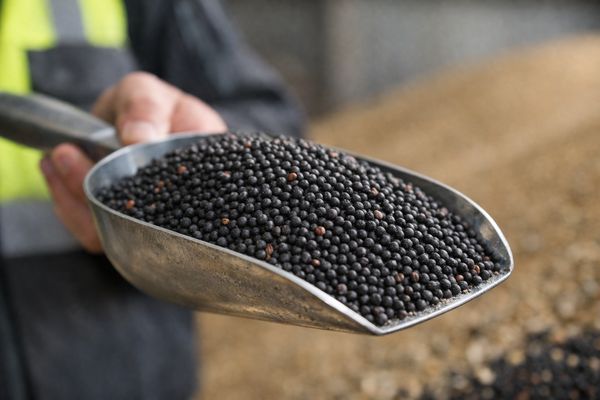
Rapeseed futures are steady to slightly firmer around €500/t, supported by gains in soybeans, canola and palm oil, while softer crude oil caps the upside. Strong U.S. soy crush and firm ICE canola keep oilseed fundamentals constructive, but ample stocks and stable forward curves argue against a sharp near‑term rally.
Rapeseed on Euronext (MATIF) edged higher on Wednesday, tracking stronger U.S. soybean futures and modest gains in ICE canola and Malaysian palm oil. At the same time, crude oil eased as the U.S.–Iran ceasefire around the Persian Gulf looks set to be extended, tempering biofuel‑linked support. Domestic rapeseed offers in Ukraine and France remain stable in euro terms, pointing to a balanced physical market. Weather risks for spring oilseeds and ongoing U.S. soybean planting progress will be key for price direction into late April.
[cmb_offer ids=449,450,450]
📈 Prices & Spreads
On April 15, Euronext rapeseed futures closed broadly unchanged, with nearby May 2026 around €509/t, August 2026 at €495/t and November 2026 at €498/t. The forward curve from 2026 into early 2028 is relatively flat in a €480–500/t range, signalling neither acute tightness nor pronounced surplus in the medium term.
ICE canola futures in Winnipeg finished modestly higher (about +0.25–0.3% on key 2026 contracts), echoing the strength in the wider oilseed complex. In the physical market, indicative FCA values for conventional rapeseed in Ukraine are holding near €610–620/t equivalent, while French FOB offers around Paris are about €570/t, confirming a firm but not overheated spot environment.
| Market / Contract | Last price (EUR/t) | Move vs. prior day |
|---|---|---|
| MATIF Rapeseed May 2026 | ≈509 | 0% (steady) |
| MATIF Rapeseed Aug 2026 | ≈495 | 0% (steady) |
| MATIF Rapeseed Nov 2026 | ≈498 | 0% (steady) |
| ICE Canola May 2026* | ≈480 | +0.25% |
*Approximate EUR conversion from CAD using a representative FX rate.
🌍 Supply, Demand & External Drivers
Rapeseed benefited from a stronger soy complex as U.S. soybean futures gained on the back of robust crushing activity and supportive NOPA data. March crush among NOPA members reached 226.16 million bushels, a record for the month and up 16.2% year‑on‑year, underscoring solid demand for soymeal and soyoil. However, the figure missed trade expectations, and U.S. soyoil stocks, while down 2% from February, remain 36% above last year, limiting runaway price strength.
In Canada, ICE canola posted modest gains in line with soybeans and palm oil, reinforcing the constructive tone across vegetable oils. At the same time, crude oil prices eased as markets anticipate an extension of the ceasefire between the U.S. and Iran, reducing immediate geopolitical risk premia around the Strait of Hormuz. This softer energy backdrop caps biofuel‑driven support for rapeseed oil values but does not alter the fundamentally firm crush margins in the short term.
📊 Fundamentals & Weather
Record‑high U.S. crush and still‑ample soyoil stocks suggest that global vegetable oil availability remains comfortable, even as demand trends higher. For rapeseed, the relatively flat MATIF forward curve around €500/t and stable physical offers in the Black Sea and EU indicate a broadly balanced outlook rather than a tight market. Market participants are also eyeing today’s USDA weekly export sales report for cues on old‑ and new‑crop U.S. soy demand, which indirectly informs rapeseed price risk via the wider oilseed complex.
In the U.S., soybean planting for 2026 is off to a quicker‑than‑average start in key states, though regional weather remains mixed, with some areas facing excess moisture risk. In Europe, April weather forecasts point to a generally cool start to spring with frost potential in parts of northern and central regions, before conditions normalise later in the month. For winter rapeseed already in flowering or stem‑elongation stages, timely rainfall and absence of hard late frosts will be crucial to preserve the current yield potential.
📆 Trading Outlook
- Producers (EU, Black Sea): Current futures around €500/t and firm physical bids favour incremental hedging of 2025/26 and 2026/27 production, especially where on‑farm margins are attractive. Consider layering in sales on rallies towards the upper €500s.
- Crushers: With strong soy crush data and still comfortable vegoil supplies, maintaining coverage on nearby rapeseed needs appears prudent, but chasing the market higher is not yet warranted. Look for dips back towards the mid‑€480s on MATIF new‑crop as an opportunity to extend coverage.
- Importers / Consumers: The combination of stable futures, flat spreads and relatively benign weather argues for a wait‑and‑see approach. Use any weather‑driven setbacks or crude‑oil rallies that lift rapeseed above ~€520/t as occasions to secure medium‑term supply.
📉 Short‑Term Price Direction (3‑Day View)
- MATIF Rapeseed (nearby): Sideways to slightly firmer; expected to trade broadly in a €495–515/t range, tracking soybeans and canola.
- ICE Canola (nearby, EUR‑equiv.): Mild upside bias, contingent on continued strength in U.S. soy and palm oil.
- Physical EU & Black Sea rapeseed: Largely stable in euro terms; basis levels may adjust modestly with local logistics and crusher demand, but no sharp moves are anticipated in the next few days.
[cmb_chart ids=449,450,450]