
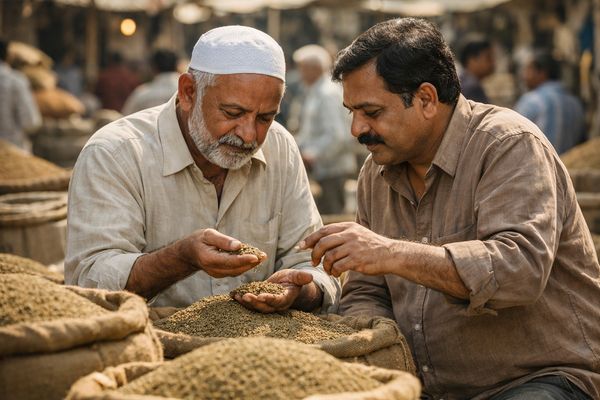
Ajwain prices remain broadly firm with a mildly bullish bias as tight old stocks and lower production estimates offset early pressure from new crop arrivals. Short-term corrections are possible if arrivals accelerate, but a deep sell-off appears unlikely given the expected output decline and still-solid domestic and export demand.
After weeks of range-bound trading and cautious liquidity, the ajwain market is entering a price-discovery phase. Old crop availability is limited, while fresh arrivals in key mandis such as Jamnagar and Unjha are slowly increasing. Export demand and steady domestic buying are providing support, but higher prices are starting to curb aggressive purchasing. Market direction over the coming weeks will largely hinge on the pace of arrivals versus the severity of the expected production shortfall, particularly in Gujarat.
[cmb_offer ids=81,80,81]
📈 Prices & Short-Term Trend
Recent local mandi quotes show a moderate recovery, with ajwain traded around USD 156–193 per quintal depending on quality and origin, signaling a firm undertone compared with earlier levels. In Unjha, good quality material is reported around USD 90–97 per 20 kg, reflecting steady domestic demand and improving trader confidence. Export-oriented offers from New Delhi for organic ajwain have edged slightly lower in recent days, with seed (grade A) and powder (grade B) each easing by about EUR 0.02 since early April, suggesting minor near-term consolidation rather than a structural downturn.
| Product | Location | Latest price (EUR/kg) | 1-week change (EUR/kg) | Note |
|---|---|---|---|---|
| Ajwain seed, grade A, organic, FOB | New Delhi | 3.33 | -0.02 | Slight softening, overall firm |
| Ajwain powder, grade B, organic, FOB | New Delhi | 3.63 | -0.02 | Tracking seed prices lower, limited volume |
🌍 Supply, New Crop Arrivals & Demand
The current balance is shaped by tight old stock supply and gradually increasing new crop arrivals. Old inventory has been restricted for months, keeping trade activity cautious as both buyers and sellers waited for clearer signals. Now, arrivals at key mandis like Jamnagar are picking up, though total supply remains limited for the moment. Traders expect that if arrivals build more strongly in the coming weeks, short-term supply pressure could cap further price gains or trigger a mild correction.
On the demand side, both domestic and export interest remain supportive. Domestic buyers, especially in value-added and blended spice segments, continue to absorb supplies at current levels, while exports are helping to hold the floor. However, rising prices have led some buyers to adopt a more selective, staggered procurement strategy, indicating emerging resistance at higher levels. This creates a tug-of-war between production-related bullishness and demand-side price sensitivity.
📊 Fundamentals & Production Outlook
The key medium-term driver is production. Early indications point to a potentially sharp decline in output in Gujarat, a major producing state, with estimates pointing to a drop of up to 50% versus last season. This prospective shortfall is a central pillar of the current firm market tone, as it is likely to offset the bearish effect of increasing arrivals. Even if other producing regions perform better, the expected reduction in Gujarat will limit overall supply flexibility.
Given months of weak liquidity and a wait-and-see approach by many market participants, the current phase looks more like a re-pricing to reflect tighter fundamentals than speculative overheating. Steady price recovery in Unjha and other trade hubs indicates that the market is gradually accepting higher replacement costs. Unless production estimates are revised upward significantly, any price dips triggered by heavy arrivals are likely to be met with scale-down buying from both domestic processors and exporters.
🌦 Weather & Crop Risk (Key Regions)
At this stage of the season, the immediate weather risk for the standing ajwain crop is limited, but post-harvest conditions and storage weather (heat and intermittent pre-monsoon showers) can still affect quality and shelf life. Traders in Gujarat and Rajasthan will watch for spells of unseasonal rain or heat spikes that could impact drying and storage, potentially tightening the share of top-quality material. For now, quality premiums in markets like Unjha suggest that buyers remain willing to pay up for well-cleaned, uniform lots.
📆 4–6 Week Market Outlook
In the coming weeks, the market is likely to oscillate between supply-driven corrections and fundamental support from lower production. If arrivals accelerate sharply across major mandis, prices could see a short-lived dip as warehouses refill and traders test lower bids. However, with an anticipated output deficit—especially in Gujarat—downside is expected to be limited, and prices should find support once immediate selling pressure eases.
Overall, the bias remains mildly bullish to sideways rather than strongly upward. Higher levels are already encountering resistance from more cautious buyers, suggesting a consolidation band rather than a runaway rally. A stable-to-firm price corridor with intraday and intra-week volatility appears the most likely scenario, particularly for exportable grades and well-sorted lots targeting premium buyers.
🧭 Trading Outlook & Strategy
- Importers & overseas buyers: Consider staggered coverage for near- to medium-term needs, using any harvest-related dips as buying opportunities, but avoid over-committing at the very top of the current range.
- Domestic processors & packers: Maintain working stocks and add on price weakness, especially in quality lots, given the risk of a 50% production drop in Gujarat and the potential for renewed firmness later in the season.
- Traders & stockists: Short-term, be cautious about chasing rallies as new crop arrivals could trigger corrections; focus on selective accumulation on declines and prioritize quality differentiation to capture premiums.
📍 3-Day Price Indication (Directional)
- New Delhi (FOB export, seed & powder): Slightly soft to sideways in EUR terms, with limited downside as buyers test lower bids but fundamental support holds.
- Unjha (domestic market): Stable to firm for good quality lots, with small upside potential if arrivals lag expectations or quality is uneven.
- Jamnagar & other Gujarat mandis: Mixed to slightly volatile as new crop arrivals gain pace; modest corrective moves possible but cushioned by low production estimates.
[cmb_chart ids=81,80,81]
Related posts:
 Fenugreek Market Holds Sideways as New Indian Crop Meets Cautious Demand
 Ajwain FOB New Delhi Softens Slightly Amid Hot, Dry Weather in Key belts
 Ginger Market Tight but Turning: China Dominates as New Crops Loom
 Indian Coriander Prices Firm as New Crop Meets Rising Global Demand
 Ajwain Prices Ease Slightly as North India Faces Stormy Harvest Weather