
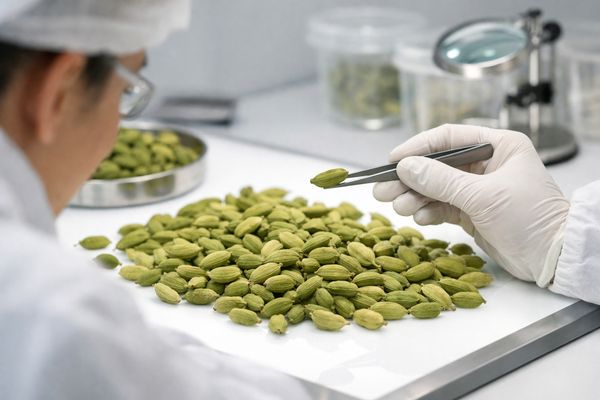
Indian green cardamom prices in Delhi have firmed this week, with premium whole grades up 7–8% in EUR terms versus last week, supported by steady auction realizations and cautious but active export buying.
The market tone is mildly bullish but still sensitive to Gulf freight and payment risks. Auction data from Kerala in March showed average prices stabilising around the mid-range, even as arrivals remained healthy, which has helped cap any runaway rally while still underpinning New Delhi wholesale and export offers. Weather in Idukki—the core small cardamom belt—remains seasonally warm but without acute heat stress, keeping immediate crop concerns limited. Over the next few sessions, prices are likely to trade with an upward bias for better grades, while smaller sizes and powder remain more range-bound as end-users and exporters negotiate margins.
[cmb_offer ids=1202,1203,1204]
📈 Prices & Spreads
Delhi FCA offers for non-organic Indian green cardamom whole moved higher on 17 April 2026. The benchmark 8 mm grade is around 21.03 EUR/kg, up roughly 8% from 19.50 EUR/kg on 10 April. Mid-grade 7.5 mm is quoted near 15.00 EUR/kg versus 13.80 EUR/kg a week earlier, while 7–7.2 mm trades close to 13.50 EUR/kg, up from 12.50 EUR/kg over the same period.
By contrast, smaller 6.5–6.8 mm declined to about 10.20 EUR/kg from 11.20 EUR/kg, indicating selective buying interest skewed toward larger, exportable sizes. Organic FOB offers from 11 April show a softer tone, with 7.5–8 mm at roughly 17.90 EUR/kg and 6.0–6.5 mm at about 16.10 EUR/kg, both slightly below late-March levels, suggesting exporters are trimming organic quotes to stay competitive.
| Product (IN origin, New Delhi) | Term | Latest price (EUR/kg) | 1-week change |
|---|---|---|---|
| Whole green 8 mm (conv.) | FCA | 21.03 | ▲ ~1.53 |
| Whole green 7.5 mm (conv.) | FCA | 15.00 | ▲ ~1.20 |
| Whole green 7–7.2 mm (conv.) | FCA | 13.50 | ▲ ~1.00 |
| Whole green 6.5–6.8 mm (conv.) | FCA | 10.20 | ▼ ~1.00 |
| Cardamom powder (organic) | FOB | 24.00 | ≈ flat vs early April |
🌍 Supply, Auctions & Weather
Kerala auctions in March 2026 showed sizable arrivals in Idukki and neighbouring centres, with average prices generally in the ₹2,250–2,350/kg band (roughly 24–26 EUR/kg), and maximum bids above ₹2,800–3,100/kg for top-quality lots. This pattern points to ample physical availability but firm buyer interest for superior grades, in line with the premium being paid in Delhi for 7.5–8 mm capsules.
Recent heat alerts in Kerala have largely spared Idukki district, where the main small cardamom plantations lie. IMD warnings of temperatures up to 40°C have focused on districts such as Palakkad and Kollam, while Idukki’s higher-elevation microclimate has avoided the worst of the heat so far, reducing immediate yield stress concerns for the standing crop.
📊 Demand, Trade Flows & Logistics
Domestic consumption remains stable, anchored by steady wholesale buying in North India and ongoing distribution to food and beverage users. On the export side, demand from Gulf markets stays structurally important for Indian cardamom, with India’s broader agri-food export focus on the GCC reinforced by recent trade agreements and promotional efforts at events such as Gulfood 2026.
At the same time, logistics into the wider Middle East remain exposed to elevated freight costs and war-risk premiums through the Strait of Hormuz, which continue to make exporters cautious in forward contracting and credit terms. Market participants report that in GCC destinations, buyers often push for aggressive prices and extended credit, keeping margins tight despite firm origin prices.
📉 Market Drivers & Short-Term Outlook
- Auction signals: Stable auction averages with healthy volumes suggest no immediate supply squeeze, but strong competition for top-end lots is supporting 7.5–8 mm premiums in Delhi.
- Weather: Seasonally warm but not extreme conditions in Idukki limit near-term crop risk, keeping fundamentals balanced rather than outright bullish.
- Exports: Structural demand from GCC markets persists, but freight, payment and credit risks temper exporters’ willingness to chase higher origin prices.
- Grade divergence: Recent Delhi data show rising prices for larger capsules alongside softer small sizes, reflecting export preferences and quality differentials.
📆 Trading Recommendations (Near Term)
- Importers / EU & GCC buyers: Consider covering a portion of Q2–early Q3 needs now in larger grades (7.5–8 mm), as premiums are rising but still below peak auction realizations; avoid overcommitting on smaller grades where prices are softer.
- Indian exporters: Use current firmness to lock in short-tenor contracts with tight credit terms; focus on high-quality lots that track auction maxima, while being selective on low-margin powder and small sizes.
- Domestic traders: Maintain moderate long exposure in premium grades around Delhi, but be ready to hedge or lighten positions if auction averages slip below recent bands or if Gulf logistics deteriorate further.
📍 3-Day Price Direction (IN, Delhi)
- Whole green 7.5–8 mm (conv., FCA): Mildly bullish bias; likely to trade slightly higher or sideways as buyers chase limited top-quality parcels.
- Whole green 7–7.2 mm (conv., FCA): Firm to slightly higher, tracking strength in premium grades with some spill-over buying.
- Whole green 6.5–6.8 mm & powder: Mostly sideways with modest downside risk, as demand concentrates on export-preferred sizes and processors negotiate discounts.
[cmb_chart ids=1202,1203,1204]
Related posts:
 Indian Cardamom Edges Softer as Delhi FOB Eases, Exports Stay Strong
 Indian Turmeric Prices Stabilise at Elevated Levels as Nizamabad Hits Records
 Fenugreek Market Firms on Tight Indian Arrivals and Seasonal Stocking
 Indian Mustard Seed Finds a Floor as Oil Mill Demand Firms Up
 Indian Black Pepper Firms as Buyers Return While Sellers Hold Back
 Large Cardamom Firms as Weather Damage and Stockists Tighten Supply
 Large cardamom firms as India’s marriage season kicks off
 Indian Cardamom Firms on Tight Supply and Pre-Monsoon Rains in Kerala