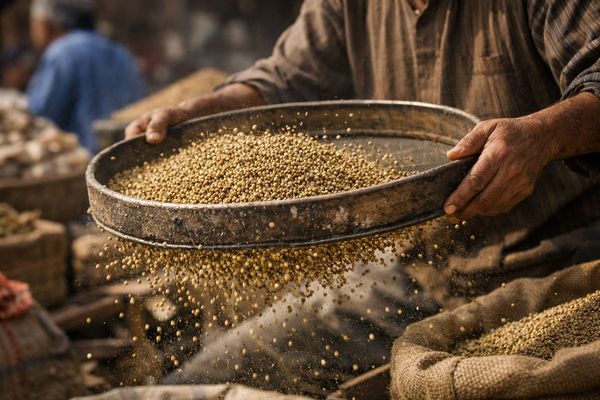
Indian coriander prices are mildly softer in the short term as fresh arrivals weigh on spot markets, but the broader 2026 balance remains tight, limiting downside. Domestic demand and constrained global supply continue to underpin New Delhi FCA and FOB offers, which show only shallow corrections in EUR terms.
The market is digesting new‑season arrivals from Rajasthan and Madhya Pradesh, with benchmark mandi prices around Ramganj/Kota holding above ₹11,000 per quintal despite increased flows, signalling solid underlying demand and limited carry‑in stocks. Export interest from Europe, the Middle East and North Africa remains steady, while weather risks for the coming months are skewed to heat stress rather than excess rain, which should support quality but could cap yield potential. Overall, prices look set for a sideways-to-firm pattern after the current post‑harvest easing.
[cmb_offer ids=1186,1187,1188]
📈 Prices & Short-Term Trend
Latest indicative New Delhi FCA and FOB offers converted to EUR (approx. 1 EUR = ₹90):
| Product | Term | Location | Current Price (EUR/kg) | WoW Change |
|---|---|---|---|---|
| Coriander seeds, eagle split 98% (conventional) | FCA | New Delhi, IN | ≈ EUR 0.90/kg | Down from ≈ EUR 1.18/kg |
| Coriander seeds, 99.9% (conventional) | FCA | New Delhi, IN | ≈ EUR 0.86/kg | Slightly softer from ≈ EUR 0.90/kg |
| Coriander seeds, double parrot (conventional) | FCA | New Delhi, IN | ≈ EUR 1.03/kg | Up from ≈ EUR 0.98/kg |
| Coriander leaves, single parrot | FCA | New Delhi, IN | ≈ EUR 1.11/kg | Marginally up vs. last week |
| Coriander seeds, whole organic | FOB | New Delhi, IN | ≈ EUR 2.05/kg | Slightly softer vs. early April |
Domestic spot benchmarks such as Kota/ Ramganj coriander are currently around ₹11,300–14,500 per quintal (≈ EUR 1.26–1.61/kg), with modest week‑on‑week gains reflecting healthy local buying against only incremental new arrivals. NCDEX coriander futures for near months continue to trade in the mid‑range of their 52‑week band, suggesting the market is consolidating rather than trending lower.
🌍 Supply, Demand & Weather Drivers
Industry estimates point to a double‑digit decline in India’s coriander production for 2025/26 (around a 13% drop), leaving total supply tight despite the current harvest pressure. Lower carry‑in stocks from the previous season and robust domestic consumption are amplifying this effect, helping to keep a floor under mandi prices in Rajasthan and Madhya Pradesh even as arrivals improve.
Export flows remain steady into Europe, the Middle East and North Africa, with India maintaining its position as the dominant global supplier. While some recent data showed a year‑on‑year decline in coriander export volumes earlier in the marketing year, this has primarily tightened domestic availability, creating a more supportive backdrop for prices than in years with heavy export‑led stock drawdowns.
Weather across the key coriander belt (Rajasthan, Madhya Pradesh, Gujarat) is shifting into a hotter phase. The India Meteorological Department’s latest outlook signals heatwave conditions for Madhya Pradesh and West Rajasthan through mid‑to‑late April, with wider concerns about a hotter‑than‑normal pre‑monsoon and potentially weaker 2026 southwest monsoon. These conditions, while mostly post‑harvest for the current crop, could stress late‑sown fields and affect seed filling and quality in pockets, reinforcing medium‑term tightness rather than easing it.
📊 Market Fundamentals & Basis
The basis between domestic mandi prices (Kota/Ramganj) and New Delhi FCA/FOB offers remains relatively stable in EUR/kg, indicating that exporters are able to pass modest inland price firmness into international quotations. Egypt-origin coriander remains an alternative, but indicative FOB Cairo values around EUR 1.05/kg keep Indian origin competitive for higher quality grades despite the tighter crop situation.
On the derivatives side, NCDEX coriander contracts have seen episodic rallies on demand spikes, but overall open interest and price action point to a market in consolidation after the strong run‑up earlier in 2026. With no major macro‑shock currently targeting spices specifically, correlation with energy and freight markets is moderate; the bigger driver remains India’s own production and export balance.
📆 3-Day Outlook & Trading View
Weather (India, coriander belt, next 3 days): IMD guidance points to continued hot and increasingly dry conditions across Madhya Pradesh and West Rajasthan, with heatwave alerts persisting and no significant rainfall forecast before early next week. This should keep harvest and drying operations on track, supporting good near‑term physical availability but adding to concerns about soil moisture ahead of the kharif season.
🧭 Trading Outlook (next 1–2 weeks)
- Importers in Europe/MENA: Use current post‑harvest softness in New Delhi FCA prices (≈ EUR 0.85–1.05/kg for main grades) to cover at least 1–2 months of demand; downside appears limited given tight Indian production and firm domestic basis.
- Indian stockists/traders: Avoid aggressive selling into current dips; a staggered release strategy is favoured as heat‑related supply risks and steady export enquiries point to a sideways‑to‑firm path into early May.
- End‑users (blenders/packers): Consider partial forward coverage in higher‑quality and organic segments, where FOB offers around EUR 2.0–2.4/kg remain elevated but could tighten further if the monsoon outlook deteriorates.
📍 3-Day Indicative Direction (Region: IN)
- New Delhi FCA (main seed grades): Slightly softer to stable in EUR terms as immediate harvest pressure persists; expected move: 0 to -1% over 3 days.
- New Delhi FOB (export grades, including organic): Largely stable; exporters likely to protect margins, expected move: -0.5 to +0.5% over 3 days.
- Kota/Ramganj spot (mandi): Stable to mildly firm as demand absorbs arrivals; expected move: 0 to +1% over 3 days.
[cmb_chart ids=1186,1187,1188]