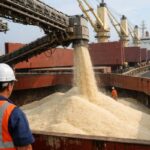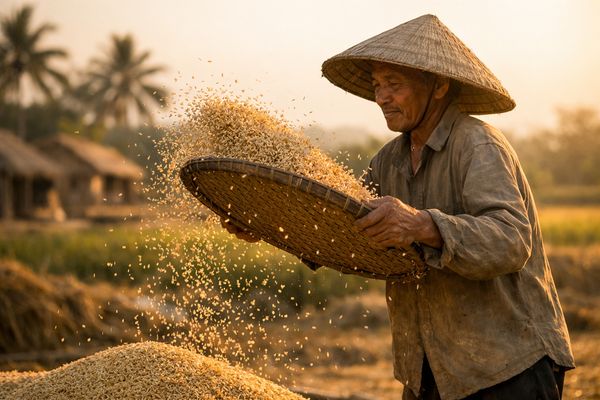
Indian and Vietnamese rice FOB prices are edging lower in EUR terms, with most grades in both New Delhi and Hanoi down around 2–3% over the past week. The downside is driven by comfortable exportable supplies and softer demand from key Asian buyers, while near-term weather risks in India are being watched but have not yet tightened physical markets.
Export markets in India remain broadly well supplied following strong 2025 harvests and stable government stock levels, keeping basmati and non‑basmati quotations under mild pressure despite ongoing policy restrictions and tariff complexities. In Vietnam, abundant winter–spring supplies and slower buying from the Philippines and Indonesia are weighing on 5% broken and fragrant grades, extending the softening trend seen since late 2025. Looking ahead, traders in both origins face a tug‑of‑war between weather‑related concerns in India and still‑bearish demand signals across Southeast Asia.
[cmb_offer ids=502,501,500]
📈 Prices & Recent Moves
All prices below are indicative FOB levels converted approximately to EUR/t for comparison (using ~1 EUR = 1.08 USD where international references are used).
| Origin | Grade (FOB) | Latest Price (EUR/t) | WoW Change |
|---|---|---|---|
| India – New Delhi | Basmati, white organic | ≈ 1,575 EUR/t | ▼ ~1% vs 11 Apr |
| India – New Delhi | Non‑basmati, white organic | ≈ 1,300 EUR/t | ▼ ~1% WoW |
| India – New Delhi | 1121 steam | ≈ 720 EUR/t | ▼ ~2–3% over 4 weeks |
| Vietnam – Hanoi | Long white 5% broken | ≈ 370–380 EUR/t | ▼ ~2–3% WoW |
| Vietnam – Hanoi | Jasmine / fragrant | ≈ 390–400 EUR/t | ▼ ~2–3% WoW |
| Vietnam – Hanoi | Premium specialty (paper‑dried, black) | ≈ 1,575–1,625 EUR/t | ▼ ~1% WoW |
Vietnamese 5% broken export offers remain globally competitive, tracking in the high‑300s EUR/t equivalent after weeks of pressure from ample winter–spring crop arrivals and weaker Philippine demand. Indian white rice export prices, including 5% broken benchmarks, are relatively stable but slightly discounted versus Vietnam, reinforcing India’s role as a price floor in the global market despite ongoing policy constraints.
🌍 Supply, Demand & Policy Drivers
Vietnam’s export pipeline is strong: winter–spring harvest volumes in the Mekong Delta are estimated above 24 million tonnes, with January 2026 exports already up more than 12% year‑on‑year and average export prices above USD 600/t before the recent softening. However, imports by the Philippines—the key buyer—are projected to slow sharply to around 150,000 t per month in March–April 2026, curbing near‑term upside for Vietnamese quotations.
In India, exportable supplies remain comfortable after good 2025 kharif output and steady government procurement, keeping basmati and non‑basmati flows active despite the more complex tariff and category system implemented since May 2025. Recent market commentary also points to some pressure on basmati prices following disruptions to Middle East demand, adding to the soft bias in premium Indian grades. Overall, global 5% broken benchmarks remain soft to range‑bound, with India anchoring the floor and Vietnam shading lower on volume‑driven competition.
🌦️ Weather Outlook – India (IN) & Vietnam (VN)
India (Northwest, incl. Delhi/Punjab/Haryana): The India Meteorological Department (IMD) reported strong western disturbances bringing rain and thunderstorms across Northwest India around 3–4 April 2026, with some localised damage risks for standing crops. Looking ahead to late April–June, IMD guidance points to above‑normal heatwave days across much of Northwest and Central India, raising concern over irrigation demand and possible stress on upcoming rice nursery preparation and transplanting windows. For now, these conditions are more of a forward risk flag than an immediate constraint on export availability.
Vietnam (Mekong & Red River Deltas): No major adverse events have been reported in the last few days; the winter–spring harvest is largely complete, and near‑term weather appears seasonally normal, allowing steady harvesting, drying and loading. Recent regional updates still emphasize abundant supply rather than weather‑driven tightness, which is consistent with the current downward drift in export offers from Hanoi.
📊 Market Fundamentals & Sentiment
Global import demand remains cautious as several Asian buyers reassess coverage after heavy purchases in 2024–2025 and amid softer domestic currencies. Reports of lower Philippine and Indonesian buying into Q2 2026, combined with steady Thai and Pakistani competition, are reinforcing a buyers’ market for standard white and broken rice.
On the policy side, India’s multi‑tier rice classification and periodic export controls continue to inject headline risk, but there have been no major fresh restrictions announced in the last three days. Vietnam, meanwhile, is leaning on strong export volumes to maintain its position as a leading global supplier, but authorities are sensitive to growers’ margins after the sharp price corrections seen through late 2025. Overall sentiment is moderately bearish on prices but alert to any weather or policy shock that could tighten nearby availabilities.
📆 Short‑Term Outlook & Trading Recommendations
Price direction (next 1–2 weeks): With comfortable stocks and no acute weather shock yet materialising, rice export prices in both India and Vietnam are likely to remain soft to slightly lower in EUR terms, especially for Vietnamese long‑grain 5% and fragrant grades where harvest pressure is still filtering through offers. Premium basmati and specialty rice could stabilise sooner if Middle East buying resumes or if Indian policy headlines spur restocking, but for now the path of least resistance is sideways‑to‑down.
- Importers (Asia, Middle East, Africa): Stagger nearby purchases over the next 2–3 weeks to capture any further dips, giving preference to Vietnamese long white 5% and fragrant rice where competitive offers and weak demand offer additional downside potential.
- Indian exporters: Consider locking in forward sales on basmati and parboiled segments on small rallies, as policy and weather risks (heatwaves) could quickly reverse the softening trend and tighten margins.
- Vietnamese exporters: Focus on volume‑driven sales into price‑sensitive African and Asian markets while hedging against potential recovery in freight or a rebound in demand from the Philippines later in Q2.
- Buy‑side risk management: Maintain some optionality via short‑term contracts rather than heavy spot exposure, given the asymmetric risk that weather or new export measures—particularly from India—could lift prices faster than currently priced in.
📍 3‑Day Regional Price Indication (EUR, Directional)
| Region | Grade | Indicative FOB Level (EUR/t) | 3‑Day Bias |
|---|---|---|---|
| India – New Delhi (IN) | 1121 steam / similar parboiled | ≈ 720–735 | Slightly softer to stable |
| India – New Delhi (IN) | Basmati white, organic | ≈ 1,560–1,590 | Stable to mildly softer |
| Vietnam – Hanoi (VN) | Long white 5% broken | ≈ 370–385 | Slightly softer |
| Vietnam – Hanoi (VN) | Jasmine / fragrant | ≈ 390–405 | Slightly softer |
Near‑term pricing is expected to remain within these bands over the next three days, with any deviations likely driven more by FX and freight adjustments than by underlying physical tightness in either India or Vietnam.
[cmb_chart ids=502,501,500]