
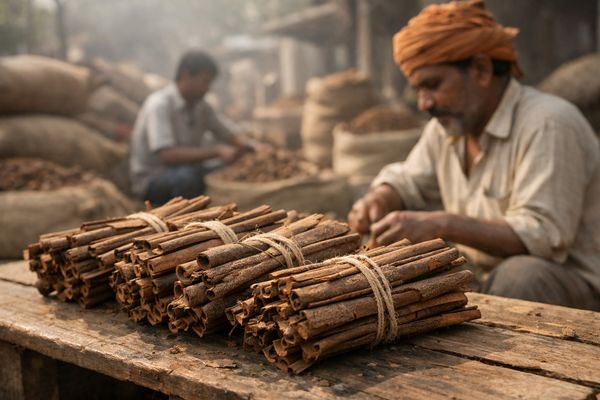
Indian organic cassia FOB Delhi is trading sideways with stable offers and no visible short‑term price momentum. Despite firm global demand for cinnamon and cassia, current Indian export offers are broadly unchanged, while hot and increasingly stressful weather in peninsular India has not yet translated into immediate supply disruption.
The cassia market is entering late April with balanced fundamentals: strong import demand from large consumers such as India and the US is being met by ample export availability from Vietnam, China and Indonesia, which together dominate global cassia and cinnamon trade. India’s broader spice export basket, which includes cinnamon and cassia, continues to show year‑on‑year growth in both volume and value, indicating resilient downstream demand. At the same time, a developing heatwave in central and southern India is raising concerns for labour conditions, curing quality and logistics in spice‑growing belts, but near‑term price effects for cassia remain muted.
[cmb_offer ids=132,132,132]
📈 Prices & Short-Term Trend
FOB Delhi offers for Indian organic whole cassia are unchanged on a week‑on‑week and month‑on‑month basis, indicating a clear sideways pattern with limited volatility. In euro terms, current quotations translate into a narrow range around the recent average, underlining the absence of strong buying or selling pressure from either side of the market.
Compared with other Indian spices where mid‑April has seen selective softness (e.g. cardamom) or firmness (e.g. raisins in heat‑hit regions), cassia is comparatively quiet, with traders reporting steady inquiries but no rush orders or cancellation waves. The flat curve suggests that participants have largely priced in global supply from Vietnam and China and are waiting for clearer signals from upcoming contract negotiations with major importers.
| Product | Origin / Term | Latest Indicative Level (EUR/kg, FOB) | 1‑Week Change | 1‑Month Change |
|---|---|---|---|---|
| Cassia, whole, organic | India, FOB New Delhi | ≈ 5.55 EUR/kg | 0% | 0% |
🌍 Supply & Demand Drivers
On the supply side, global cassia availability remains comfortable. Vietnam has just reported record cinnamon export volumes and values for 2025, consolidating its role as the largest exporter and signalling that global buyers can diversify away from India when needed. China and Indonesia also continue to act as major cassia suppliers, keeping a lid on aggressive price appreciation despite robust world demand.
Demand is underpinned by steady consumption in food, beverage and pharmaceutical segments, particularly in the US and EU. Recent analysis of the US ground cinnamon market highlights rising volumes and a still‑concentrated import structure, with Vietnam and Indonesia dominating but India gradually increasing its share as a diversification origin. Meanwhile, India’s official spice export statistics show double‑digit growth in the broader category that includes cinnamon and cassia between April–February 2023‑24 and 2024‑25, implying that downstream demand for Indian-origin cassia remains resilient even at current price levels.
📊 Fundamentals & Weather
Fundamentals in India are currently neutral. Stocks at origin are considered adequate for near‑term shipment programs, and no major crop failure has been reported in key cassia‑ and cinnamon‑producing countries. However, competitive pricing from Vietnam and China is limiting the room for Indian origin to move higher in the short term without a clear catalyst.
Weather is a growing watchpoint. The India Meteorological Department and private forecasters flag a developing heatwave across central and southern India over the next three days, with very hot and humid conditions in Andhra Pradesh, coastal Karnataka, Kerala, Konkan–Goa, Odisha and Tamil Nadu, and severe heat in parts of North Karnataka and adjoining regions. For cassia and related spices, this raises short‑term risks around field labour productivity, drying/curing quality and inland transport but is not yet severe enough to tighten immediate export availability.
📆 3-Day Market & Price Outlook
For the next three trading days, the baseline scenario for Indian organic cassia FOB Delhi is continued sideways movement within a narrow band around current levels. Global buyers are well covered in the short term, and no major new demand shock is visible from key import regions. Heat‑related disruptions in India are more likely to affect other perishable horticultural crops first before materially impacting cassia exports.
- Weather impact: Hot conditions in southern and central India could modestly slow primary processing and handling, but any logistical delays are expected to be localised and short‑lived at this stage.
- Global competition: Record and sustained high exports from Vietnam and stable flows from China/Indonesia continue to cap upside for Indian prices in the immediate term.
🧭 Trading Outlook & Recommendations
- Exporters (India): Consider using current flat prices to lock in near‑term contracts with key buyers, especially for organic grades where India enjoys a quality premium. Maintain offer discipline but be prepared for selective discounts against aggressive Vietnamese or Chinese quotations in commoditised segments.
- Importers (EU / MENA): With prices stable and supply ample, this is a favourable window to secure coverage for late Q2 and early Q3 needs. Diversifying volumes between India and Vietnam can balance quality preferences and price risk.
- Industrial users & blenders: Do not expect significant price relief in the very near term, but also no sharp spikes unless weather problems escalate or logistics in major exporting countries deteriorate. Gradual, staggered purchasing remains an appropriate strategy.
📍 3-Day Regional Price Indication (Direction Only)
- India – New Delhi (FOB, organic whole cassia): Sideways; prices expected to hover around current levels in EUR terms with very limited intraday volatility.
- Competing origins (Vietnam/China, bulk cassia CIF India/EU): Stable to marginally softer bias as strong export capacity meets steady but not surging demand.
[cmb_chart ids=132,132,132]
Related posts:
 Indian Organic Rosemary FOB Prices Hold Steady as Heat Builds in Delhi
 Indian Organic Oregano FOB Delhi: Prices Flat as Heat Builds
 Indian Dill Seed Prices Ease Slightly as Heat Builds in Key Belt
 Indian fennel prices ease slightly as summer heat builds in key growing belts
 Indian Cardamom Eases from Highs as Heat Builds in Kerala Growing Belt
 Indian Fenugreek FOB Prices Edge Mixed as Heat Builds in Delhi
 Indian Aniseed FOB Softens as Heat Builds in Key Producing States
 Indian Organic Cassia FOB New Delhi Holds Steady Amid Cool April Weather