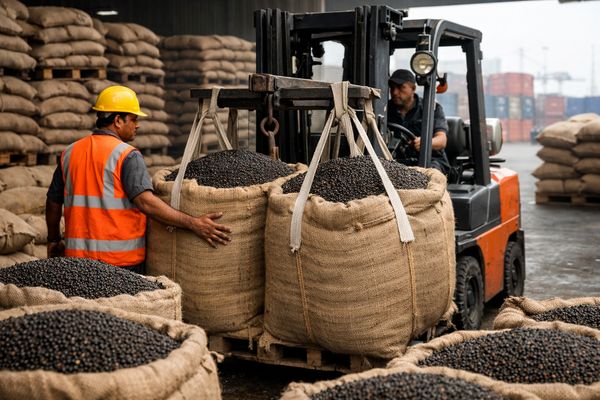
Indian black pepper prices are in a firm bull run, with Kochi auction levels tightening toward the upper end of the current 700–730 INR/kg range and traders openly targeting 750–800 INR/kg in the weeks ahead. A steep production shortfall in Kerala and Karnataka, rupee weakness, and synchronized global tightness are amplifying the rally.
The market is being driven by a rare alignment of factors: output in India’s main growing states is down roughly a quarter, arrivals at Kochi remain well below historical norms despite a recent spike, and stockists are aggressively building long positions. At the same time, Vietnam and other key origins are facing constrained crops and low carryover stocks, keeping world prices elevated even where month‑on‑month corrections are modest. Export-grade Indian pepper is trading at a quality premium and attracting forward buying interest from Europe and the Middle East, reinforcing upside momentum and limiting the scope for a near-term correction.
[cmb_offer ids=305,300,302]
📈 Prices & Differentials
Indian black pepper prices have risen by about 25 INR/kg over the last 15 days at Kochi auctions, lifting the trading band to roughly 700–730 INR/kg. This move follows intense buying by stockists and traders who began accumulating at 677–707 INR/kg and have continued to support the market even as arrivals picked up.
Indicative export offers from New Delhi mirror these firm domestic levels. Recent quotes for Indian black pepper 500 g/l (conventional) sit near EUR 5.9/kg (FOB), with organic and higher density or whole grades in the EUR 7–8/kg range. Competing Vietnamese origins are somewhat cheaper at around EUR 5.6–6.4/kg FOB for standard clean FAQ and extra bold grades, underlining India’s quality premium but also its reduced price competitiveness in the purely cost-driven segment.
| Origin / Grade | Location / Term | Latest price (EUR/kg) |
|---|---|---|
| India black pepper 500 g/l, clean (conv.) | New Delhi, FOB | ≈ 5.90 |
| India black pepper whole 500 g/l (organic) | New Delhi, FOB | ≈ 8.00 |
| India white pepper whole (organic) | New Delhi, FOB | ≈ 7.00 |
| Vietnam black pepper 500 g/l FAQ | Hanoi, FOB | ≈ 5.65 |
| Vietnam black pepper 550–600 g/l clean | Hanoi, FOB | ≈ 5.80–6.20 |
🌍 Supply & Demand Balance
Indian supply is the central driver of the current rally. Production in Kerala and Karnataka has fallen an estimated 25–27% from previous seasons, leaving the pipeline structurally short. At Kochi, arrivals opened this month at only about 35 tonnes on the first trading day and later surged to a record 78–80 tonnes, yet cumulative inflows remain far below prior-year norms. Instead of easing prices, each uptick in arrivals has been fully absorbed by fresh buying, tightening visible stocks.
Stockists and traders are deliberately holding back physical availability, expecting tighter conditions over the next 30–90 days. This behaviour has created a self-reinforcing demand loop: expectations of scarcity encourage further buying, which in turn validates the bullish view as auction prices ratchet higher session by session. Karnataka mandis report modest but good-quality arrivals, while Kerala’s harvest window is just opening, offering some short-term relief but not enough to offset the underlying production deficit.
Globally, black pepper supply is also constrained. Vietnam, the largest producer, is facing an output decline this season alongside minimal carry-in stocks, even though some recent export quotations there show only marginal month-on-month price softening from elevated levels. Brazil’s crop has improved but is insufficient to cover the Asian shortfall. With inventories at origin generally low and farmers inclined to hold stocks in anticipation of higher prices, destination markets must compete more aggressively for exportable volumes.
📊 Fundamentals, Currency & Trade Flows
The rupee’s weakness against the US dollar is adding another layer of support to Indian pepper prices. A stronger dollar magnifies the local-currency value of export returns, enabling Indian sellers to maintain or raise rupee-denominated offers without losing too much competitiveness in dollar terms. This effect is particularly pronounced in high-quality export grades where buyers have limited alternative suppliers.
On the demand side, Indian exports are set to increase despite higher prices. Trade houses report a clear rise in forward contracting interest from European and Middle Eastern buyers who accept India’s premium for certified quality and consistent food-safety credentials. At the same time, India’s dual position as both importer and exporter of different grades and qualities is making internal price signals more complex, but the net effect this season is a tightening of export-grade availability and a bullish bias across the value chain.
Internationally, demand from the US, Europe and the Middle East remains robust. Recent Vietnamese market reports highlight that strong February buying into those regions helped keep FOB prices historically high, even as new-crop shipments from Vietnam and Brazil introduced only modest downward pressure. With freight routes still occasionally disrupted and risk premia on certain trade lanes elevated, buyers show a preference for secure, traceable supply chains, further supporting origin premiums like India’s.
☀️ Weather & Crop Outlook
Weather conditions this season have contributed to yield stress in India and Vietnam. In Vietnam’s Central Highlands, heavy rainfall in parts of the previous year affected plant health and disease incidence, which is now reflected in lower 2026 output estimates and high on-farm price expectations. The current harvest there is progressing, with peak arrivals falling across March and April, but low carryover means incremental flow does not translate into comfortable global surpluses.
In India, recent seasons have underscored the vulnerability of Kerala’s pepper to both excessive heat and erratic rainfall, with trade sources now converging on a 25–27% production cut in 2026. Against this backdrop, any weather disruptions to the ongoing Kerala harvest or a delay in Karnataka’s main picking window would quickly tighten the market further. Conversely, a smooth, timely harvest and strong logistics over the next two to three months could stabilize Kochi prices in the 700–730 INR/kg range, at least temporarily.
📆 Price & Trading Outlook
Over the next 30–90 days, the balance of risks for Indian black pepper prices remains skewed to the upside. If arrivals do not materially improve or if farmers and stockists continue to hold back, Kochi auction prices are likely to test 750–800 INR/kg. In that scenario, export-parity offers in EUR terms would rise correspondingly, further widening the premium over Vietnamese and Brazilian origins.
Across the six to twelve month horizon, the structural supply deficit in India and low global inventories argue against a deep or sustained price correction. An eventual recovery in Vietnam’s 2026/27 crop or a stronger Brazilian output response could trigger a modest easing, most likely toward the fourth quarter. Until clearer evidence of such a rebound appears, importers—particularly in Europe, where dependence on imported pepper is near total—face meaningful coverage risk if they delay procurement in hopes of lower prices.
🎯 Trading Recommendations
- European and Middle Eastern buyers: Increase forward cover on Indian export grades at current levels for at least 3–6 months, prioritizing certified and higher-quality material where substitution risk is lowest.
- Blenders and processors with price flexibility: Consider selectively shifting some volumes to Vietnamese or Brazilian origins to mitigate cost escalation, while maintaining core contracts in Indian grades for premium products.
- Indian stockists and traders: The risk–reward favours maintaining a moderately long bias into the early monsoon period, but be prepared for volatility if Kerala arrivals accelerate faster than expected.
- End-users without storage capacity: Use staggered purchasing and simple option-style hedges where available to manage upside risk rather than relying solely on spot coverage.
📍 3‑Day Price Indication (Directional)
- Kochi (India, physical auctions): Bias mildly higher within the 700–730 INR/kg band as stockist demand stays active and arrivals remain below normal.
- New Delhi export offers (India, FOB, EUR): Stable to slightly firmer around EUR 5.9–8.0/kg across main black pepper grades, reflecting domestic strength and currency support.
- Hanoi (Vietnam, FOB, EUR): Largely steady in the near term around EUR 5.6–6.4/kg, with any further harvest-related softness likely limited by low stocks and solid export demand.
[cmb_chart ids=305,300,302]