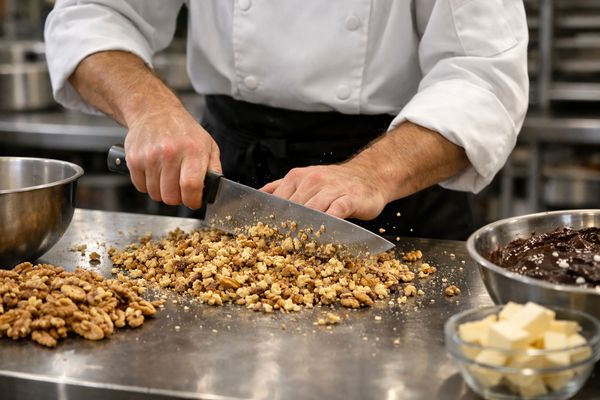
California walnut shipments are surging in early 2026, but the market remains under price pressure as ample supply and competition from other origins weigh on grower returns.
Shipment data for March and the season to date show a clear normalization after last year’s production shortfall, with in-shell movement rebounding particularly strongly. Yet market participants report that sales are driven more by the need to move stock than by margin optimization. For buyers, the current environment offers attractive pricing and good availability across main origins; for sellers, the key question is how fast remaining inventory can be cleared before the next crop arrives.
[cmb_offer ids=356,355,650]
📈 Prices & Current Levels
Industry sources characterize the walnut market as “under pressure”, with higher shipment volumes occurring alongside declining prices as supply normalizes after the 2024-25 shortfall. This aligns with a broadly soft tone in tree nut markets and steady to slightly lower wholesale prices across Europe and Asia.
Recent offer indications (FOB, converted to EUR) underline a wide global price spread between origins and qualities. Organic light halves from the US and India trade at a clear premium to conventional Chinese material, which defines the lower end of the kernel market:
| Product | Origin | Location / Term | Latest Price (EUR/kg) |
|---|---|---|---|
| Walnut kernels, light halves, organic | US | London, FOB | ≈ 4.55 EUR/kg |
| Walnut kernels, light halves, organic | India | New Delhi, FOB | ≈ 5.35 EUR/kg |
| Walnut kernels, light pieces 8–12 mm | China | Dalian, FOB | ≈ 2.85 EUR/kg |
| Walnut kernels, light amber pieces 8–12 mm | China | Dalian, FOB | ≈ 2.30 EUR/kg |
| Walnut kernels, light broken 4–8 mm | China | Dalian, FOB | ≈ 2.95 EUR/kg |
| Walnut kernels, light quarters | China | Dalian, FOB | ≈ 3.35 EUR/kg |
Across major European wholesale hubs, shelled walnuts often trade above 9.00 EUR/kg for higher-quality product, confirming that current origin offers leave room for logistics, processing and margins along the chain.
🌍 Supply & Demand Dynamics
California, the dominant commercial walnut origin, shipped 166.4 million pounds in-shell equivalent in March 2026, up 43.6% year-on-year from 115.9 million pounds. In-shell shipments rebounded dramatically from 3.1 million pounds in March 2025 to 30.5 million pounds (+867.9%), while kernel shipments rose 20.6% to 57.8 million pounds. The product mix shifted accordingly, with kernels falling from 97.3% to 81.7% of total volume on an in-shell equivalent basis as in-shell demand returned. Season-to-date (September–March), total shipments reached 1.04 billion pounds, up 22.6% from 852.0 million pounds a year earlier.
In-shell shipments have been the main growth driver this marketing year, nearly doubling (+96.9%) to 252.3 million pounds, while kernel shipments increased 9.5% to 336.8 million pounds over the same period. With total 2025-26 crop receipts at 1.62 billion pounds, 73.6% of the season’s supply has already been shipped. Including outstanding commitments of 399.5 million pounds in-shell equivalent, roughly 67.8% of total available supply has been sold, indicating a relatively advanced sell-through but still meaningful uncommitted stocks that must clear before the next harvest.
Demand appears elastic to the current price level: industry participants report that sellers are prioritizing maintaining product flow over optimizing prices, yet the strong shipment pace signals robust buyer interest, especially after last season’s constrained availability. The sharp recovery in in-shell movement likely reflects renewed buying from markets where in-shell walnuts have seasonal or festive importance, including parts of the Middle East and Asia. Competition from Chile and Ukraine continues to shape price benchmarks in Europe, Asia and the Middle East, but California’s scale and increased availability keep it central to global supply planning.
📊 Fundamentals & Weather Outlook
The underlying fundamental picture is one of improved supply after the 2024-25 production shortfall. With a 1.62 billion pound crop and more than two-thirds of supply already sold or committed by end-March, the sector is in a better position to meet global demand but faces a period of price adjustment as the market absorbs larger volumes. Grower returns are under pressure as lower prices and competition from alternative origins erode margins.
Weather-wise, early to mid-April conditions across California’s Central Valley — the key walnut-growing region — have been seasonally mild, with daytime highs in the low-to-high 20s °C and no significant rainfall or frost risk reported, supporting orchard development. While short-term weather appears benign for tree health, it does little to tighten the current balance: the main fundamental driver for the rest of the 2025-26 marketing year will be the pace at which remaining stocks are sold ahead of the 2026-27 harvest.
📆 Market Outlook
In the near term, shipment volumes are likely to stay elevated as handlers and traders continue working through remaining 2025-26 inventory. With 73.6% of the crop already shipped and 67.8% sold including commitments, the industry still needs to place the remaining uncommitted tonnage before the next crop. This creates an incentive to maintain aggressive offers, especially in price-sensitive destinations that can absorb additional volume.
Price pressure is therefore expected to persist in the coming 60–90 days, particularly for standard kernel grades where competition from Chinese and Eastern European origins is strongest. If prices stabilize at these lower levels, demand from import markets in Europe, the Middle East and South Asia could continue to improve, supporting shipment momentum into late summer. However, without a meaningful price recovery before the onset of the new harvest, grower profitability will remain a key concern and could influence medium-term investment and planting decisions.
💼 Trading Outlook
- Industrial buyers / roasters: Consider extending coverage for Q3–Q4 2026 on standard kernels and selected in-shell volumes while California supply is ample and prices remain under pressure. Stagger purchases to benefit from any further spot softness but avoid over-reliance on a late-season price rebound.
- Retail packers in Europe: Use the current wide origin price spread to optimize blends — combining competitively priced Chinese pieces with higher-value US or Indian organic halves to hit target price points without sacrificing quality perception.
- Growers and handlers: Focus on disciplined sales programs over the next 2–3 months to limit carryover into 2026-27. Premium segments (organic, large light halves) should be positioned carefully, but bulk product may still require tactical discounts to secure movement.
📉 Short-Term Price Direction (3-Day View)
- California kernels (export, EUR-equivalent): Sideways to slightly softer, as sellers continue to prioritize movement over price optimization.
- Chinese kernels (FOB Dalian, EUR-equivalent): Largely stable around 2.3–3.35 EUR/kg, with only marginal downside seen given already low price levels.
- Organic premium kernels (US/India, EUR-equivalent): Steady with a mild soft bias, but downside is limited by tighter availability and stable niche demand.
[cmb_chart ids=356,355,650]