
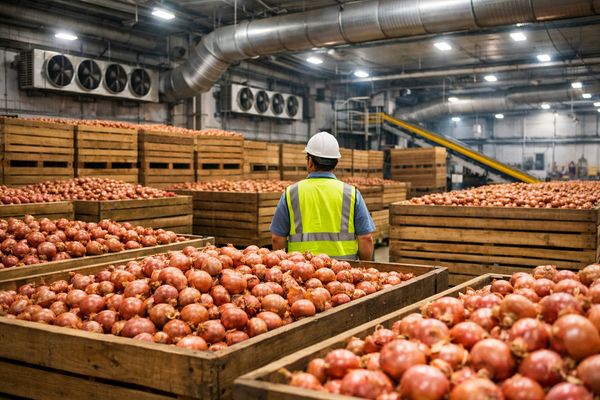
Indian onion prices at origin are sitting at seasonal lows despite broadly stable national output, as weather‑related quality losses and a fivefold spike in Gulf freight costs simultaneously pressure exporters. With government intervention expected around mid‑May, the market is caught between cheap farm‑gate prices and severely constrained access to core Gulf destinations.
India’s onion sector enters late April with harvest‑season price pressure, rising quality risks and unprecedented logistics disruption on Middle East routes. Unseasonal March rains have damaged the pink Garwa crop in Nashik, forcing stricter grading just as arrivals increase. At the same time, conflict‑related disruptions around the Strait of Hormuz have driven container freight to Jebel Ali sharply higher, sidelining many new exporters and narrowing trade to a handful of established players. Alternative Asian routes to Malaysia and Vietnam are cushioning the blow, but the decisive near‑term catalyst remains the anticipated government stock purchase programme in mid‑May.
[cmb_offer ids=634,273,633]
📈 Prices & Differentials
Export‑grade Indian onions are currently trading at a harvest‑season low of roughly US$0.11–0.16/kg at origin. Converted at about 1.05 USD/EUR, this implies approximately EUR 0.10–0.15/kg for top grades at farm‑gate, underlining how deeply the seasonal slump and export bottlenecks have depressed returns. Lower‑grade bulbs are being pushed aggressively into the domestic market, adding further pressure.
Processed onion products show a more stable picture. Recent FOB offers from India indicate onion powder around EUR 1.27–1.54/kg and organic onion powder near EUR 2.62/kg, while organic onion flakes from India are quoted around EUR 5.05/kg. Fresh Egyptian onions for export sit near EUR 0.82/kg FOB, underscoring the competitive alternative for buyers seeking to replace disrupted Indian volumes.
| Product | Origin | Specification | Latest Price (EUR/kg, FOB/FCA) |
|---|---|---|---|
| Onion powder (grade B) | India | Conventional | 1.27 |
| Onion powder (white) | India | Conventional | 1.54 |
| Onion powder | India | Organic | 2.62 |
| Onion flakes | India | Organic | 5.05 |
| Fresh onions | Egypt | Conventional | 0.82 |
🌍 Supply, Weather & Freight Disruptions
National Indian onion production this season remains broadly stable thanks to compensating supply from Solapur and Pune, despite weather‑related losses in Nashik’s pink Garwa segment. Local traders estimate Nashik output down roughly 2–5% year‑on‑year, driven by unseasonal March rainfall that damaged quality rather than dramatically eroding national volume. Grading standards have been tightened to avoid quality complaints from overseas buyers.
Weather remains a key short‑term risk. Nashik has experienced a sharp rise in humidity and temperatures in recent days, and the India Meteorological Department has issued fresh yellow alerts for unseasonal rain and thunderstorms in the next 48 hours, raising the chance of further late‑season quality hits to unharvested fields. Any additional rain would likely swell the share of downgraded onions entering domestic channels, diluting average quality and limiting exportable volumes in the critical weeks ahead.
The most acute constraint, however, is on logistics. Container freight rates from India to Jebel Ali in Dubai have reportedly surged from around US$2,150 to US$8,600–9,700 per container, a roughly fivefold increase tied directly to the 2026 Strait of Hormuz crisis and the broader US–Israel–Iran conflict. Many Gulf‑bound containers carrying perishables, including onions, are reportedly stranded at Indian ports, and several mainline carriers have suspended or severely curtailed direct services to key Gulf destinations.
This disruption has effectively choked Indian onion exports to Oman, Qatar, Saudi Arabia, Bahrain and Dubai. While a few established exporters continue limited shipments—leveraging alternate routings and absorbing inflated freight and insurance costs to defend long‑term buyer relationships—new and marginal exporters have largely withdrawn. Meanwhile, alternative suppliers from Yemen, Sudan and Pakistan are actively filling gaps in Gulf markets, gaining a foothold while Indian product remains hampered by cost and transit uncertainty.
📊 Domestic Market Dynamics & Policy Outlook
Inside India, the onion market is experiencing a textbook harvest‑season pattern, but amplified by weather and freight stress. Export‑grade onions are cheap at origin, while a wave of downgraded product floods wholesale yards as farmers and traders deliberately hold back better lots, waiting for signs of price recovery. Arrivals are ramping up as the main harvest progresses in Maharashtra, even as some competing inflows from Rajasthan and West Bengal remain in the pipeline.
Traders in Nashik expect government intervention via procurement agencies around mid‑May, mirroring the approach taken in 2025. The anticipated mechanism is state purchase of onions at roughly 50% above prevailing market prices, with the goal of stabilising domestic supply and preventing excessive retail inflation later in the year. This tool is designed primarily for internal market management, not export support, but it tends to lift farm‑gate prices and reduce distress selling that might otherwise be channelled into exports at uneconomic levels.
Last season, similar intervention pushed origin prices up to around US$0.17–0.22/kg (approximately EUR 0.16–0.21/kg), and a comparable trajectory is plausible if procurement volumes and timing align with current expectations. Given broadly stable national production, the main price lever in the medium term remains policy action rather than a sudden supply shock. Until intervention materialises—or logistics to the Gulf normalise—domestic market conditions are likely to remain soft at grower level, with wholesale markets seeing heavy volumes of mixed quality.
📆 Short- to Medium-Term Forecast
In the near term (late April to early May), export‑grade onion prices in India are likely to hover around present lows while harvest arrivals peak and freight to the Gulf remains elevated. Any further unseasonal rainfall in Maharashtra, especially around Nashik, would probably add to the share of lower‑grade onions, pressuring domestic wholesale prices even as exportable quality tightens. Asian export routes to Malaysia and Vietnam are expected to remain relatively stable, continuing to offer cash‑flow opportunities for exporters focusing away from the Middle East.
Over the medium term (mid‑May onward), government stock purchases are the main bullish catalyst. If agencies step in at roughly 50% above spot levels, farm‑gate prices could gradually firm toward last year’s US$0.17–0.22/kg range. However, a sustainable recovery of India’s traditional Gulf business will depend on a resolution of the current shipping crisis and a normalisation of container rates and insurance premia. Continued high freight beyond this season would likely accelerate Indian exporters’ diversification towards Asian and possibly African or European destinations, while consolidating the new footholds of alternative Gulf suppliers.
🧭 Trading Outlook & Recommendations
- Exporters to Gulf: Treat the Gulf as a constrained, relationship‑maintenance market rather than a profit driver. Prioritise long‑term buyers and only commit volumes where freight, insurance and routing risks are clearly priced into contracts.
- Exporters to Asia: Leverage competitive Indian origin prices to grow positions in Malaysia, Vietnam and other Asian markets. Focus on strict grading and consistent sizing from Nashik, Solapur and Pune to differentiate against emerging competitors.
- Domestic traders: Consider phased stocking of higher‑quality onions ahead of the expected mid‑May intervention, while remaining cautious about weather‑related spoilage risks. Avoid over‑exposure to low‑grade lots that may remain oversupplied.
- Industrial buyers & processors: Current low farm‑gate prices and relatively stable processed onion quotations in EUR suggest a favourable window for forward contracting, particularly for powders and flakes sourced from India.
📉 3‑Day Price & Directional Outlook (Indicative, EUR)
- Indian fresh export‑grade onions (origin, Nashik/Solapur): Around EUR 0.10–0.15/kg equivalent; bias sideways to slightly softer as arrivals continue and Gulf logistics stay tight.
- Processed Indian onion products (powders, flakes, FOB New Delhi): Approximately EUR 1.25–1.55/kg for conventional powder and EUR 2.6–5.1/kg for organic powder/flakes; outlook mostly steady over the next three days.
- Fresh Egyptian export onions (FOB Kairo): Near EUR 0.82/kg; stable to slightly firm as Gulf buyers partially substitute away from disrupted Indian supply.
[cmb_chart ids=634,273,633]
Related posts:
 Onion Prices Flat To Soft As Indian Exports Rise And Egypt Enters Slow Season
 Indian Onion Glut Drives Prices to One‑Year Low, Farmers Deep in Losses
 Softening Onion Complex: Poland Fried Onions Edge Lower as India and Egypt Weigh on Prices
 Automation reshapes onion markets: tech-driven efficiency, mild price firming
 Onion Market Snapshot: Mild Firming in Egypt and India as Trade Flows Shift
 Indian Onion Prices Turn Higher as Ghazipur Market Tightens
 India’s Onion Export Slump to Gulf Deepens as Freight Surges; Sector Seeks Policy Relief
 Unseasonal Rains Put India’s Onion Market on a Two-Stage Price Path