
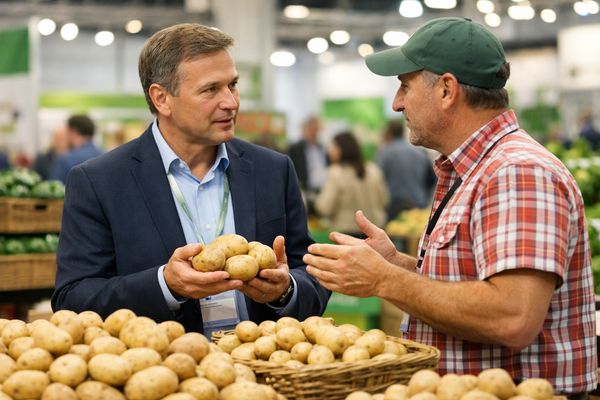
Early-season Maltese potatoes are arriving into Northern Europe with volumes down about 40%, pushing prices sharply higher and tightening the overall Mediterranean new-crop supply balance.
The first Maltese early potatoes of the 2026 season have reached importers in the Netherlands under exceptionally tight conditions. Severe January storms in Malta, combined with reduced volumes from Cyprus and delayed planting in Spain, are constraining Mediterranean early potato availability into Northern Europe. Importers are prioritising distribution through established networks rather than open-market trading, while retailers in Germany and the Netherlands continue to pivot toward domestic supply. Against this backdrop, structural decline in Maltese production capacity and modest firmness in derivative products like potato starch underline a market that is fundamentally tighter than in previous years.
[cmb_offer ids=910,910,910]
📈 Prices & Market Sentiment
Prices for Maltese early potatoes are described as very high, reflecting a roughly 40% drop in expected seasonal volumes and a lack of compensating supply from other Mediterranean origins. Initial arrivals are being carefully allocated, indicating a seller’s market and limited liquidity in spot channels. While exact price levels are not disclosed, the tone of trade suggests a premium market structure that is unlikely to ease in the next one to two weeks.
On the processing side, indicative Polish potato starch offers around Lodz are currently at approximately EUR 0.85/kg FCA, up from about EUR 0.82/kg in late March, signalling a modest firming trend. Although table potatoes and starch follow different demand chains, both reflect a tighter raw potato balance versus earlier in the year, supporting a generally bullish undertone across the wider potato complex.
🌍 Supply & Demand Balance
Extreme winter weather in Malta in early January 2026 caused extensive damage to early-planted fields, cutting expected supply by around 40% versus a normal season. Importers report that this shortfall cannot be easily replaced: Cyprus is facing similar weather-related volume losses, while Spanish early plantings are delayed. This combination means that Northern European buyers are simultaneously exposed to reduced availability from multiple key Mediterranean origins.
On the demand side, the first Mediterranean new potatoes traditionally fill a clear seasonal window in Northern Europe before Dutch, German and UK new crops arrive. With less product available, loyal customers—particularly in traditional markets and among older consumers—are competing for reduced volumes. At the same time, some large German retailers are increasingly relying on year-round domestic potatoes, which slightly cushions demand pressure but does not fully offset the tightness in specialised early-import channels.
📊 Structural Factors & Trade Flows
The current tightness is amplified by longer-term structural change in Malta’s potato sector. Over the past two decades, many older farmers have sold land for tourism and housing development, significantly reducing the number of active growers. Seasonal import volumes into Northern Europe have fallen from around 80 containers per season in earlier years to roughly 40 containers today—about a 50% decline in two decades, even before weather-related losses are factored in.
Distribution patterns are also evolving. Major supermarket chains in the Netherlands and Germany are increasingly reluctant to allocate shelf space to imported early potatoes, preferring consistent domestic supply. Nonetheless, traditional wholesale and open markets continue to absorb strong volumes of Maltese potatoes, supported by robust brand recognition among older consumer segments. For 2026, the combination of structural shrinkage and acute weather damage means that even these traditional channels face constrained availability.
🌦️ Weather & Seasonal Outlook
The immediate impact of the January storms has already been realised in the early Maltese crop, with no meaningful recovery expected during the next one to two weeks of shipments. Later-planted Maltese fields may still provide some relief if they escaped the worst of the winter weather, but visibility remains limited. Any improvement would likely materialise only as the season progresses, and cannot fully reverse the early-season deficit.
For Northern Europe, the constrained Mediterranean supply raises the importance of upcoming domestic new potato harvests. Should spring conditions in the Netherlands, Germany and the UK remain favourable, local new-crop arrivals could temper price pressure later in the season. However, if Northern European weather turns adverse, the current Mediterranean shortfall could translate into much stronger price support for domestic new potatoes as buyers compete for limited fresh supply.
📆 Trading Outlook & Strategy
- Short term (next 1–2 weeks): Expect persistently high prices and limited spot availability for Maltese early potatoes; buyers should secure volumes via existing supplier relationships where possible.
- Medium term (remainder of Maltese season): Monitor the performance of later-planted Maltese fields; any incremental recovery will likely be pre-sold into established channels and only partially visible to the broader market.
- Risk management: Retail and foodservice users dependent on imported early potatoes should consider flexible specifications and partial substitution with domestic stored potatoes until local new-crop supply increases.
- Processing linkage: Slightly firmer potato starch prices in Poland confirm a generally tighter raw-potato environment; processors may look to lock in forward cover if further raw material tightening becomes visible.
📍 3-Day Directional Price Indication (EUR)
| Market | Product | Direction (3 days) | Comment |
|---|---|---|---|
| Netherlands (import) | Maltese early table potatoes | ⬆️ / steady at high level | Tight supply, controlled distribution; no near-term volume relief expected. |
| Northern Europe (wholesale) | Other Mediterranean early potatoes | ⬆️ | Reduced volumes from Cyprus and delayed Spain reinforce upside risk. |
| Poland (Lodz, FCA) | Potato starch | ⬆️ / ➡️ | Recent move from ~EUR 0.82 to ~EUR 0.85/kg suggests a firm to slightly bullish tone. |
[cmb_chart ids=910,910,910]
Related posts:
 Polish Potato Starch Prices Firm Up on Tight Supply and Strong Processing Demand
 Pakistan’s Potato Exports to Russia Reopen: What It Means for Prices
 Greek Flooding Triggers Double-Digit Spike in Fresh Produce Prices, Reshaping Near-Term Import Needs
 Nigeria’s OFSP Nutrition Project Reshapes Local Sweet Potato Value Chain, Signals Niche Demand Shift
 Ukraine’s Early Vegetable Import Wave from Turkey and Egypt Intensifies Competition on Domestic Market
 New Ukrainian Import Control Rules Reshape Early-Season Onion and Potato Trade
 Polish Potato Starch Prices Hold Firm Amid EU Potato Oversupply